Rotational power mechanics and 4 essential adjustments that unleash devastating athletic force
Explosive athletic movement does not stem from colossal arms or brute muscular strain. Learn how the kinetic chain orchestrates effortless rotational power across sports.

Mastering rotational power mechanics determines whether an athlete merely muscles through a swing or unleashes effortless, whip-like momentum. Watch an elite baseball batter launch a ninety-mile-per-hour fastball four hundred feet into the bleachers, or observe a lightweight boxer deliver a fight-ending hook. From the outside, the casual spectator attributes that sudden violence to massive arms or furious shoulder torque. The reality is far more counterintuitive. The fastest swings, throws, and strikes in sports history emerge not from isolated upper-body strain, but from an unbroken biomechanical conduit running from the soles of the feet through the fingertips.
When an athlete tries to generate power by violently contracting their chest and shoulders, they inadvertently sabotage the very speed they crave. High-velocity movement requires a delicate marriage of extreme relaxation and instantaneous stiffness. Understanding the mechanical architecture of rotary sports transforms how we train, throw, hit, and fight, moving athletes away from exhausting brute force toward fluid kinetic energy transfer.
The Hidden Kinetic Chain Behind Human Torque
Every dynamic rotation starts as a linear push against the planet. Newton’s third law dictates that for every action, there is an equal and opposite reaction. When a golfer sets their trail foot or a pitcher drives down the mound, they actively press down into the turf. The ground pushes back with identical force. This ground reaction force serves as the raw currency of human movement, but raw force is completely useless until it undergoes conversion into angular velocity.
When sports scientists deconstruct rotational power mechanics in hitters, golfers, and combat athletes, they trace how ground force migrates upward through the ankles, knees, and pelvis. As documented in peer-reviewed kinetic chain analysis in sports medicine, each bodily segment acts as a successive link in a whip. The pelvis, possessing significant mass, accelerates first and then brakes violently. That abrupt deceleration transfers kinetic energy up into the torso, which accelerates faster than the hips did, before braking in turn to launch the arms and finally the implement.
If any segment along this anatomical pathway fails to perform its specific duty, energy bleeds into surrounding joints. A weak ankle, an immobile hip, or an unstable lumbar spine dissipates force like a cracked gear in an engine. Elite rotational athletes do not necessarily produce drastically more raw force than their amateur counterparts; rather, they transfer an astonishingly higher percentage of created energy straight to the target without leakage.
Why Muscle Mass Alone Fails to Produce Explosive Rotary Speed
Walk into any commercial gym and you will see athletes training under the mistaken belief that larger pectoral muscles and bulging deltoids yield harder punches or longer drives. Hypertrophy has its place, but static mass without elastic recoil actually slows down rotary velocity. The human body generates peak rotary speed through the stretch-shortening cycle, a neurological mechanism wherein connective tissues and fascial planes function like heavy-duty rubber bands.
Consider the anterior and posterior oblique slings, crossing webs of muscle and fascia that stitch opposite shoulders to opposite hips across the abdominal wall. When an athlete winds up for a throw or strike, they pull these fascial bands taut. The elastic energy stored within these connective tissues discharges exponentially faster than voluntary muscular contraction can manage. If an athlete tenses their upper body prematurely, the tissue stiffens into a rigid board rather than an elastic sling, throttling potential speed before movement even begins.
Athletic composure under extreme physical strain mirrors psychological resilience under intense public pressure. Just as maintaining emotional clarity under chaotic circumstances proved vital when Emma Willis Husband Matt Reveals 3 Major Truths Behind Addiction and Media Scrutiny during intense personal challenges, an athlete must remain mentally composed to prevent panic-induced muscle guarding from locking the torso. Relaxation is not passive softness; it is the physical prerequisite for elastic snap.
Four Proven Principles That Maximize Rotational Force Transfer
Unlocking elite rotational power mechanics requires an athlete to honor the physiological cascade that governs angular momentum. By aligning movement patterns with the laws of classical mechanics, competitors unlock hidden reservoirs of speed while shielding their spines from degenerative shearing forces.
Ground Reaction Force and the Lead Foot Anchor
Rotational movement cannot accelerate efficiently without a rigid anchor point against which to pull. During the initiation phase of a swing or punch, the trail side supplies linear drive, but the lead foot acts as the ultimate mechanical fulcrum. As the lead foot strikes the ground, it does not merely rest there; it drives into the turf with extraordinary force, creating a sudden braking action.
Think of a speeding car hitting a solid curb. The car’s forward motion halts instantly, launching whatever is unrestrained forward over the hood. In the human body, the lead leg plants firmly, locking the lead hip in space. That instantaneous arrest converts forward linear momentum into explosive rotational torque around the lead hip axis. Without a firm lead leg block, energy continues drifting forward, resulting in a weak, sweeping movement that lacks snapping authority.
Pelvic Rotation and Hip Shoulder Separation
The single greatest differentiator between recreational swings and elite ballistic strikes is the degree and timing of hip-shoulder separation, often termed the rotary angle. At the precise moment the pelvis begins firing open toward the target, the torso and shoulders must lag behind, revealing how deeply rotational power mechanics rely on the stretch-shortening cycle across the midsection.
This lag stretches the internal and external obliques, the rectus abdominis, and the deep spinal rotators under tremendous tension. Amateurs universally commit the error of rotating the hips and shoulders simultaneously, moving as a single, uniform block. Moving as a block completely eliminates elastic stretch. When the hips rip open while the chest stays pinned back, the midsection loads like an industrial spring, storing kinetic energy that discharges with blistering acceleration once the torso is released.
Torso Stiffness and Core Deceleration
Generating rotational speed represents only half of the mechanical equation. The often-ignored half is deceleration. High-level rotational striking is a game of sequential braking. Once the elastic energy from the hips snaps the torso forward, the core musculature must instantaneously clamp down into rock-hard isometric stiffness.
If the torso continues spinning freely without stopping, energy dissipates along an elongated arc instead of transferring outward into the extremities. By locking the core muscles rigid right before impact, the torso acts as a solid wall. Kinetic energy has nowhere left to travel except down the shoulder girdle, through the arm, and directly into the hand or implement. Torso stiffness converts a long, slow rotational arc into a compact, whip-cracking snap.
Distal Release and Loose Extremities
The arms and hands are not prime movers in rotary athletics; they are delivery mechanisms. The most devastating punchers and longest hitters describe their arms feeling like loose ropes or wet towels during the initial rotation. Only at the final millisecond before impact do the hands clench and the wrists firm up.
Maintaining slack in the arms during the acceleration phase allows the whip to unfold completely. Tension in the forearms, biceps, or traps creates friction within the kinetic chain, acting like dragging brakes on a high-speed bicycle. The speed of the distal extremity is an emergent property of the entire system accelerating from ground to core, never an isolated effort from the limb itself.
Costly Mechanical Leaks That Rob Athletes of Rotary Velocity
A catastrophic failure mode in rotational power mechanics is premature arm initiation, commonly known as casting in baseball and golf or looping in combat sports. When an athlete feels anxious about hitting hard, their instinct commands them to pull violently with the arms early in the movement. This uncouples the upper body from the ground, rendering the entire lower half useless. The result is a weak, arm-driven strike that exposes the rotator cuff and labrum to crippling strain.
Another pervasive leak occurs through early pelvic extension, where the hips thrust upward and forward toward the ball or opponent rather than rotating along their original tilt. When an athlete loses their athletic posture and stands upright during the turn, the mechanical axis tilts off plane. Spinal rotation under extension produces severe facet joint compression and forces the arms to compensate by altering their swing path on the fly. Preserving spinal angles throughout the rotary cycle ensures that angular momentum remains tightly centered along a clean rotational axis.
Training Methods That Reinforce Dynamic Torque in the Gym
To effectively develop rotational power mechanics outside of sport-specific scrimmages, conventional weightlifting routines must be recalibrated. Traditional barbell squats and deadlifts build invaluable foundational strength, but they operate almost exclusively in the sagittal plane. Human rotation occurs predominantly in the transverse plane, demanding training protocols that teach the nervous system how to create and resist twisting force.
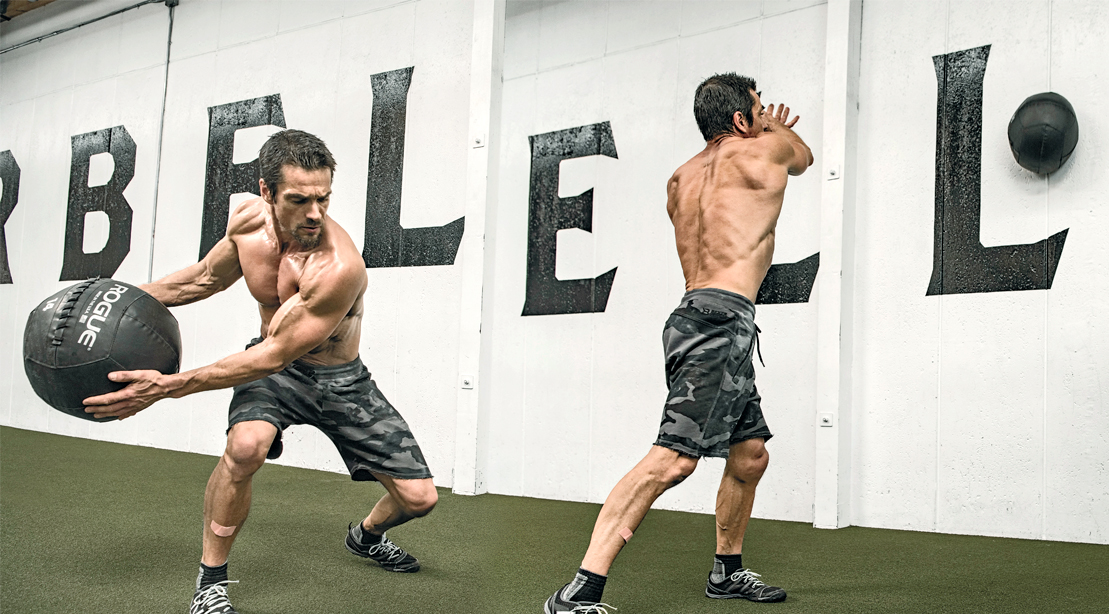
Rotational medicine ball throws stand out as the gold standard for rotary development. Hurling a heavy medicine ball sideways into a reinforced wall forces the lower body to generate ground force, demands hip-shoulder separation, and necessitates aggressive core deceleration, all without the decelerative braking phase that plagues traditional gym lifts. Pair these ballistic throws with anti-rotation holds, such as the Pallof press, to build the deep stabilizing strength required to brake high-speed rotational momentum safely.
Sustaining Explosive Torque Across an Athletic Career
Longevity in rotational sports hinges on asymmetrical care and intelligent recovery. By their very nature, rotary disciplines subject the body to thousands of one-sided rotational reps per week. Over time, this repetitive asymmetrical loading creates significant imbalances in hip internal rotation, thoracic mobility, and lateral abdominal development. Neglecting these imbalances inevitably invites chronic lower back pain, oblique tears, and hip impingement.
Ultimately, mastering rotational power mechanics transforms raw physiological potential into repeatable, injury-resistant performance. When athletes stop fighting their own anatomy and start channeling the kinetic chain, they discover that maximum power does not feel like straining exhaustion. It feels effortless, smooth, and devastatingly fast.