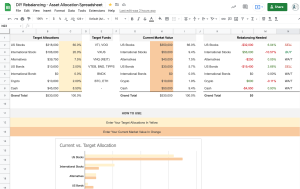
Portfolio rebalancing mechanics and 4 proven rules that prevent costly portfolio drift
Unchecked portfolio drift quietly turns conservative investors into reckless speculators during bull runs. Discover the exact mechanics of rebalancing to harvest volatility and preserve hard-earned capital.

Mastering portfolio rebalancing mechanics remains the single most reliable defense against the quiet, catastrophic risk of unmonitored asset drift. When markets march upward in sustained rallies, most investors sit back, admire expanding account balances, and assume their financial strategy is firing on all cylinders. That sense of security is almost always an illusion. Without deliberate intervention, strong asset classes outgrow their allocations, bloating your exposure to market swings and exposing you to drawdowns you never signed up for.
True financial stewardship is never about guessing which stock or sector will surge over the coming quarter. It is an engineering discipline built on risk tolerance, probability distributions, and the mechanical maintenance of predetermined guardrails. When you understand the underlying mathematics of asset allocation, rebalancing transforms from an irritating chore into an automated profit engine.
The Hidden Drift Eroding Your Wealth Under the Radar
Asset drift is the quiet erosion of your intended risk profile caused by the uneven performance of different asset classes over time. Imagine building an investment portfolio split evenly between equities and high-grade fixed income to reflect a moderate tolerance for risk. During a vigorous multi-year bull market, equities might easily double while conservative bonds generate modest single-digit yields. Without intervention, that carefully constructed balanced portfolio gradually mutates into an aggressive fund dominated by equities.
At first glance, this runaway equity growth feels wonderful. Capital balances are rising, and the portfolio seems to be outperforming expectations. Yet underneath that attractive performance, your underlying vulnerability has quietly metastasized. Many amateur investors fail to realize that portfolio rebalancing mechanics are not about timing market peaks, but about preventing the portfolio from transforming into a volatile vehicle that will crush their emotional resolve during the inevitable crash.
When the broader market eventually reverses, an unhedged, drifted portfolio crashes with the full fury of an equity-heavy fund. The conservative investor who thought they were insulated suddenly faces stomach-churning paper losses. Terrified by the unexpected magnitude of the drawdown, they panic and liquidate assets at rock bottom. The breakdown was never caused by bad market luck, but by passive neglect of their asset distribution.
Why Most Investors Mistake Passive Holding for Disciplined Stewardship
The rise of index investing has popularized the concept of buying and holding for the long run. While passive index accumulation is undeniably superior to active day-trading for the overwhelming majority of people, buying and holding was never meant to mean buying and forgetting. Total passivity is not discipline; it is an abdication of structural risk management.
Understanding granular portfolio rebalancing mechanics reveals that doing nothing is actually an active, unvetted bet on the best-performing asset class. Every day you allow your high-flying assets to outgrow their assigned weighting, you are actively choosing to increase leverage on that single segment of the market. You are concentrating risk precisely when valuations are highest and margin of safety is thinnest.

Furthermore, human psychology conspires against sound portfolio management. Just as sensational media coverage like how Tucker Carlson triggers 5 explosive battles across the political divide captures emotional energy and inflames tribal sentiment, financial headlines manipulate identical psychological triggers to provoke impulsive, wealth-destroying trades. When equities surge, greed urges you to let winners run indefinitely. When markets plummet, fear insists that buying distressed assets is financial suicide. Robust rebalancing creates a mechanical framework that overrides these toxic emotional impulses.
Four Proven Strategies to Restore True Structural Equilibrium
Restoring balance to a deviated portfolio requires a repeatable framework rather than arbitrary guesswork. Implementing tested execution systems guarantees that you consistently extract capital from frothy markets and allocate it toward undervalued opportunities.
Tolerance Bands That Outperform Rigid Calendar Deadlines
Traditional financial literature often recommends rebalancing on a fixed calendar date, such as every December or at the end of each quarter. While calendar rebalancing is certainly better than total neglect, it remains deeply inefficient. Markets do not move on a synchronized schedule. A fixed date might force you to rebalance when asset prices have barely shifted, triggering unnecessary trading commissions, bid-ask spreads, and taxable events for negligible benefit.
A vastly superior framework relies on dynamic corridor bands or tolerance thresholds. When you ground your strategy in disciplined portfolio rebalancing mechanics, calendar arbitrary dates take a backseat to actual market volatility. Under this model, you only intervene when an asset class wanders outside a predetermined percentage corridor relative to its target allocation. For instance, if your target allocation for international equities is 20 percent, you might establish an absolute tolerance band of plus or minus 5 percent. As long as international equities stay between 15 and 25 percent, you make zero adjustments. The moment an asset punches through that corridor, you execute a corrective trade back to the target. This ensures you only trade when market divergence genuinely justifies the friction.
Cash Flow Allocation to Neutralize Capital Gains Friction
Selling appreciated assets in a non-registered, taxable account generates capital gains taxes that can severely cannibalize long-term compound growth. High-net-worth investors frequently avoid rebalancing specifically because they dread paying the tax bill. Fortunately, you can rebalance a portfolio without selling a single share of your winning investments by utilizing organic cash flows.
Every portfolio generates an influx of liquidity through incoming earned income, quarterly stock dividends, and bond coupon payments. Rather than automatically reinvesting those distributions back into the exact security that generated them, direct all incoming cash toward the asset classes that have fallen below their target allocations. By channeling fresh capital exclusively toward lagging assets, you gradually nudge the portfolio back toward equilibrium. This cash flow steering strategy allows you to systematically buy undervalued assets at reduced prices without triggering taxable liquidation events.
Volatility Harvesting Across Uncorrelated Asset Classes
One of the most fascinating phenomena in mathematical finance is Shannon’s Demon, a theoretical concept illustrating that rebalancing between two volatile, uncorrelated assets can generate a higher compound return than either asset produces independently. This phenomenon is known among institutional practitioners as the rebalancing bonus.
To exploit this dynamic, your portfolio must contain asset classes that respond differently to shifting macroeconomic conditions. When growth equities surge during low-inflation expansions, real commodities or defensive bonds might stagnate. When unexpected inflation shocks hit the system, commodities spike while growth tech equities plunge. Documented across extensive CFA Institute research on asset allocation rebalancing strategies, these volatility harvesting dynamics highlight why systematic portfolio rebalancing mechanics extract excess return from market chop without predicting macroeconomic trends. You are mechanically selling assets at relative highs and reallocating into assets at cyclical lows.
Systematic Execution Protocols That Overcome Human Loss Aversion
The finest mathematical model is worthless if the investor refuses to pull the trigger when the signal flashes. During steep market panics, buying equities feels like catching falling knives. The instinctive human reaction is to freeze, waiting for green shoots or economic certainty before committing capital. Unfortunately, by the time economic certainty returns, asset prices have already skyrocketed, leaving your portfolio permanently underweight.
You must establish strict, unemotional execution protocols that operate like a flight checklist. Write down your tolerance bands, your designated trade execution days, and the exact accounts where changes will occur. If you are balancing across multiple vehicles, such as retirement accounts and taxable brokerage accounts, execute all sales inside tax-sheltered wrappers to eliminate immediate tax reporting obligations. Treat rebalancing as an automated risk-reduction mandate rather than an active investment choice.
The Psychological Trap of Selling Winners and Buying Losers
At its emotional core, portfolio rebalancing forces you to do the exact opposite of what feels comfortable. It demands that you trim your best-performing investments to pour money into your worst-performing laggards. Behavioral economists call this overcoming the disposition effect, the natural human urge to cling to winning stocks while avoiding beaten-down assets that generate shame or anxiety.
Without strict portfolio rebalancing mechanics in place, human instinct reflexively hoards high-flying equities at top valuations while shunning beaten-down securities that carry the best forward-looking risk premiums. Every retail investor loves the feeling of holding a runaway winner, boasting about triple-digit returns at dinner parties. Yet trees do not grow to the sky. Super-cycles mature, industries encounter competitive saturation, and monetary tightening routinely deflates inflated price multiples.
Trimming a winning position is not an admission of defeat, nor is it a prediction that the asset has reached an absolute ceiling. It is simply harvesting a portion of the harvest to secure the farm against winter storms. When you mentally reframe rebalancing from pruning gains to purchasing undervalued insurance, the psychological barrier vanishes.
Building an Automated Operating System for Long Term Solvency
Financial durability is not achieved through brilliant economic forecasts or tracking real-time stock quotes. True financial durability is engineered through unyielding systems that quietly enforce discipline when emotional impulses run high. Your long-term net worth depends far less on picking the next breakout stock than on designing an asset allocation that survives brutal market drawdowns without rupturing your sanity.
Take an honest inventory of your current investment accounts today. Calculate the exact percentage weights of your domestic equities, foreign securities, bonds, cash equivalents, and alternative assets against the original targets you established when you first funded those accounts. If significant market run-ups have skewed your original allocation by more than five percentage points, you are carrying uncompensated risk.
Establish your corridor boundaries, redirect incoming dividend streams to fortify lagging holdings, and embrace the dispassionate logic of mathematical rebalancing. By embedding robust portfolio rebalancing mechanics directly into your financial architecture, you transform volatile swings into systematic opportunities, guaranteeing that your wealth remains protected through every economic cycle.