NASA Space Exploration Faces 3 Critical Milestones and Major Budget Setbacks
Perseverance broke the all-time off-planet driving record while lunar caves opened new frontiers, yet the abrupt cancellation of the Mars Sample Return program leaves irreplaceable rock samples stranded.
Recent developments across NASA space exploration reveal a dramatic paradox between historic engineering triumphs on distant worlds and severe fiscal cancellations back home. Within the span of a single operational week, robotic instruments hundreds of millions of miles away achieved what was once considered science fiction, even as policymakers in Washington pulled the plug on one of the most consequential sample-retrieval campaigns in modern history.
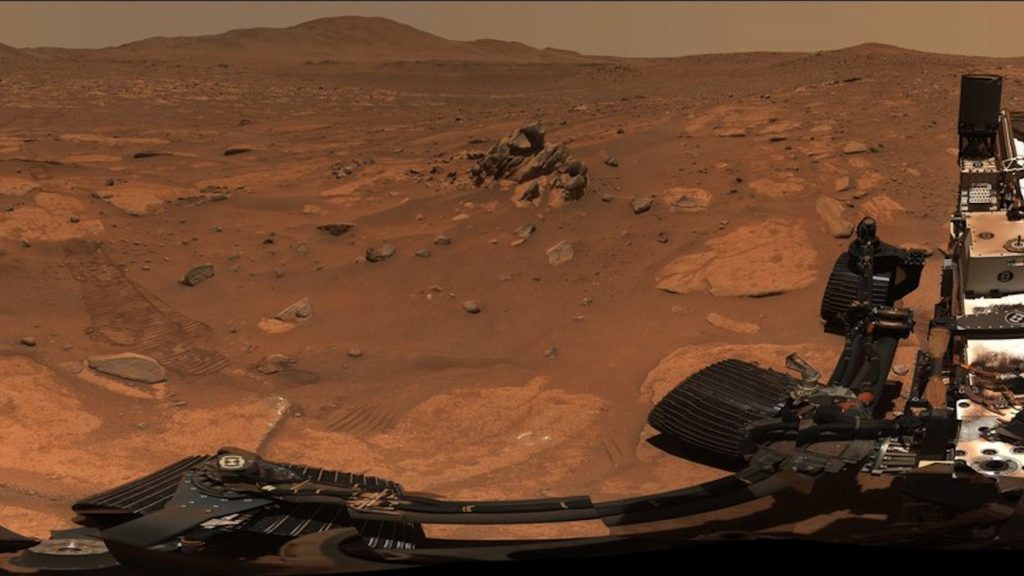
On the crimson plains of Jezero Crater, the Perseverance rover officially broke the all-time off-planet driving record on Mars, surpassing 28 cumulative miles across hazardous, boulder-strewn terrain. As documented in joint reporting by Reuters, The New York Times, and The Seattle Times, the six-wheeled explorer crossed this milestone while continuing its hunt for signs of ancient life, demonstrating unprecedented autonomous navigation resilience. Almost simultaneously, researchers examining high-resolution lunar imaging confirmed that an enormous pit on the Moon likely leads into a vast subterranean volcanic cavern, offering potential radiation-shielded havens for future astronauts.
Yet these technological breakthroughs arrived beneath an unmistakable cloud of scientific grief. As reported by CNN, United States officials canceled the agency’s flagship Mars Sample Return program. That decision abruptly stranded dozens of meticulously drilled geological cores, including a prized rock extracted from Sapphire Canyon that scientists believe offers humanity’s best chance of confirming ancient Martian biology. The contrasting events expose an agonizing chapter for American planetary science, where rover longevity thrives while the logistical bridge back to Earth collapses under budgetary strain.
The Bittersweet Record on the Martian Surface
When Perseverance touched down in February 2021, mission planners designed the car-sized robot to navigate Jezero Crater with calculated caution. Over three years later, the rover has shattered every endurance expectation. According to Reuters and The New York Times, Perseverance surpassed 28 miles of driving, capturing the record for total distance traversed off Earth by an active Martian rover and surpassing previous benchmarks set by legacy missions.
The achievement represents a landmark milestone in NASA space exploration, proving that robotic explorers can endure brutal temperature swings, wheel-shredding regolith, and persistent mechanical wear far longer than their primary design lifespans. As detailed by The Seattle Times, the rover’s autonomous navigation software, known as AutoNav, allowed Perseverance to chart its own course around jagged boulders and steep sand dunes without waiting for turn-by-turn guidance from mission controllers at the Jet Propulsion Laboratory in Pasadena, California.
That autonomy allowed Perseverance to scramble up the slopes of the ancient Jezero river delta, extracting pencil-thin core samples from bedrock layers deposited billions of years ago when liquid water washed across the planet. Each sample was hermetically sealed inside a titanium tube, ready to be retrieved by a follow-up spacecraft. Every mile logged by the rover was intended to culminate in the ultimate handoff, where a retrieval lander and an ascent vehicle would lift those precious specimens off the Martian surface and haul them back to terrestrial laboratories.
Stranded Treasure and the Sapphire Canyon Dilemma
While the rover was celebrating its historic mileage, the broader strategy steering NASA space exploration faced a severe blow when US officials canceled the multi-billion-dollar Mars Sample Return program. CNN reported that escalating budget projections, combined with severe supply-chain disruptions and technical complexities, forced federal decision-makers to pull funding from the architectural blueprint.
The scientific fallout of this cancellation is difficult to overstate. Among the sealed capsules resting on the floor of Jezero Crater is a rock core harvested from an area known as Sapphire Canyon. Planetary geologists consider the Sapphire Canyon sample a generational discovery because it contains fine-grained sedimentary mudstone, the precise geological medium capable of preserving biosignatures, organic molecules, and fossilized microscopic structures.
Without a funded return vehicle, that rock core remains an abandoned relic sitting on cold Martian sand. Scientists who spent decades designing the caching protocol now confront the reality that humanity’s strongest prospective evidence of extraterrestrial life might remain out of reach for decades. Making the cancellation even more urgent is the geopolitical reality outlined by CNN, which noted that China is aggressively accelerating its own robotic sample retrieval mission, Tianwen-3, aiming to bring Martian soil back to Earth by 2030 and potentially eclipsing American supremacy in Mars exploration.

Three Pivotal Fronts Reshaping Planetary Discovery
The convergence of operational breakthroughs and administrative cutbacks highlights three interlocking fronts that define the current era of NASA space exploration.
Perseverance Smashes the 28-Mile Off-Planet Driving Record
Perseverance surpassing 28 miles of off-planet travel represents an extraordinary validation of modern robotic mechanical design and artificial intelligence. Autonomous routing algorithms enabled the rover to analyze stereoscopic imagery in real time, making independent driving choices across treacherous sedimentary outcrops. Operating in Jezero Crater required overcoming loose gravel, abrasive bedrock, and intense wheel friction. The rover’s durable aluminum wheels, fitted with curved titanium spokes, absorbed constant kinetic punishment, demonstrating that future planetary rovers can traverse long distances across unpredictable alien topography without catastrophic system failure.
Cancellation of Mars Sample Return Leaves Ancient Biosignatures Behind
The cancellation of the Mars Sample Return architecture represents one of the steepest retreats in planetary exploration since the termination of the Apollo flight series. According to CNN, initial estimates that placed the return program at roughly four billion dollars skyrocketed toward eleven billion dollars, with return dates sliding into 2040. Federal budget appropriators deemed that trajectory unsustainable, effectively freezing the mission. As a consequence, the Sapphire Canyon sample, which holds high-priority mineral deposits formed in calm standing water, sits stranded millions of miles away with no verified spacecraft commissioned to bring it home.
Subterranean Lunar Caves Open Unprecedented Astronaut Shelters
While Mars planning faces operational stagnation, lunar discoveries are opening entirely new pathways for human habitation. Futurism reported that NASA scientists investigating a conspicuous, deep pit on the Moon discovered evidence that it opens into an expansive subterranean cavern. Formed billions of years ago during the Moon’s active volcanic era, these hollowed-out lava tubes could provide pristine natural shelters. Surface temperatures on the Moon swing violently from scorching daytime heat to deadly nighttime freezing, all while astronauts face relentless cosmic radiation and micrometeoroid impacts. Subsurface lava conduits offer stable thermal environments and natural shielding, fundamentally altering how architects envision permanent Artemis bases.
Navigating Fiscal Realities and Policy Reallocations
The decision to end the Mars Sample Return mission while celebrating robotic driving records reflects a broader institutional recalculation inside the federal government. High-stakes capital programs frequently face intense scrutiny when cost overruns threaten to cannibalize other critical priorities across the agency’s portfolio. When independent review boards cautioned that the sample retrieval architecture would drain resources from deep-space astrophysics and heliophysics, lawmakers chose to cut their losses.
Similar patterns of rigorous federal scrutiny occur across diverse domestic regulatory landscapes. Just as federal agencies weigh high-stakes fiscal trade-offs and regulatory scrutiny, similar oversight battles play out on Capitol Hill, such as how Kratom Regulation Sparks 4 Critical Battles Over Gas Station Opioids amidst shifting enforcement priorities. In both planetary science and public health oversight, Washington lawmakers routinely wrestle with balancing ambitious statutory mandates against strict fiscal limits and competing public interests.
For the scientific community, the long-term viability of NASA space exploration relies on maintaining public trust and congressional backing. If flagship initiatives consistently overrun their authorized budgets by billions of dollars, future robotic ventures will face extreme skepticism from congressional committees charged with allocating finite federal dollars.
The Unfolding Horizon for Interplanetary Missions
Despite the cancellation of the original sample retrieval pipeline, researchers are refusing to surrender the scientific bounty cached by Perseverance. Engineers at commercial aerospace firms and regional research centers are already drafting proposals for smaller, cheaper, and faster alternatives to bring the Sapphire Canyon specimens home before rival nations claim the milestone.
Simultaneously, the discovery of accessible lunar caves reported by Futurism provides an operational boost for upcoming human landings. If robotic probes can successfully rappel into these volcanic conduits, astronauts could build secure habitats beneath the surface, turning lunar exploration from brief surface camping trips into durable subterranean settlements. The underground chambers could store equipment, safeguard life-support systems, and house long-duration research laboratories.
The future trajectory of NASA space exploration will depend on agile commercial partnerships rather than monolithic, multi-decade government architectures that become vulnerable to budget cuts. If private rockets and autonomous landing systems can reduce delivery costs, the samples sitting in Jezero Crater may still find their way to cleanrooms on Earth.
As NASA space exploration navigates this delicate crossroads between engineering genius and fiscal constraint, Perseverance continues rolling across the Martian dust. Every additional mile the rover logs along the Jezero rim reinforces the enduring brilliance of robotic discovery, standing as a quiet testament to human ingenuity waiting for policy decisions to catch up with its achievements.