
Sequence of Returns Risk and 4 Proven Defenses That Protect Lifetime Wealth
A market crash during early retirement can permanently drain a portfolio, even if long-term averages look healthy. Discover the hidden mechanics behind sequence risk and the dynamic safeguards that keep your wealth intact.
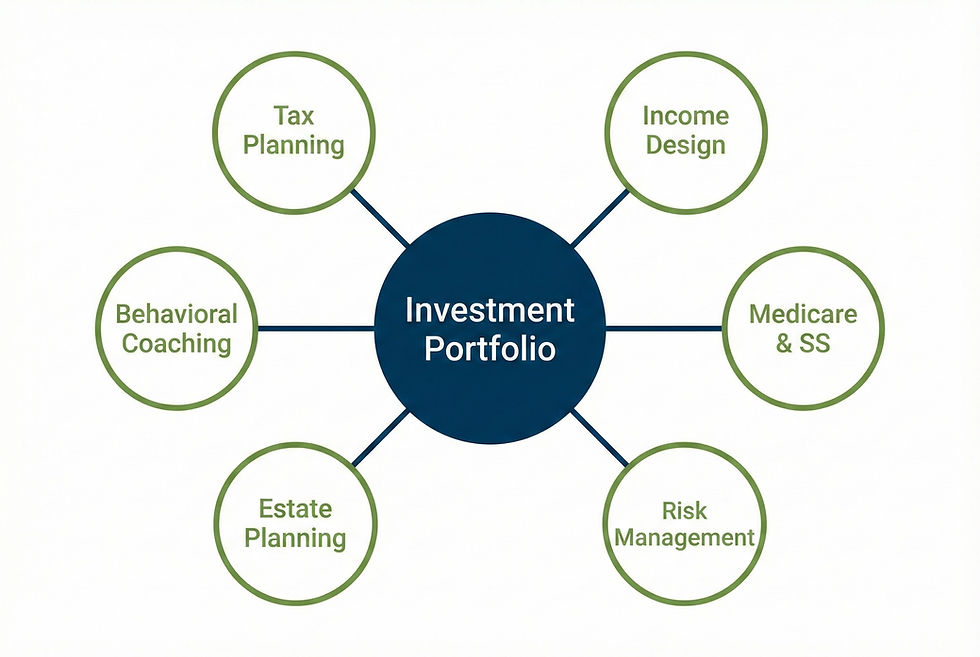
Navigating sequence of returns risk is the single most defining test anyone faces when transitioning from career paychecks to living off accumulated capital. During your working years, market crashes are disguised blessings. Every market drop allows you to accumulate resilient index funds, dividend-paying equities, or real estate assets at substantial discounts. Dollar-cost averaging functions like an automated wealth engine, quietly buying low and capitalizing on the inevitable economic recoveries. Time remains your greatest ally because you never have to sell down your assets to buy groceries or cover housing costs.
The exact day you retire, that structural safety net evaporates. When income switches from an incoming stream to an outgoing distribution, market volatility completely flips its character. Down markets stop being buying opportunities and transform into immediate structural threats. If your portfolio experiences sharp losses in the initial five to ten years of distributions, the durability of your wealth faces severe jeopardy. Understanding how this phenomenon operates is what separates those who enjoy comfortable retirements from those who spend decades worrying over fluctuating brokerage balances.
The Hidden Mathematics Dividing Accumulation from Decumulation
Most long-term financial plans hinge on a seductive illusion: the long-term historical average. Advisers often run thirty-year retirement projections using an assumed baseline return of seven or eight percent per year. On a spreadsheet, compound math is orderly, linear, and reassuring. If you start with a million dollars, withdraw four percent annually, and average seven percent nominal growth, your wealth appears destined to double over time. The problem is that real markets do not hand out neat average returns in predictable annual increments.
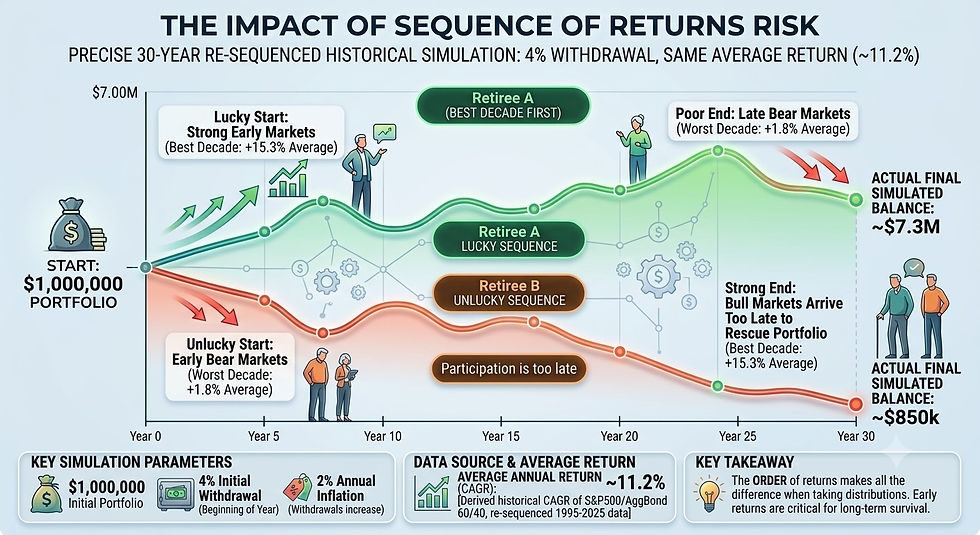
The brutal mechanic of sequence of returns risk stems from simple mathematical asymmetry. Consider two hypothetical investors, each retiring with an identical nest egg and withdrawing the exact same dollar amount every year over a twenty-year stretch. Suppose both portfolios produce the exact same average annualized return of seven percent over that full window. However, the first investor encounters a deep bear market during their first three years of retirement followed by a blistering bull run. The second investor experiences the opposite pattern, enjoying massive gains early on before suffering a severe downturn at the end of their retirement.
The difference in their financial outcomes is staggering. The second investor finishes their life with multi-generational wealth because their early gains expanded the underlying capital base before withdrawals could carve out deep gouges. The first investor runs out of money before reaching the end of the twenty-year timeline. Even though the arithmetic average of their market returns was identical, the timing of those returns dictated everything. When you withdraw cash from assets that are actively falling in value, you permanently destroy capital capacity that can never compound again.
Why Traditional Average Returns Lie to Retiring Investors
In wealth accumulation, the order of returns does not matter at all if you make zero withdrawals. If you invest a lump sum into an index fund and let it sit undisturbed for thirty years, it makes no mathematical difference whether the market crashes in year one or year twenty-nine. The commutative property of multiplication guarantees that the final account balance remains precisely the same. Yet the moment regular cash outflows begin, that commutative property completely breaks down.
Decumulation introduces what practitioners call reverse dollar-cost averaging. Instead of buying extra shares at depressed prices, you are forced to liquidate a larger quantity of shares simply to produce your fixed living expenses. Selling ten thousand dollars of equities when an index trades at its high requires sacrificing far fewer shares than selling that same ten thousand dollars after a forty percent market correction. Every extra share surrendered at a cyclical trough is a permanent loss of future dividend yield and upside momentum.
Preparing a portfolio for decumulation requires the same proactive, foundational foresight seen in culinary preparation, where studying Dry Brining Meat and 4 Costly Mistakes That Ruin Great Cuts illustrates how managing variables hours before applying heat dictates the ultimate outcome. Leaving your portfolio exposed to chance as you cross the threshold into distribution invites unforced errors that no amount of late-stage adjustments can fix. When financial projections rely solely on annualized averages, they obscure the true damage caused by sequence of returns risk, leaving families blindsided by market drawdowns they believed their diversified portfolios could absorb effortlessly.
Four Proven Defenses Against Premature Portfolio Exhaustion
Safeguarding hard-earned capital against sequence of returns risk demands proactive structural engineering rather than nervous hope. Relying solely on the classic four percent rule is no longer enough when valuations fluctuate and market regimes undergo extended structural shifts. You need dynamic, multi-layered portfolio mechanisms that prevent the catastrophic necessity of liquidating core equities during severe cyclical troughs.
Dynamic Spending Guardrails That Respond to Market Shocks
Static withdrawal strategies assume that an investor blindly increases their spending by inflation every single year regardless of market conditions. In the real world, human behavior can and should be more adaptive. Implementing spending guardrails introduces clear, rules-based adjustments to your annual withdrawals based on actual portfolio performance.
Under a guardrail framework, you establish upper and lower boundary thresholds for your withdrawal rate. If a market boom pushes your current withdrawal rate well below your initial target, you award yourself a modest increase in discretionary lifestyle spending. Conversely, if a market crash pushes your withdrawal rate above a designated upper ceiling, you implement a predefined cut to discretionary expenditures. Freezing inflation adjustments or trimming non-essential travel budgets during down years dramatically curbs portfolio bleed. That small tactical concession preserves irreplaceable equity shares, allowing your asset base to heal rapidly during the subsequent recovery cycle.
A Dedicated Cash Buffer to Eliminate Forced Asset Liquidation
The most intuitive way to prevent selling beaten-down equities is to hold a non-correlated bucket of safe, liquid capital designed specifically for short-term consumption. This strategy involves keeping anywhere from two to four years of baseline living expenses in cash equivalents, short-term treasury bills, or high-yield money market instruments. Maintaining liquid reserves directly blunts sequence of returns risk by providing living expenses during steep bear markets without tapping equity balances.
When equity valuations drop, you turn off automated share sales and fund your daily living expenses entirely from the cash reserve. This buffer buys your growth assets the critical time they need to rebound from cyclical contractions. Once market valuations recover and equities reach fresh highs, you harvest opportunistic gains to replenish the cash bucket back to its operational baseline. This simple decoupling of day-to-day spending from volatile market swings provides both financial security and emotional clarity.
A Rising Equity Glidepath Built for the Vulnerability Window
Conventional retirement advice dictates that investors should perpetually decrease their equity exposure as they get older, moving steadily toward bonds. However, quantitative research pioneered by leading financial planning scholars demonstrates that a declining equity glidepath can actually worsen decumulation vulnerabilities during the fragile early retirement phase. If you hold a high equity allocation right at retirement, a sudden crash inflicts maximum damage on your largest account balance.
A rising equity glidepath flips this paradigm on its head. In this framework, you enter retirement at a relatively conservative asset allocation, perhaps thirty to forty percent equities and sixty to seventy percent fixed income and cash. Over the subsequent decade, as you spend down fixed-income reserves to cover living costs, you systematically allow your equity allocation to drift upward toward sixty or seventy percent. By gradually expanding equity exposure after the initial retirement transition, investors insulate their portfolio from sequence of returns risk while capturing long-term compound growth that preserves purchasing power against late-life inflation.
Optimized Asset Location Across Taxable and Qualified Accounts
How you sequence your withdrawals across different account tax structures plays a monumental role in portfolio longevity. A retirement balance spread across taxable brokerage accounts, traditional tax-deferred individual retirement accounts, and tax-free Roth accounts represents three distinct tax profiles that should never be drawn down randomly.
During years when market pullbacks compress your taxable portfolio value, strategically sourcing distributions from Roth accounts allows you to generate tax-free cash flow while keeping your recognized taxable income minimal. Concurrently, down market years offer an exceptional window to conduct partial Roth conversions of depressed traditional retirement assets at historically lower tax rates. By coordinating tax bracket management with market cycles, you create an operational cushion that protects capital integrity across the full retirement horizon.
Building an All Weather Retirement Architecture
Long-term wealth preservation is fundamentally an exercise in risk engineering rather than return maximization. Many investors spend thirty years obsessing over generating the highest possible nominal returns, only to discover that the distribution phase requires a completely different mindset. Decumulation is not about winning a race; it is about eliminating unforced vulnerabilities that could knock you out of the game entirely.
To ground your financial architecture in empirical reality, consult trusted regulatory resources such as FINRA educational guidance on sequence risk dynamics to benchmark your assumptions against historical drawdown timelines. Integrating dynamic guardrails, short-term cash buffers, thoughtful glidepaths, and tax-aware distributions transforms an otherwise brittle retirement plan into an enduring, all-weather asset base.
Markets will inevitably face painful bear markets, economic recessions, and global surprises that test your resolve. Yet when your distribution strategy is built to handle unfavorable sequences, market volatility ceases to be an existential threat. Mastering sequence of returns risk is ultimately about preserving your independence and buying peace of mind for decades to come, ensuring that your wealth continues to serve your life long after your final day at work.