Foley sound design mechanics and 4 proven secrets behind cinema auditory illusions
Cinema soundstages are notoriously silent, leaving post-production audio artists to rebuild every footstep, cloth rustle, and bone break by hand. Discover the tactile physics and psychoacoustic trickery behind Foley sound design mechanics.

Mastering Foley sound design mechanics requires a bizarre blend of physical theater, psychoacoustic manipulation, and tactile chemistry that few moviegoers ever consciously register. When a character strides down a dimly lit cobblestone alleyway in a sweeping period drama, the clatter of leather heels echoing against damp brickwork sounds undeniably authentic. Yet that sound never existed on the filming set. On location, boom microphones point exclusively at the actors’ lips, deliberately tuned to isolate dialogue while filtering out ambient footfalls, fabric rustle, and atmospheric scrape. The sonic soul of that cinematic walk was generated weeks later in a windowless room, where an audio artist stepped into an antique pair of wingtips and marched across a concrete trough filled with crushed river slate.
Moviegoers routinely assume that cinema audio is simply a high-fidelity capture of what transpired before the camera lens. In reality, modern filmmaking is an almost entirely synthetic medium. The visual frame captures light, but the acoustic landscape must be dismantled, scrubbed clean, and physically resurrected from scratch. Without custom post-production audio, films feel eerie, weightless, and clinical. Foley artists occupy a singular niche in the creative pipeline, bridging the chasm between raw visual footage and the emotional architecture of the human auditory cortex.
Why production microphones capture image rather than auditory reality
To grasp why replacement sound is mandatory, you must examine the acoustic hostility of modern film sets. Sound recordists on soundstages or outdoor locations face an impossible mission, which is capturing pristine, intelligible spoken dialogue amidst buzzing air conditioners, whirring camera cooling fans, generator hums, and the clatter of eighty crew members shifting weight behind the lens. Directional shotgun microphones feature hypercardioid pickup patterns engineered to reject off-axis noise. Consequently, they flatten peripheral presence. A teacup set upon a porcelain saucer registers as an anemic, muffled click. A silk skirt sliding across an oak chair disappears completely into the ambient noise floor.
Understanding the underlying Foley sound design mechanics reveals why digital sound libraries constantly fail when editors attempt to drag and drop pre-recorded samples into complex sequences. Canned audio clips are frozen in time. They carry the fixed reverberation of the studio where they were taped, the singular velocity of an actor who is not on screen, and an emotional cadence completely disconnected from the dramatic beat. When an editor pastes a generic punch sound into a gritty fight scene, the brain rejects it. The human ear possesses an uncanny ability to spot sonic forgery when transients, acoustic decay, and physical effort do not synchronize with visual micro-movements. A library sound remains static, while a human performance is fluid, responsive, and alive.
The psychoacoustic trickery of tactile acoustic substitution
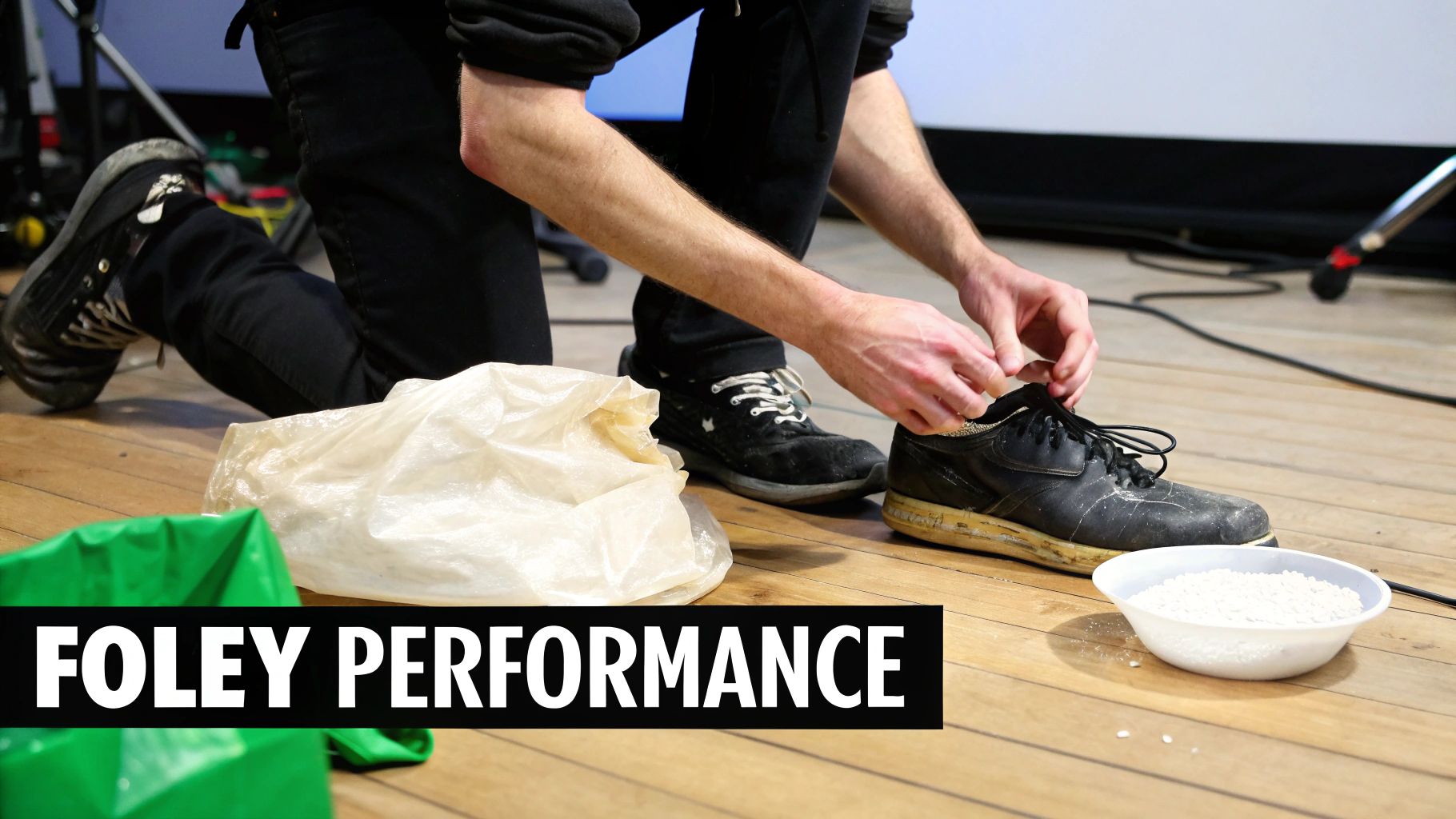
The craft takes its name from Jack Foley, a Universal Studios stage worker who, during the transition from silent films to talkies in the late 1920s, recognized that synchronized performance held the secret to emotional realism. Rather than relying on clunky mechanical effects boxes or generic library discs, Foley projected the film onto a studio wall and performed the characters’ physical actions in real time while tracking a single microphone. Today, professional Foley stages are not sleek digital control booths; they resemble chaotic salvage yards. Shelves groan under rusty tire rims, cracked bowling balls, leather saddles, severed automobile hoods, stalks of limp celery, and burlap bags filled with cornstarch.
The foundational physics of Foley sound design mechanics operate on sensory cross-talk, an evolutionary quirk in human perception known as the ventriloquism effect. When visual motion and an acoustic transient occur simultaneously, the brain automatically binds them together, overriding minor discrepancies in sonic profile. You do not actually know what a medieval broadsword plunging through plate armor sounds like. If a boom mic had recorded the real event centuries ago, it would have produced a dull, flat thud accompanied by the muffled groan of crushed padding. In movie theaters, audiences expect a resonant metallic scrape followed by a wet, sickening crunch. Foley artists deliver the expectation of truth rather than literal acoustic duplication, constructing hyper-real acoustic illusions that feel truer than life itself.
The 4 proven physical techniques that fool the human ear
Behind every compelling film sequence lies an arsenal of physical methods refined over decades of studio production. These tactile formulas turn mundane household junk into visceral cinematic moments through precise material interactions.
Vegetable destruction and the viscous anatomy of cinematic violence
When cinema depicts catastrophic bodily trauma, audio professionals avoid biological tissue entirely. Instead, they visit produce markets. Observing how Foley sound design mechanics transform inert studio junk into living tissue begins with cold cabbages, cantaloupes, and stalks of crisp celery. To produce the sickening crack of an arm snap, an artist does not break a piece of lumber. Dry timber produces a hollow, sharp acoustic spike lacking organic moisture and flesh resistance. A seasoned audio performer wraps damp celery in a wet chamois cloth and snaps it directly in front of a sensitive large-diaphragm condenser microphone. The celery fibers deliver the brittle fracture of bone, while the saturated leather skin produces the tearing sound of muscle, cartilage, and connective tissue. Cantaloupes struck with wooden mallets replicate cranial impacts, while squished tomatoes, halved grapefruits, and soaked sponges yield the squelching aftermath of deep lacerations.
Layered textile friction and the subtle language of movement
Every dramatic character carries a distinctive acoustic footprint constructed entirely from clothing movements. On set, modern wireless lavalier microphones taped beneath shirts pick up distracting textile friction that must be meticulously silenced in dialog cleanup. Once the production track is stripped bare, Foley artists recreate every swish, brush, and drag to define the weight and social status of the performer. Heavy wool overcoats require coarse tweed friction, whereas an undercover operative requires silent microfiber or slippery nylon. When observing how physical movement conveys deep emotional vulnerability, audiences connect viscerally to kinetic presence, much like how Tyler Cameron Shares 3 Major Life Milestones In Emotional Dancing With The Stars Reveal showed how raw human movement captures audience empathy far better than synthetic spectacle. In the studio, the artist wears the garments or rubs swathes of silk, denim, and oilcloth against their forearms in rhythm with the screen actor, establishing psychological subtext through fabric tension.
Footwear density and the spatial weight of human locomotion
Footsteps represent roughly seventy percent of a Foley performer’s daily workload, yet they demand the highest level of athletic coordination and dramatic intuition. Studios feature specialized Foley pits, which are sunken concrete troughs filled with distinct surfaces such as loose gravel, packed loam, asphalt, hardwood parquetry, muddy silt, and splintered timber decking. An overlooked pillar of Foley sound design mechanics involves microscopic temporal displacement and surface contact pressure. If an actor on screen is grieving, their heel strikes the floor before their toe, lingering with a low-frequency scrape that conveys hesitation, fatigue, and sorrow. If a character is panicked, the strike shifts toward the ball of the foot with rapid, shallow impact transients. Foley artists maintain collections of dozens of pairs of worn shoes, knowing that an Italian leather loafer flexes with a soft creak that a hard rubber combat boot can never mimic.
Temporal micro-sync and the biological limits of visual cohesion
Amateur sound editors assume that perfect synchronization means aligning audio spikes to the exact visual video frame. The reality of psychoacoustics is far more nuanced. Sound travels through air at approximately 343 meters per second, while light reaches our eyes virtually instantaneously. In real life, when you watch someone drop a coffee mug across a large room, your brain anticipates a tiny delay between the visual shatter and the auditory crack. If audio transients in a film hit exactly on the impact frame during wide shots, the event feels unnatural, sterile, and jarring. Seasoned performers play with micro-sync, intentionally leading or lagging the visual image by one or two frames depending on camera distance, lens focal length, and acoustic room depth. This fluid alignment honors biological limits, ensuring the brain fuses image and wave into an unbroken perceptual reality.
Why algorithmic digital soundboards will never replace manual performance
As artificial intelligence and automated synthesis creep into post-production workflows, proponents claim that neural networks will soon synthesize every environmental sound effect from raw video pixels. While computer vision models can detect a dog walking across a rug, the longevity of Foley sound design mechanics endures because human ears instinctively register digital perfection as artificial. Algorithmic audio generation relies on statistical probability; it delivers the mathematically expected sound wave for a shoe striking wood.
What algorithms miss is intentional dramatic imperfection. A living artist does not merely match footsteps; they interpret dramatic intention. If an actor on screen subtly tenses their jaw before drawing a weapon, an observant Foley artist leans into the prop mic with a gentle intake of breath and a tight, strained leather stretch that foreshadows the violence. That emotional translation requires human empathy, a somatic understanding of weight, muscle tension, and narrative pacing that no mathematical algorithm can simulate. Mechanical repetition creates auditory fatigue, whereas organic variation sustains audience immersion across a two-hour theatrical feature. Every micro-hesitation, scraping heel, and rustling cuff is an act of acting.
Preserving the physical soul of post-production audio
The art of cinematic audio remains one of the last sanctuaries of physical craftsmanship in an industry dominated by computer-generated imagery and synthetic rendering. When we sit in a darkened cinema, our bodies respond to frequencies crafted by real hands manipulating dirt, snapping stalks, and scuffing leather against cold stone. As documented in Audio Engineering Society research on psychoacoustics, human perception relies heavily on complex non-linear acoustic cues to infer physical presence and spatial volume. By understanding how tactile objects can be coaxed into telling magnificent auditory lies, we gain a renewed appreciation for the invisible artisans working in the shadows of the projection booth. Revisiting classic Foley sound design mechanics reminds us that human touch produces the truest resonance, proving that cinema’s greatest illusions often start with nothing more than a head of lettuce, an old shoe, and an ear tuned to the rhythms of life.