Bond duration mechanics and 4 proven rules that shield your fixed income portfolio from devastating rate spikes
Maturity tells you when a bond expires, but duration reveals how violently its price reacts when interest rates shift. Unpack the mathematics of cash flow gravity and 4 proven rules that safeguard capital against rate shocks.

Mastering bond duration mechanics transforms how an investor views interest rate risk, turning obscure mathematical formulas into a clear roadmap for capital preservation. Many novice allocators mistakenly treat a bond’s maturity date as its true lifespan, assuming that a ten-year note exposes them to ten years of unwavering market exposure. That assumption is both dangerous and fundamentally flawed. A fixed income security is not a monolith that sleeps quietly until its redemption date arrives. It is an ongoing stream of individual cash commitments, each arriving at a distinct moment in time and each carrying its own vulnerability to prevailing economic forces.
When central banks adjust policy rates or secondary markets demand higher risk premiums, bond prices do not move according to arbitrary emotional whims. They adjust through deterministic arithmetic. Understanding that arithmetic is what separates reactive savers from seasoned allocators who navigate changing economic cycles with deliberate composure.
Why maturity tells only half the story in fixed income
To understand why maturity fails as a comprehensive risk metric, imagine two distinct borrowers who both promise to return ten thousand dollars ten years from today. The first borrower pays zero interest along the way, delivering the entire sum in a single lump payment on the final afternoon of the tenth year. The second borrower pays five hundred dollars every six months for a decade, steadily returning half of the principal through interim interest before the final redemption occurs. While both agreements carry a ten-year maturity on paper, their financial behavior during those ten years is vastly different.
The second agreement continuously returns capital to your hands, allowing you to deploy that cash into newer opportunities, higher interest rates, or safer assets long before the contract expires. The first agreement leaves your capital entirely trapped in limbo, exposed to every breeze and tempest that sweeps through the credit markets. Understanding bond duration mechanics requires looking past the nominal calendar date on the certificate and focusing on cash flow velocity.
This is where Frederick Macaulay made his breakthrough discovery in the late nineteen thirties. He realized that fixed income investors needed a single metric that expressed the true economic center of gravity of a debt instrument. By weighting the timing of every coupon and principal payment by its discounted present value, Macaulay created a measurement of effective maturity. Duration measures the average time it takes for an investor to recoup their initial investment through accumulated cash flows, expressed in years. If maturity represents the geographic boundary of a bond, duration represents its physical center of mass.
The hidden anatomy of Macaulay and modified duration
While Macaulay duration provides an elegant temporal snapshot, capital allocators face an immediate practical concern when interest rates move. They need to know the exact dollar percentage their bond holdings will gain or drop when central banks adjust benchmark rates or when market yields fluctuate. This mathematical pivot reveals why bond duration mechanics serve as the definitive bridge between maturity and price volatility.
Modified duration takes the temporal measurement of Macaulay duration and adjusts it by the bond’s yield to maturity divided by its coupon payment frequency. Through this simple adjustment, duration transforms from a calendar metric into a direct volatility coefficient. A modified duration of seven does not merely mean a seven-year weighted payback window. It means that for every one hundred basis points, or one percentage point, shift in market yield, the bond’s price will move approximately seven percent in the opposite direction.
The mechanics resemble a playground seesaw. The fulcrum rests beneath the bar, while yield sits on one end and bond price sits on the other. When yields rise, the price end drops. The modified duration represents the physical length of the board. A short board with a duration of two tilts slightly when yields jump, creating a modest price decline of two percent. A long board with a duration of fifteen swings wildly through the air, plunging fifteen percent on that identical one percent rate increase.
For instruments with embedded options, such as callable corporate bonds or mortgage-backed securities where borrowers can prepay their debt, analysts rely on effective duration. Effective duration abandons the assumption of fixed cash flows and recalculates value by simulating how cash flows shift under rate changes. Regardless of the flavor used, the foundational reality remains identical. Duration is the ultimate gauge of sensitivity, mapping the precise mechanical friction between prevailing interest rates and portfolio wealth.
4 proven duration rules that protect capital across shifting interest rate regimes
Applying bond duration mechanics across practical portfolio management comes down to four fundamental structural realities. These rules are not speculative opinions or temporary trends. They are mathematical constants derived from the physics of discounted cash flows. Investors who internalize them possess the rare ability to anticipate market volatility rather than merely react to statement losses.
Rule 1 Coupon size dictates the balance of the cash flow seesaw
The size of the periodic interest payment exerts massive influence over duration. The higher the coupon rate on a bond, the shorter its duration will be relative to its maturity date. This occurs because heavy coupon distributions front-load the return of capital, pulling the economic center of gravity closer to the present day.
Consider a zero-coupon bond. Because it yields nothing until the final redemption bell rings, its Macaulay duration is precisely equal to its maturity date. A thirty-year zero-coupon bond has a Macaulay duration of thirty years, leaving it ferociously sensitive to rate shifts. Conversely, a thirty-year bond carrying an eight percent coupon continuously sends substantial cash back to the holder. Those early distributions pull the weighted average lifespan inward, shrinking its duration down to roughly twelve or thirteen years. When constructing an income portfolio during volatile macro environments, holding higher-coupon instruments cushions your capital against severe price drawdowns by systematically accelerating cash recovery.
Rule 2 Yield levels warp price sensitivity through structural asymmetry
The baseline yield from which a rate change begins alters the severity of duration risk. When prevailing yields across the economy sit at historically depressed levels, bond duration expands across the entire market. Conversely, when yields are already elevated, duration contracts, providing a built-in buffer against further rate hikes.
This asymmetry catches millions of market participants off guard. When sovereign yields sit near one or two percent, the discounting factor applied to distant cash flows is exceptionally weak. This weak discounting elevates the present value of payments far out on the horizon, stretching the duration of every bond to maximum length. When unexpected inflationary bottlenecks strike broader industrial commerce, much like when a diesel fuel shock sparks 4 major economic clashes that threaten energy markets and accelerates consumer prices, central banks inevitably raise borrowing costs. If an investor enters that environment holding paper with razor-thin yields, the resulting capital destruction is swift and brutal because their duration was stretched taut right before rates spiked.
Rule 3 Convexity acts as the indispensable shock absorber for non-linear moves
Modified duration is inherently a straight-line approximation. In mathematics, it represents the first derivative of the price-yield curve, drawing a flat tangent line against a curved path. In reality, the true relationship between a bond’s price and market interest rates is distinctly curved, or convex. At this stage of rate analysis, bond duration mechanics must account for curvature rather than relying purely on linear projections.
Convexity is the second derivative, representing the rate of change of duration itself. For standard non-callable bonds, positive convexity works decisively in the investor’s favor. As market yields fall, the bond price rises at an accelerating pace, surpassing the gains predicted by simple duration. When yields rise, the price drops at a decelerating pace, losing less than duration models project. Convexity is essentially the curvature cushion that protects fixed income investors during extreme rate shocks. Understanding convexity prevents allocators from miscalculating the actual dollar risk of massive market moves.
Rule 4 Key rate duration unmasks yield curve twists and steepeners
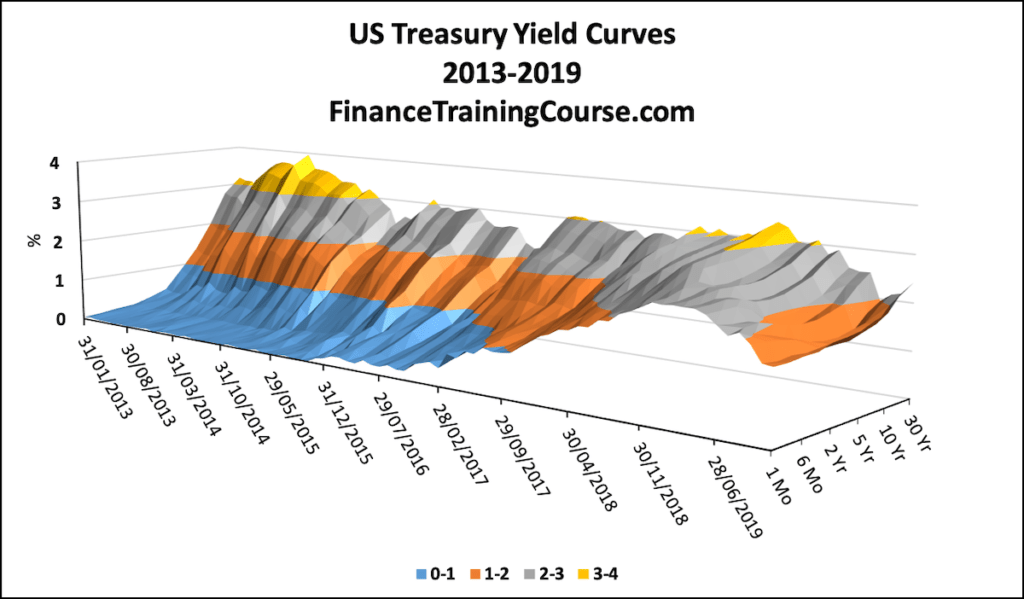
Most textbook explanations make a seductive error by assuming that the yield curve always shifts in parallel, with one-year, five-year, ten-year, and thirty-year yields rising or falling by the exact same amount. In actual financial markets, parallel shifts are extraordinarily rare. The yield curve twists, steepens, flattens, and inverts based on monetary policy expectations and economic growth outlooks.
Key rate duration solves this problem by measuring a portfolio’s price sensitivity to yield changes at specific benchmark maturities along the curve while holding all other points constant. A portfolio might possess an aggregate modified duration of six years, leading an allocator to feel comfortably diversified. Yet if fifty percent of that duration is concentrated directly at the thirty-year mark, a steepening curve will inflict savage damage on the portfolio even if intermediate benchmark rates remain calm. Key rate duration dissects the entire curve into distinct operational sectors, ensuring that risk is truly distributed rather than clustered in hidden pockets.
Practical portfolio immunization and cash flow matching
Beyond mere defense, understanding rate sensitivity enables one of the most powerful institutional techniques in finance, namely portfolio immunization. Developed to insulate pension funds, insurance balance sheets, and endowment spending obligations from interest rate turbulence, immunization locks in a targeted rate of return over a fixed investment horizon.
The framework relies on the deliberate balance between price risk and reinvestment risk. When interest rates rise, bond prices fall, inflicting immediate capital losses. However, the coupons arriving in subsequent months can now be reinvested at those higher, more attractive yields. When interest rates fall, bond prices experience a surge in capital appreciation, but incoming cash flows must be reinvested at lower yields.
By matching the Macaulay duration of a bond portfolio precisely to the time horizon of an investor’s future cash liability, these two antagonistic forces cancel each other out. If rates rise, higher reinvestment earnings on incoming coupons compound to cover the initial paper loss. If rates fall, capital gains cover the lower future yield. Through the lens of bond duration mechanics, immunization creates a self-correcting financial ecosystem where capital losses match reinvestment gains, neutralizing market chaos for long-term allocators. Rigorous CFA Institute analysis on fixed income risk and return dynamics demonstrates that matching duration to liability horizons remains the single most reliable framework for eliminating market timing anxiety.
The permanent wisdom of managing rate sensitivity before the storm hits
Fixed income is often sold as the tranquil counterpart to the volatile equity arena. Yet without rigorous attention to rate sensitivity, debt markets can inflict losses every bit as devastating as a severe equity downturn. Maturity provides a calendar date, but duration reveals the living pulse of capital commitment.
Investors who respect bond duration mechanics never mistake yield for total return, nor do they treat fixed income as a passive refuge. They view every holding through the interplay of cash flow timing, baseline yield levels, structural convexity, and curve positioning. When economic tides turn and monetary policies tighten, portfolios engineered with these principles do not scramble for safety. They remain anchored by design, converting market volatility from a destructive threat into an orderly source of liquidity and long-term stability.