Baseball Pitch Spin Mechanics Reveal 4 Proven Secrets to Create Unhittable Movement
Raw throwing velocity gets attention, but true pitch deception lives in aerodynamic friction and spin design. Uncover the biomechanical principles that transform ordinary fastballs into unhittable breaking pitches.
Mastering baseball pitch spin mechanics transforms a pedestrian fastball into an explosive, late-breaking weapon that leaves hitters flailing at thin air. To the naked eye from the grandstands, a major-league heater looks like a straight line fired out of a cannon. Yet every batter who has ever stepped into the batter box knows that straight lines do not generate swing-and-miss frustration. Two pitches clocked at an identical ninety-five miles per hour can provoke radically different reactions from an elite hitter, with one pitch feeling utterly dead and meat-balled, while the other appears to explode upward as if defying earth gravity.
The secret lies entirely in the flight physics and microscopic force transfers occurring during the three to four milliseconds where human flesh parts ways with raised leather seams. The baseball does not float on magic; it negotiates an intense, turbulent war against atmospheric friction. When you comprehend the physical mechanics behind seam orientation, wrist positioning, and aerodynamic boundary layers, the art of pitching ceases to be a genetic lottery. It becomes an exact science of fluid manipulation that any dedicated arm can systematically deconstruct and rebuild.
The Invisible Aerodynamics of Ball Flight Through Free Air
Before a ball travels sixty feet and six inches, it must claw through a thick soup of ambient air molecules. As a baseball spins, its raised cowhide stitches drag nearby air particles along with its rotational direction. This phenomenon generates an asymmetric velocity field around the sphere. On one side of the ball, the spinning surface travels in direct opposition to the oncoming airstream, slowing the relative airflow and generating a high-pressure pocket. On the opposing side, the surface moves in parallel with oncoming air, accelerating airflow and bleeding local pressure dry.
Understanding baseball pitch spin mechanics begins with the Magnus effect, where this acute pressure differential forces the ball toward the lower-pressure zone. If a four-seam fastball is fired with pure, backspinning rotation, the accelerated airflow races across the top hemisphere of the baseball while the high-pressure buffer builds underneath. Gravity continues to pull the ball downward toward the dirt at thirty-two feet per second squared, yet the upward Magnus lift fights that gravitational drop with remarkable violence. The ball never genuinely rises above its initial release trajectory, but because it drops four to eight inches less than the human brain anticipates, the hitter swings harmlessly underneath the leather.
The physical interactions between textured surfaces and fluid boundaries govern real-world movement across all disciplines. Just as microscopic surface carbonization alters fluid behavior in cookware, as explored in how Cast iron seasoning mechanics reveal 4 proven secrets to build indestructible cookware, baseball seams catch and trip the surrounding air to build localized pressure differentials. As thoroughly documented by The Physics of Baseball research at the University of Illinois, air does not behave like a passive void; it actively bends trajectories depending on the microscopic surface irregularities it encounters.
Active Spin Versus Gyroscopic Waste in Ball Flight
For decades, traditional pitching instruction celebrated high spin rates as the universal holy grail of mound dominance. Scouts carried portable radar units and instantly fell in love with any athlete generating more than twenty-four hundred revolutions per minute. Modern optical tracking technology has thoroughly demolished this crude oversimplification. Spin rate measures the total raw revolutions of the baseball, but raw spin means virtually nothing if the axis of that rotation does not interact productively with the oncoming atmosphere.
When coaches analyze baseball pitch spin mechanics on modern high-speed cameras, they split rotational velocity into active spin and gyroscopic spin. Active spin, commonly termed transverse spin, represents the rotation that sits perpendicular to the trajectory of the pitch, directly powering the Magnus effect to create lateral and vertical break. Gyroscopic spin, conversely, operates like a perfectly thrown spiral on an American football or a rifle bullet spinning along its heading axis. The nose of the ball cuts through the air without creating a differential pressure boundary between opposing hemispheres.
A curveball spinning at three thousand revolutions per minute with seventy percent gyroscopic tilt will tumble forward without biting. It drifts passively through the strike zone, presenting a plump target for batters. Conversely, an off-speed pitch spinning at only nineteen hundred revolutions per minute with near-total active efficiency will bite sharply off the table, generating devastating swings and misses. True mastery is never about chasing raw rotational numbers on a tracking monitor; it hinges on aligning rotational tilt to harvest maximum aerodynamic leverage.
Four Pillars That Dictate Aerodynamic Deception
Generating unpredictable pitch movement demands deliberate kinetic execution. Pitchers do not simply throw harder to produce break; they manipulate microscopic release points, hand positions, and seam tracks to sculpt how air breaks around the projectile.
Seam Shifted Wake and Boundary Layer Asymmetry
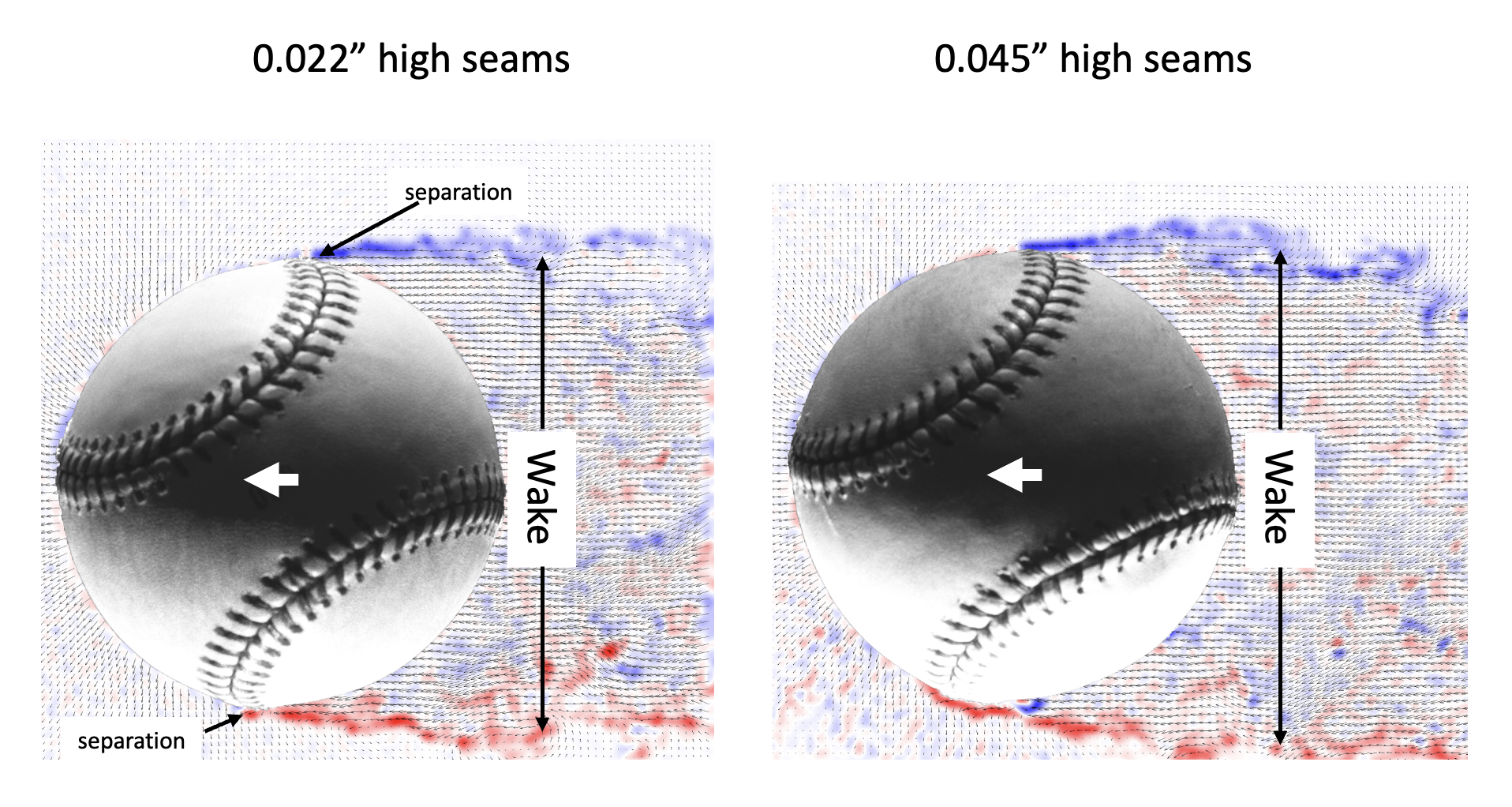
Until recently, pitch mechanics were considered entirely bound to the classic Magnus force. Advanced aerodynamic wind-tunnel testing and optical velocimetry revealed a second, equally potent aerodynamic phenomenon known as seam shifted wake. As air flows over a smooth leather panel of the baseball, the smooth boundary layer detaches early from the ball surface. When that same moving air collides with a raised, interlocking cotton stitch, the seam trips the air into a turbulent state, which clings to the curvature of the ball much longer before separating.
This delayed detachment on the stitched hemisphere tilts the entire downstream wake of the baseball toward that side. Newton third law of motion guarantees that when air is diverted in one direction, the sphere is propelled in the exact opposite direction. This non-Magnus deviation allows pitchers to throw pitches, such as hard sinkers and sudden changeups, that break violently without displaying the traditional spin axis required for such movement. By presenting a specific, tilted seam pattern to the oncoming airflow, you turn the ball into an asymmetric rudder that steers itself through the air.
Fingertip Pressure Vectors at the Instant of Release
The micro-kinetics of baseball pitch spin mechanics ultimately distill down to finger pad positioning during the final centimeters of arm extension. Many amateur throwers mistakenly attempt to twist the baseball with their wrist or snap their forearm at release. In reality, rotational torque is applied through concentrated, offset finger pressure against the leather grain.
For a high-carry four-seam fastball, the index and middle fingertips must apply identical downward force through the absolute center of mass until the ball rolls off the distal phalanges. If the index finger applies slightly more downward friction than the middle finger, the spin axis tilts horizontally, transforming a vertical carry into an arm-side runner. For a sweeping breaking ball, the middle finger acts as a violent fulcrum, driving downward along the outside seam while the index finger rests passively. Controlling these micro-vectors gives you the power to deliberately command whether a pitch rises, fades, cuts, or plummets.
Wrist Pronation and Supination Angle Timing
The forearm operates as the final mechanical transmission between your core kinetic energy and the ball. Pronation turns the palm outward and downward, while supination turns the palm inward toward the face. The precise millisecond at which this forearm rotation occurs dictates whether a pitch achieves optimal spin efficiency or bleeds its velocity harmlessly into the mitt.
Throwing an elite fading changeup requires aggressive, early pronation where the thumb rotates downward through the release point, pulling the inside hemisphere of the ball down and peeling the air off the outer seam. Attempting to throw a sweeping slider with that same forearm orientation causes immediate mechanical failure. Elite pitchers do not alter their foundational arm speed between pitch varieties; they change only the structural orientation of the forearm and wrist joint as the hand accelerates into the release window.
Tunneling and Perceptual Deception in the Hitters Mind
Movement does not occur in an perceptual vacuum. A pitch that breaks twenty inches horizontally is completely useless if the batter recognizes the break out of the hand and refuses to offer at it. The ultimate purpose of spin manipulation is pitch tunneling, which is the discipline of launching distinct pitch types through an identical spatial corridor for the first twenty-five feet of ball flight.
Elite arms integrate baseball pitch spin mechanics into broader deceptive frameworks by ensuring that high fastballs, sweeping sliders, and diving changeups exit the hand from an identical release window with matching initial trajectories. A major-league hitter has approximately one hundred and fifty milliseconds to decipher a pitch flight before deciding to initiate a swing. When opposing pitches mimic the identical flight path through that critical decision threshold before breaking in opposing directions, the hitter brain relies on guesswork rather than vision.
Common Biomechanical Traps That Kill Break
Amateur pitchers attempting to sharpen their baseball pitch spin mechanics often fall into mechanical overcorrection that destroys both velocity and break. The most widespread error is the death grip. Clenching the baseball with excessive tension locks the musculature of the forearm and restricts the distal joints of the fingers. Fluid rotational energy demands elastic compliance. When your fingers are rigid, they scrape across the leather rather than allowing the seams to roll cleanly off the pads, generating empty gyro spin instead of crisp, active rotation.
Another pervasive mechanical flaw is the dropped elbow slot. When an arm tires, the body naturally attempts to relieve shoulder strain by dropping the elbow below the shoulder plane during acceleration. This biomechanical collapse flattens the rotational axis of the ball. Instead of achieving clean vertical backspin or sharp, distinct side-spin, the hand is forced underneath the sphere, creating a slurry of sloppy diagonal spin that sits flat in the hitting zone. Maintaining a consistent shoulder-to-elbow alignment protects your spin efficiency and keeps the ball sharp deep into long outings.
The Modern Diagnostic Path to Pitch Sculpting
Developing filthy movement no longer relies on mystical coaching cliches or endless trial and error. Modern high-speed diagnostic tools have demystified ball flight, allowing pitchers to visualize their release mechanics in microscopic detail. By combining high-frame-rate video with radar tracking, an athlete can pinpoint the exact moment of ball separation, observe the precise seam orientation relative to the airflow, and immediately adjust fingertip pressures to achieve desired movement profiles.
When you finally master baseball pitch spin mechanics, the mound transforms from a test of raw power into a laboratory of aerodynamic flight. Pitch velocity sets your competitive baseline, but the ability to command the invisible fluid dynamics of the air dictates whether you survive when hitters can match your speed. By harnessing the physical interactions of seam wakes, active rotational efficiency, and micro-release kinematics, you take full command of the sixty feet between you and the plate.