Curveball Pitch Mechanics Reveal 4 Proven Forces Behind Devastating Late Movement
Elite breaking balls do not defy physics; they exploit the subtle boundary layers of air and the flaws of human vision. Discover the aerodynamic forces and biomechanical realities that transform a standard pitch into an unhittable hammer.
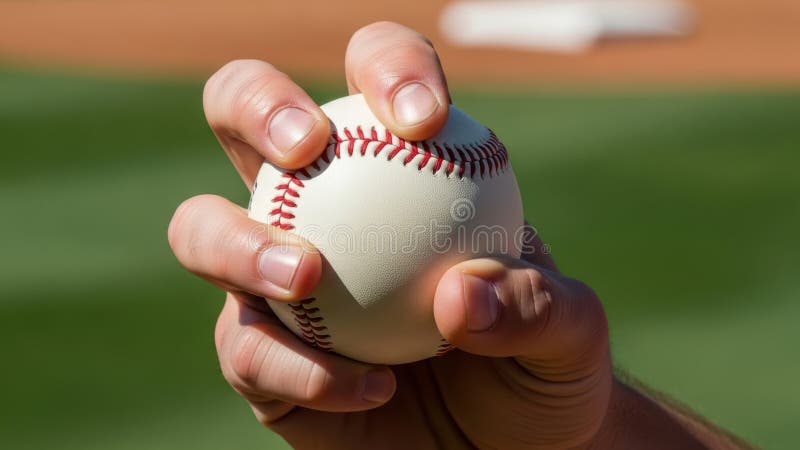
Mastering curveball pitch mechanics requires abandoning the comforting illusion that a baseball curves simply because a pitcher snaps their wrist with violent downward intention. For over a century, dugout folklore insisted that pitchers could twist their joints at release to force a sphere to make an abrupt, sharp dive toward the dirt. That belief created generations of damaged elbows and bewildered hitters. The reality is far more elegant. A baseball in flight is an aerodynamic projectile navigating a turbulent fluid medium, and its deceptive flight path is governed entirely by classical physics, boundary layer separation, and the physiological processing limits of the human eye.
When a pitcher releases a true breaking ball, the leather sphere undergoes an intense struggle against atmospheric resistance. At roughly eighty miles per hour, every raised stitch and cowhide imperfection acts as a micro-rudder. By coordinating the orientation of the spin axis with precise fingertip pressure, an elite athlete transforms sixty feet six inches of air into an obstacle course of uneven atmospheric pressure. Understanding how this sequence unfolds exposes why hitters swing helplessly over pitches that look strike-high until the split-second they vanish into the dirt.
The Optical Illusion of the Late Dropping Hammer
Generations of hitters have sworn under oath that a premier twelve-to-six curveball drops off an invisible table at the fifty-foot mark. This sensation is terrifyingly real to a batter standing inside the box, yet high-speed optical tracking cameras prove that the trajectory of the ball is an unbroken, smooth parabolic arc from release to glove. The pitch does not suddenly fall off a cliff; rather, human biology falls off a processing cliff.
The perceptual trickery baked into curveball pitch mechanics emerges from the hardwired limitations of human biology. When an object approaches an observer at high velocity, the visual cortex must constantly switch tracking modes. During the first two-thirds of ball flight, the batter relies on foveal vision, where the center of the retina tracks the object with pinpoint resolution and fine detail. Because the baseball is moving forward rapidly, its lateral and vertical movement against the background appears gradual and easily digestible.
At approximately twenty feet from home plate, the angular velocity of the baseball overwhelms the physical ability of human eyes to track it smoothly. The human eyeball simply cannot rotate fast enough inside its socket to keep the ball centered on the fovea. To maintain tracking, the batter instinctively transitions to peripheral vision while executing a rapid, anticipatory eye movement known as a saccade. Peripheral vision is exceptionally sensitive to motion but terrible at judging precise spatial coordinates and gradual acceleration. Because the eye jumps forward to where it expects the ball to arrive, the brain smooths over the gap in data. When the baseball arrives lower than expected due to continuous downward acceleration, the brain registers that accumulated discrepancy as an instantaneous, violent plunge.
How Fluid Boundary Layers Dictate Ball Flight
To comprehend why the ball accelerates downward faster than gravity alone would dictate, one must look at how air adheres to a spinning leather surface. Air behaves like a viscous fluid. When a smooth ball travels through the atmosphere, a thin blanket of air called the boundary layer clings to the front hemisphere before separating cleanly at the sides, leaving a symmetrical, low-pressure wake directly behind the sphere.
A baseball, however, is not smooth. It features one hundred and eight double stitches of raised, waxed red thread woven across vegetable-tanned cowhide. These seams protrude roughly zero-point-zero-three inches above the surface. That minuscule profile is large enough to violently disrupt oncoming airflow, tripping laminar air into chaotic turbulence. Just as Foley sound design mechanics reveal 4 proven secrets to forge astonishing cinematic realism by exploiting how human ears decipher artificial acoustics, modern curveball pitch mechanics exploit the fluid physics of the atmosphere to generate impossible trajectories.
Four Foundational Pillars Defining Modern Curveball Pitch Mechanics
Crafting a pitch that consistently dives below the barrel of a bat demands more than raw arm strength. It requires an exact synchronization of fluid dynamics, grip geometry, and forearm kinetic timing.
Magnus Force and Boundary Air Deflection
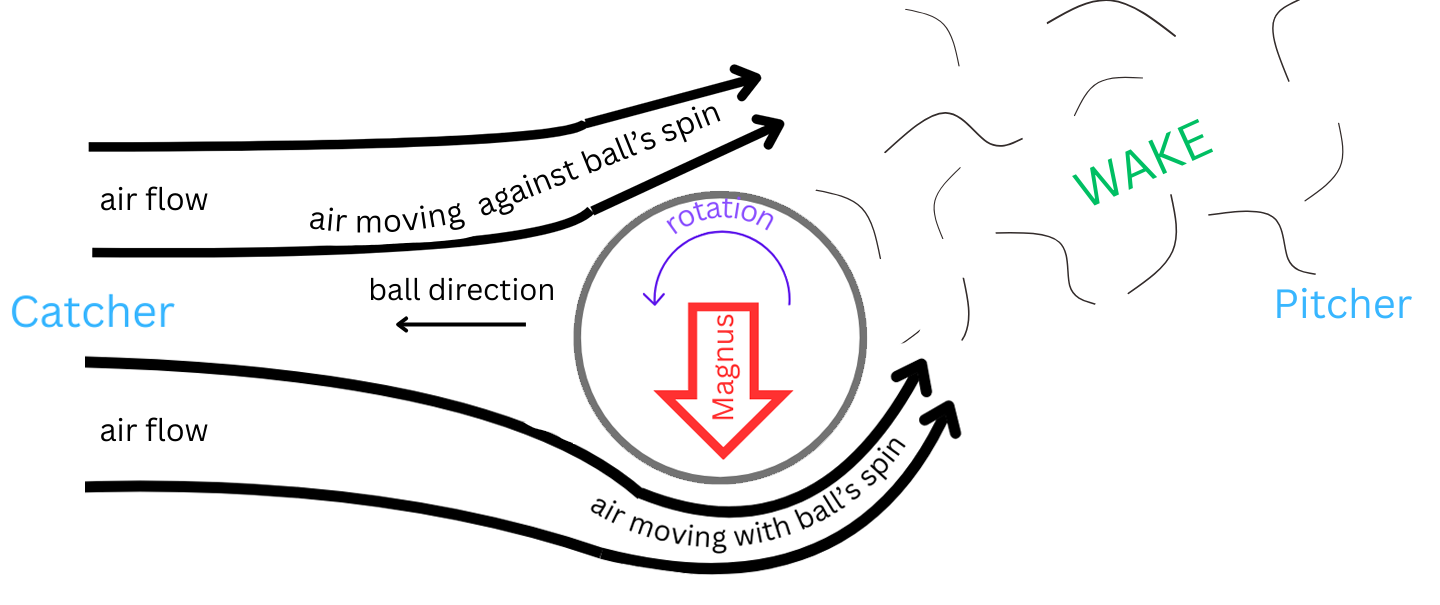
The primary engine driving downward break is the Magnus effect. When a pitcher imparts heavy topspin, the top surface of the baseball rotates directly into the oncoming airflow, colliding with the oncoming wind and creating a localized region of high pressure. Conversely, the bottom surface of the ball rotates in the exact same direction as the oncoming air stream, pulling air along with it and accelerating local air velocity.
According to fluid mechanics principles outlined in NASA Glenn Research Center fluid dynamics research on the Magnus effect, this asymmetry produces a net deflection in the trailing wake. As the air passing beneath the ball is pulled upward behind the ball, Newton’s third law commands an equal and opposite reaction: the atmosphere exerts a continuous, downward perpendicular force directly onto the baseball. Under standard gravity, a projectile falls thirty-two feet per second squared. A ball thrown with optimal topspin and high rotational velocity experiences downward acceleration that significantly exceeds gravitational pull, dragging the trajectory into an aggressive descent long before it reaches the plate.
Seam Shifted Wake and Non Magnus Movement
Until recently, traditional pitching theory credited the Magnus effect for all baseball movement. Modern high-resolution optical tracking laboratories have uncovered a secondary phenomenon known as seam-shifted wake. When a baseball rotates with its seams oriented at specific angles relative to the oncoming wind, the raised stitches force the boundary layer to detach prematurely on one side while staying attached longer on the opposing side.
This asymmetrical boundary layer separation creates an uneven aerodynamic wake that tilts the trajectory independent of the primary spin axis. If a pitcher configures their grip so that smooth leather faces the wind on one hemisphere while turbulent seams face the wind on the other, the resulting pressure differential steers the ball laterally or vertically without requiring additional rotational speed. Pitchers who synchronize seam-shifted wake with traditional topspin create pitches that break in ways that defy traditional spin-rate algorithms, confounding hitters who base their swing path on early spin identification.
Kinetic Energy Transfer Through Grip Pressure and Forearm Supination
Coaches once instructed young athletes to violently twist their wrist inward or snap their hand downward like pulling a window shade. This antiquated advice is anatomically disastrous. When evaluating real-world curveball pitch mechanics, high-speed cameras demonstrate that elite throwers rarely twist their wrists at release.
The human wrist joint is poorly configured to handle high-velocity torsional twisting under eccentric loads. Elite breaking balls are generated by pre-setting the forearm into supination prior to ball release. The pitcher locks the wrist into a firm, neutral position, nesting the index and middle fingers securely against the horseshoe seam. As the arm accelerates through the kinetic chain, the middle finger acts as a fulcrum. Rather than snapping the joint downward, the pitcher pulls the fingertips firmly through the front face of the ball while decelerating the thumb upward. The topspin is an outcome of leverage, friction, and directional momentum transfer, completely sparing the delicate ligaments of the flexor-pronator mass from injurious torque.
Spin Axis Alignment and Gyro Degree Efficiency
Not every revolution imparted to a baseball contributes to its movement. The efficiency of a pitch is determined by its spin axis. If a ball spins around an axis perpendicular to its direction of flight, every revolution contributes directly to the Magnus force. This is classified as transverse spin, or active spin.
If the ball spins like a perfectly thrown football, with its axis pointing straight down the line of flight, that spin is classified as gyro spin. Gyro spin generates zero Magnus deflection. An elite twelve-to-six curveball typically features an active spin efficiency above ninety percent, meaning nearly every ounce of kinetic energy converted into rotation works to pull the baseball toward the dirt. Conversely, sweeping breaking pitches, commonly referred to as slurves or knuckle-curves, deliberately blend gyro tilt with transverse spin to generate compound breaks that run horizontally across the plate while maintaining enough downward dive to miss the sweet spot of the bat.
Biomechanical Realities and Elbow Valgus Torque
Orthopedic research examining curveball pitch mechanics reveals a surprising paradox regarding arm stress and youth athletic development. For decades, conventional wisdom warned that throwing breaking balls was the leading catalyst for ulnar collateral ligament tears and severe medial epicondyle strain. Clinical kinematics laboratories have systematically dismantled this assumption.
Biomechanical studies tracking joint kinetic forces consistently demonstrate that a properly thrown fastball generates equal to or slightly higher valgus torque at the elbow joint than a properly executed curveball. The reason is straightforward: fastballs are thrown with maximum velocity, maximum arm extension, and violent terminal pronation. A curveball, because it requires controlled release and slightly reduced arm speed, actually produces marginally lower peak torque on the elbow joint when thrown with sound fundamentals.
The elevated injury rates associated with the pitch do not stem from the pitch itself, but from mechanical corruption. When pitchers experience muscular fatigue, their arm slot drops, and their kinetic chain lags. Pitchers attempting to manufacture break while fatigued often pull their elbow out of alignment, casting the arm away from the body to artificially generate spin. This mechanical flaw shifts immense shear stress directly onto the medial ligaments of the elbow. The risk is not the topspin; the risk is the breakdown of the kinetic chain that delivers the baseball to the release window.
Modern Tunneling and Pitch Design Diagnostics
The devastating nature of elite curveballs is ultimately realized through the discipline of pitch tunneling. A pitch with fifteen inches of downward drop is useless if the hitter recognizes the trajectory thirty feet out of the hand. If a curveball pops out of the pitcher’s hand with an upward arc, the visual processing system of an experienced batter identifies the distinctive hump instantly and waits for the pitch to settle into the hitting zone.
Modern pitch design labs use stroboscopic high-speed photography to ensure that the initial trajectory of the breaking ball mirrors the release window and initial flight path of the pitcher’s primary fastball. For the first twenty feet of flight, the ball must travel through an identical imaginary spatial tunnel. By matching the release height, release angle, and arm velocity of the fastball, the pitcher forces the batter to commit to an aggressive swing decision within the initial one hundred and fifty milliseconds of ball flight.
By the time the baseball emerges from that shared tunnel, aerodynamic forces take full custody of the flight path. The combined impact of the Magnus effect, turbulent wake deflection, and seam orientation pulls the ball out of the anticipated strike zone, dipping beneath the path of the bat while the batter swings at ghost trajectories. Ultimately, refining repeatable curveball pitch mechanics bridges classical aerodynamics with the brutal realities of human performance under pressure. When execution meets scientific precision, the pitcher controls not merely the ball, but the perceptual reality of the batter standing at the plate.