Sprint acceleration mechanics reveal 4 proven secrets to build explosive athletic speed
Unlocking true first-step explosiveness requires more than raw muscular power. Discover how directional force, shin angles, and neural timing engineer game-changing horizontal speed.
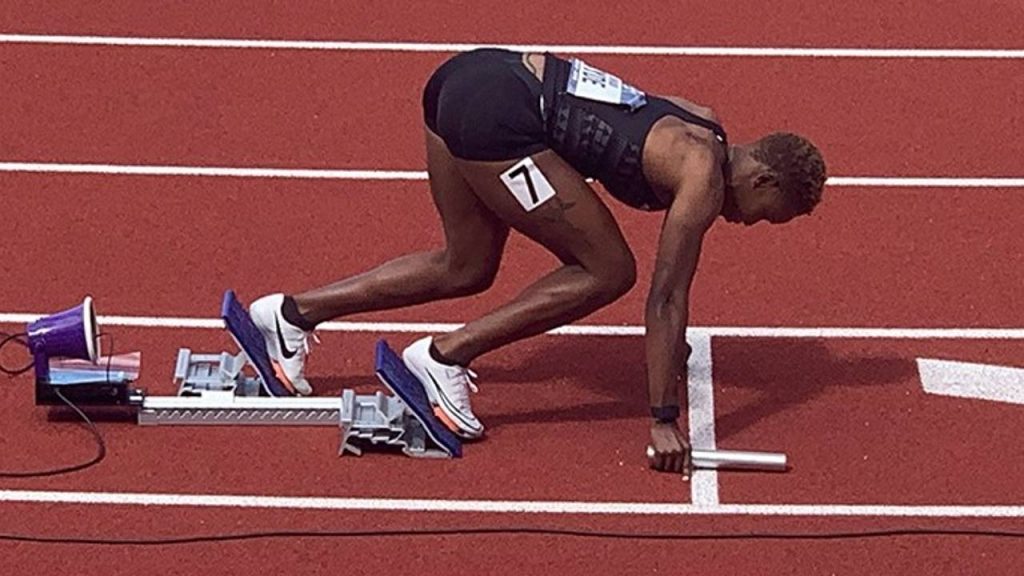
Mastering sprint acceleration mechanics separates elite field athletes from those who merely spin their wheels on the turf. Watch a high school track heat or a weekend recreational soccer match, and you will notice an immediate pattern. Athletes churn their legs furiously, their heads bob up and down, and their spikes chew up the surface, yet their bodies barely move across the field. They mistake frantic movement for genuine velocity. Speed is not a measurement of how rapidly your feet flutter through the air. Speed is the mathematical consequence of how efficiently you drive kinetic energy into the planet beneath you.
Human locomotion operates on pure Newtonian physics. To accelerate forward, an athlete must push backward against the ground with massive force in minimal time. When this mechanical reality fails to register in training, performance stalls. Athletes spend countless hours in squat racks and on leg press machines, building colossal horsepower that never transfers to the opening steps of a sprint. The bottleneck is rarely a total lack of force; the bottleneck is the structural delivery of that force through the kinetic chain.
The Physics of Ground Reaction Force and Horizontal Vectoring
When coaches break down sprint acceleration mechanics, the conversation almost always shifts from muscle size to ground reaction force. The earth acts as an immovable platform. When your foot strikes the turf, the surface pushes right back with equal and opposite magnitude. The critical variable during the first ten to fifteen meters is not how much vertical force you generate to keep yourself upright, but the percentage of that total force directed backward through the horizontal vector.
At top-end velocity, elite sprinters spend roughly eighty-five milliseconds in contact with the ground. Their bodies bounce like rigid springs, relying on vertical ground reaction force to overcome gravity and keep stride length long. Acceleration reverses this equation. During the initial drive phase, ground contact times stretch between one hundred fifty and two hundred milliseconds. This extended contact window is not a flaw; it provides the mechanical window required to generate substantial forward impulse.
If an athlete rises into an upright posture too early, their ground reaction vector tilts vertically. They effectively jump over the ground rather than pushing the planet behind them. As documented in groundbreaking research on horizontal force application and sprint mechanical effectiveness, an athlete’s ability to orient total force horizontally is a far stronger predictor of acceleration performance than raw maximum force output alone. You can possess the squat numbers of an Olympic lifter, but without the horizontal vector alignment, that energy evaporates into useless vertical oscillation.
The Neural Sequencing Behind the First Ten Yards
Understanding the neural side of sprint acceleration mechanics requires looking at muscle activation patterns before the foot even touches the grass. The human central nervous system must pre-tension the lower limbs prior to ground impact. Without this anticipatory muscular contraction, the ankle, knee, and hip joints collapse under the incoming load, leaking force like a ruptured hydraulic hose.
Novice runners treat ground contact as a passive landing event followed by an active push. Elite sprinters treat ground contact as an aggressive, calculated collision. Milliseconds before strike, the nervous system fires the gluteus maximus, hamstrings, and calves, turning the entire lower extremity into a stiff, pre-loaded lever. This rigid lever absorbs the ground impact and redirects stored elastic energy straight through the pelvis to throw the torso forward.
This neuromuscular synchronization cannot happen when an athlete overstrides. Landing with the foot placed far out in front of the center of mass produces a violent braking force. Instead of propelling the body onward, the lead limb acts as a kickstand, actively halting forward momentum until the hips travel over the foot. True acceleration demands that the foot strike underneath or marginally behind the hips while moving rearward relative to the body.
Four Core Biomechanical Pillars That Transform Acceleration
A deep dive into sprint acceleration mechanics uncovers four distinct physical levers that dictate how quickly a human body can overcome inertia. These pillars operate in total harmony. Altering one element triggers a cascade across the entire structural chain.
Positive Shin Angles and the Geometry of Triple Extension
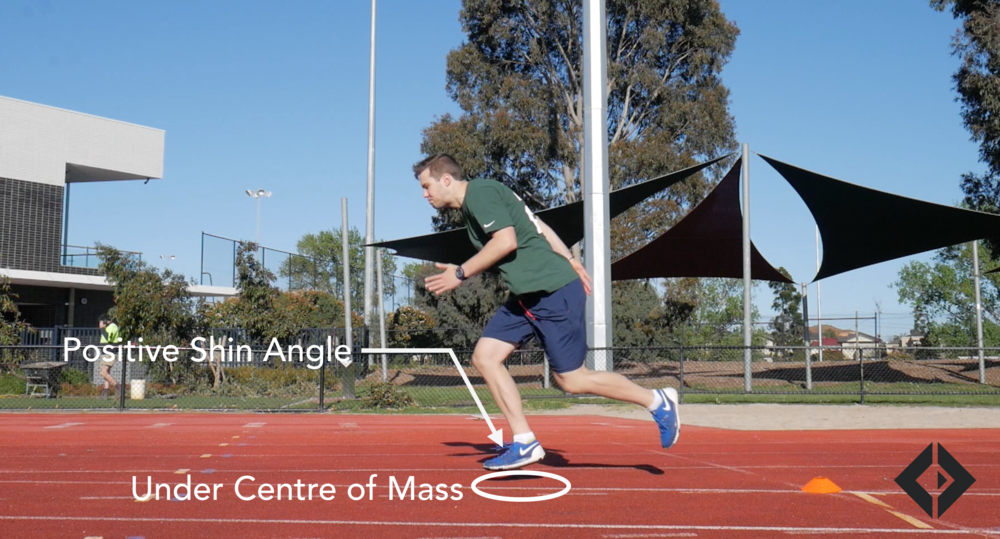
The angle of the lower leg at ground contact and during propulsion dictates the direction of applied force. A positive shin angle means the knee projects visibly ahead of the ankle, angling the shin bone acutely toward the running surface. This forward lean aligns the femur, pelvis, and spine into a direct diagonal line that channels muscular effort horizontally.
Achieving this diagonal posture requires authentic triple extension: the synchronized opening of the hip, knee, and ankle joints. When an athlete hits full triple extension with a low, aggressive shin angle, the body creates a straight structural bridge. The drive from the glutes travels directly into the track without spinal buckle or pelvic rotation. If the shin collapses into a perpendicular, ninety-degree angle relative to the ground, forward thrust is instantly cut in half.
Piston Strike Dynamic Over Premature Heel Recovery
Watch a sprinter who has already reached eighty meters, and you will observe cyclic mechanics: the heel swings up toward the buttock in an elliptical arc to facilitate rapid swing-leg turnover. Attempting to replicate that looping movement during the initial acceleration steps is disastrous. Acceleration requires piston-like, punch-and-strike leg action.
Instead of swinging the heel up and around, the athlete must punch the knee forward while keeping the heel low and tight under the center of mass. Once the thigh achieves forward projection, the foot drives back into the ground like a sledgehammer striking concrete. This ground-strike behavior is one of the most neglected elements of sprint acceleration mechanics among amateur runners. Eliminating the backside butt-kick loop cuts wasted air time and increases the frequency of force-producing ground strikes.
Upper Body Counterbalance and Arm Swing Torque
Sprinting is an intensely rotational activity. Every time a powerful leg hammers backward, it applies massive rotational torque to the pelvis. If left unchecked, this torque would spin the torso like a top and destroy forward tracking. The shoulders and arms serve as the counter-balancing balance wheel of the kinetic machine.
During the drive phase, arm strokes must match the aggression of the legs. The hands should travel from hip height all the way past the cheekbone, driving down and back with explosive intention. The rearward arm stroke counteracts the opposite leg’s drive, neutralizing rotational sway and stabilizing the spine. A passive or floppy arm action forces the core musculature to waste valuable energy fighting rotational drift rather than maintaining a rigid power bridge.
Tendon Stiffness and Elastic Energy Recoil
Muscles produce force, but tendons transmit it. The Achilles tendon and the plantaris act like high-grade steel springs during rapid acceleration. As the forefoot contacts the surface, these dense connective tissues stretch under the athlete’s weight and instantly snap back, returning free kinetic energy to the stride.
To exploit this tendon elasticity, an athlete must cultivate extreme ankle stiffness. If the heel sinks toward the turf upon impact, the Achilles tendon stretches too slowly, and the elastic recoil dissipates as metabolic heat. Maintaining an active, dorsiflexed foot—pulling the toes up toward the shin prior to impact—prepares the calf-tendon complex to resist deformation and produce instantaneous recoil upon contact.
Translating Linear Velocity to Multi Directional Field Sports
Transferring textbook sprint acceleration mechanics to chaotic team sports introduces fresh kinetic variables. Track sprinters accelerate from static blocks along a predictable, laser-straight lane with spiked shoes designed for high-traction synthetic tracks. Field sport athletes—competing in rugby, soccer, or American football—rarely begin from a static track stance. They accelerate while reacting to opponent maneuvers, cutting on damp grass, or tracking a bouncing ball.
This dynamic reality has revolutionized modern professional scouting. In European football, analysts no longer just evaluate an athlete based on nominal top speed recorded over forty meters. The decisive metric is burst capacity over the first five to ten meters, an evaluation framework highlighted when examining how the Liverpool Transfer Target David Otorbi Triggers 3 Major Shifts in Anfield Spending Plans through the pursuit of explosive wide attackers capable of shattering compact defensive blocks.
In multi-directional sports, acceleration frequently occurs from curved approach runs or out of rapid deceleration. Even when attacking off an angle, the core physical laws remain undefeated. An athlete breaking toward open space must establish positive shin angles relative to their chosen direction of travel, keep their center of mass low, and hammer backward against the turf to escape defensive pursuit.
Practical Drills to Hardwire Horizontal Force Production
Refining your sprint acceleration mechanics does not require exotic technology or hyper-complicated plyometrics. It requires loading the movement pattern just enough to force the body into correct positional angles without corrupting the neuromuscular rhythm. The two most effective training modalities for this objective are heavy sled towing and wall-drill isometric holds.
Heavy sled towing forces an athlete into a natural forward lean. Because the athlete is pulling resistance anchored behind them, standing upright immediately halts forward momentum. The sled physically forces positive shin angles and rewards powerful backward ground strikes. The key is programming the load properly. Using loads that slow the sprint by roughly thirty to fifty percent allows the nervous system to spend extended time in the horizontal force production zone, ingraining the sensation of pushing the ground away.
Wall march and wall drive drills serve as static biomechanical mirrors. By placing their hands against a sturdy wall at a forty-five-degree angle, an athlete can practice the piston-punch knee action and ankle dorsiflexion without the metabolic fatigue of full sprints. These drills build kinesthetic awareness, allowing athletes to feel true triple extension through the ankle, knee, and hip before translating those motor patterns onto open grass.
Stop chasing speed by running endless high-volume laps or performing meaningless agility ladder dances. Real speed is engineered through directional force, structural stiffness, and patience in the acceleration posture. Align your shin angles, stiffen your tendons, hammer the earth behind you, and let Newtonian physics do the rest.