Emulsion Sauce Mechanics and 4 Proven Secrets to Create Flawless Silky Textures
A broken sauce is not bad luck; it is a predictable failure of fluid dynamics and interfacial chemistry. Unlock the mechanical principles behind silky hollandaise, velvety mayonnaise, and resilient pan sauces.
Mastering emulsion sauce mechanics separates panicked home cooks from confident culinary craftsmen who command the stove with absolute composure. We have all stood over a saucepan, watching in horror as a glossy, golden ribbon of hollandaise suddenly collapses into an unappealing puddle of yellow grease and curdled grit. The instinct is to blame bad luck, an uncooperative stove, or a rogue egg yolk. Yet sauces do not break out of malice or mystery. They break because the rigid laws of thermodynamics and fluid dynamics were violated in a matter of seconds.
An emulsion is an inherently unnatural physical state. Left to their own devices, polar molecules like water cling desperately to each other, aggressively excluding nonpolar lipid molecules like butterfat and oil. Forcing these mortal enemies to coexist in a stable, velvet suspension requires mechanical violence, molecular diplomacy, and strict thermal vigilance. When you understand the underlying machinery of how microscopic droplets interact, the fear of ruined dinners evaporates completely.
The Invisible Physics of Holding Water and Fat Together
Unpacking practical emulsion sauce mechanics requires zooming into the invisible war between water and oil. In classical culinary work, every emulsion consists of two critical elements: a dispersed phase and a continuous phase. In nearly every classic sauce, from a crisp vinaigrette to a velvety béarnaise, water is the continuous matrix, while trillions of microscopic fat droplets form the suspended, dispersed phase.
Water molecules are intensely dipolar. The positive hydrogen ends and negative oxygen ends form an intricate, tightly knit lattice of hydrogen bonds. Lipids, composed of neutral hydrocarbon chains, cannot participate in this electrostatic dance. When fat is introduced into water, water pushes the fat aside to maximize its own molecular bonding. This fundamental repulsion generates what physicists call interfacial tension. The natural tendency of any oil-and-water mixture is to minimize surface contact area, which inevitably drives microscopic fat globules to collide, merge, and float to the top as a unified slick.
To stop this separation, a cook must achieve two distinct milestones. You must first provide intense kinetic shear force to fracture large pools of fat into microscopic spheres between one and ten micrometers across. By doing so, you increase the surface area of the fat exponentially. Second, you must coat every newly created droplet with a specialized protective boundary layer before those droplets can bump into each other and coalesce. Without that mechanical barrier, thermodynamic entropy wins every time.
Why Molecular Emulsifiers Make or Break the Bond
Shear force alone cannot keep fat suspended for more than a few minutes. Anyone who has vigorously shaken an unadulterated jar of olive oil and vinegar knows that the resulting cloudy suspension separates into two clear layers within a quarter of an hour. To forge an enduring bond, the liquid architecture demands an emulsifier.
Emulsifiers are amphiphilic molecules, which means they possess a dual chemical personality. One end of the molecule is hydrophilic, carrying an electric charge that bonds enthusiastically with water. The opposite end is lipophilic, craving the greasy interior of nonpolar fats. When whisked into a developing sauce, these molecules act as microscopic molecular anchors. Their oily tails bury themselves deep within the suspended fat droplets, while their charged heads project outward into the surrounding water.
As documented by the Harvard Science and Cooking research group, egg yolk stands as the biological marvel at the center of emulsion sauce mechanics. The yolk is not just a rich flavor base; it is a dense slurry of powerful amphiphilic agents, chief among them being lecithin and complex low-density lipoproteins. These proteins do more than sit passively on the perimeter of oil droplets. They impart a matching electrostatic charge across the exterior of every coated sphere. Because like charges repel, the suspended fat droplets actively push away from one another when they drift close, preventing the catastrophic collisions that lead to separation.
Four Proven Rules to Build Rock Solid Emulsions
A cook who understands interfacial chemistry can execute complex sauces without consulting recipe cards or praying over a double boiler. By following specific, disciplined techniques, you eliminate the mechanical failures that cause sauces to split.
Control the Initial Droplet Dispersion With Relentless Shear Force
The earliest moments of building an emulsion dictate its ultimate structural integrity, and anyone seeking to master emulsion sauce mechanics must pay obsessive attention to early shear force. Pouring a quarter cup of fat into an egg yolk at the beginning of the process is an immediate death sentence. When the volume of oil overwhelms the volume of the continuous phase, the oil simply surrounds the water, creating an inverted, greasy mess that cannot be whipped into submission.
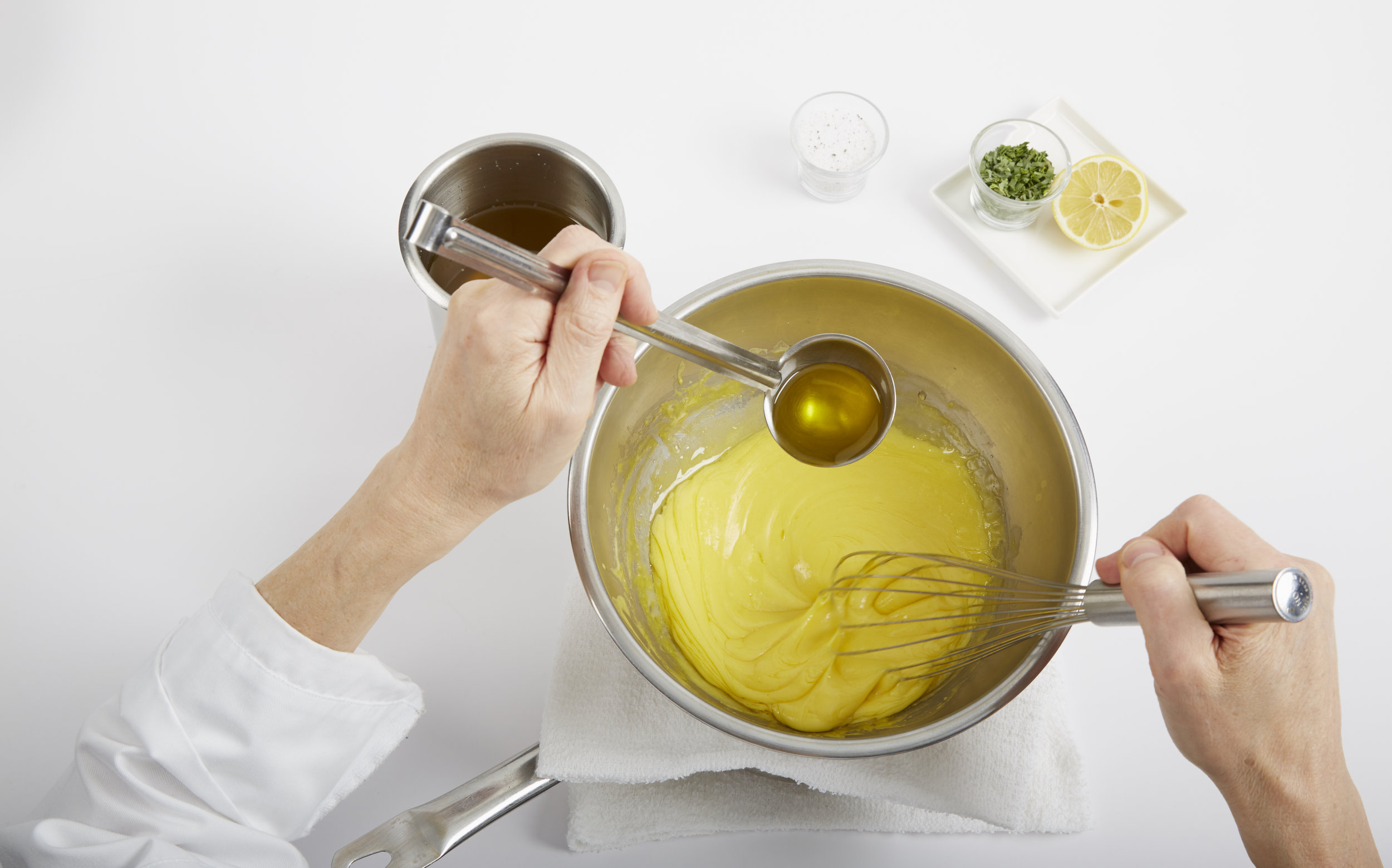
Begin by adding fat literally drop by single drop while whisking with high-frequency kinetic energy. Your physical goal is droplet fragmentation. A whisk moving across the bowl must physically tear the fat stream into sub-microscopic droplets. Once you have established a dense, stable foundation of billions of shielded spheres, the viscosity of the base rises dramatically. This increased thickness resists rapid fluid movement, which in turn helps pull subsequent additions of fat into fine droplets with far less physical effort.
Match the Viscosity Before Introducing the Bulk of the Fat
One of the quietest reasons pan sauces and mayonnaise fail is a viscosity mismatch between the base and the incoming fat. If you attempt to whisk melted, watery butter into cold, stiff egg yolks, the sheer disparity in flow resistance prevents clean shear. The whisk pushes the heavy yolk around in clumps while the liquid fat glides harmlessly over the top, never experiencing the tearing force required to form droplets.
Your water base must have enough mobility to accept the fat while remaining thick enough to provide drag against the whisk wires. Whisk your egg yolks with an initial splash of acid, water, or wine reduction until the mixture expands, lightens in color, and forms faint ribbons. This slight pre-aeration and dilution creates the optimal fluid resistance, ensuring that every stroke of the whisk creates high shear stress along the boundary where fat meets water.
Respect the Thermal Danger Zone That Destroys Protein Networks
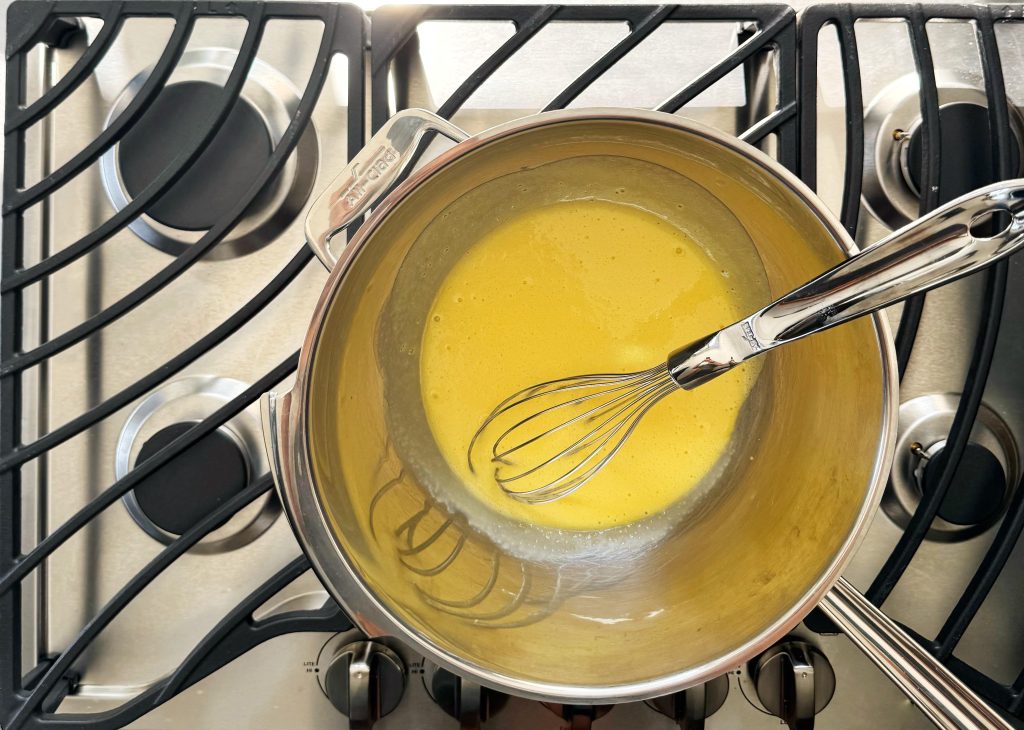
Warm emulsions like hollandaise and béarnaise require a delicate dance with egg yolk protein denaturation, where thermal shock breaks the delicate structural balance governed by emulsion sauce mechanics. Egg yolk proteins must unfold partially to create a resilient web that thickens the sauce and holds the fat in place. This controlled denaturation occurs between 145°F and 150°F (63°C to 65°C).
If the temperature climbs beyond 160°F (71°C), the proteins cross-link aggressively into tight, rigid aggregates. When this occurs, the proteins squeeze out their trapped water, exactly like a wrung-out sponge, and expel the fat droplets they were tasked with protecting. The sauce curdle-breaks, leaving rubbery flecks of scrambled yolk floating in yellow butter oil. Conversely, if the temperature drops below 115°F (46°C), the butterfat begins to crystallize into solid, jagged fat shards. These solid fat crystals slice straight through the delicate surfactant membranes, causing the entire liquid matrix to collapse.
Anchor the Volume With Adequate Continuous Phase Liquid
There is a mathematical ceiling to how much fat a specific volume of water can hold, a concept known in physical chemistry as the maximum close-packing limit of spheres. If you imagine fat droplets as microscopic marbles packed inside a jar, they naturally fill approximately 74 percent of the total available volume. Once the fat content crosses this threshold, the droplets press against each other so tightly that they deform and burst their protective membranes, causing immediate phase inversion where the sauce flips inside out and dumps all its oil.
A single large egg yolk contains roughly two to three tablespoons of water and enough lecithin to emulsify gallons of oil in theory. But in practice, you must maintain at least one teaspoon of continuous water-based liquid for every half-cup of fat introduced. If your hollandaise or mayonnaise becomes stubbornly stiff, chalky, and unyielding as you add fat, it is crying out for hydration. Whisk in a teaspoon of warm water or lemon juice immediately. You will watch the sauce loosen, regain its glossy sheen, and instantly restore the structural breathing room required to accept more fat safely.
The Mechanical Fix for Salvaging a Broken Sauce
Even seasoned professionals occasionally push an emulsion too far, misjudging the heat of a pan or dumping oil too quickly during a rush. Diagnosing and salvaging a broken batch is the ultimate proving ground for your understanding of emulsion sauce mechanics. Panicking and throwing the sauce in the trash is an admission of ignorance; an emulsion is merely disorganized matter, and it can be mechanically reorganized.
First, identify why it broke. If the bottom of your pan shows scrambled egg solids, the proteins overheated. Strain the mixture through a fine-mesh sieve into a clean bowl to remove the curdled debris, leaving the warm butter and water behind. If the sauce separated into clear oil without curdling, it either suffered from catastrophic phase inversion due to lack of water, or the fat was added faster than the shear force could disperse it.
To rebuild the structure, start clean in a fresh, warm bowl. Add one teaspoon of water, lemon juice, or a fresh egg yolk. Take your broken mixture and treat it as pure fat. Whisking vigorously, dribble the broken liquid into the new base drop by drop. Much like the discipline explained in our breakdown of Asset allocation rebalancing mechanics and 4 proven rules to protect portfolio wealth, culinary balance demands constant risk mitigation before a structural collapse occurs. By introducing the broken sauce slowly into a fresh continuous phase, the existing emulsifiers and water instantly reconstitute the protective surfactant shell, turning a ruined prep into a flawless, velvety finish within ninety seconds.
Culinary Intuition Born From Molecular Discipline
Cooking is often romanticized as an ephemeral, mystical craft guided purely by ancestral feeling and creative passion. Yet the cooks who work with the deepest freedom are invariably those who respect the cold, unyielding physical laws governing their raw materials. When you recognize that a pan sauce is not a soup but a dynamic fluid suspension, your hands adjust their speed naturally, your ears register the subtle change in the whisk’s splashing sound, and your eyes catch the faint matte texture that warns of an impending split.
Internalizing core emulsion sauce mechanics transforms culinary anxiety into instinctual command. You no longer fear the high-stakes table sauces that intimidate so many home kitchens. You know how much kinetic force to apply, how much heat the proteins can withstand, and precisely how much moisture is required to keep trillions of energetic droplets suspended in perfect harmony. Cooking ceases to be a gamble; it becomes a deliberate, repeatable triumph of everyday physics.