Tennis topspin mechanics and 4 proven rules to generate devastating baseline power
Unravel the aerodynamic physics and kinetic chain sequencing behind heavy topspin. Learn how racquet head acceleration and forward tilt transform wild swings into dipping, explosive baseline weapons.

Mastering modern tennis topspin mechanics represents the single greatest inflection point between tentative baseline rallies and suffocating, court-tilting dominance. Watch any elite baseliner unleash a forehand from three feet behind the baseline, and you witness a shot that defies intuitive geometry. The racquet moves violently upward, imparting brutal forward rotation that causes the ball to clear the net by several feet before plunging abruptly inside the opposite baseline. To the uninitiated, swinging harder should send the ball soaring into the back fence. Yet in high-performance tennis, velocity creates its own security.
The secret lies in the marriage between physical laws and human anatomy. A ball rotating forward at three thousand revolutions per minute interacts with surrounding air in ways that actively force it toward the court surface. Understanding tennis topspin mechanics requires looking past visual aesthetics into fluid dynamics. It demands examining how microsecond collisions between synthetic strings and fuzzy felt generate the rotational torque necessary to bend trajectories at will.
The invisible fluid dynamics pulling the ball downward
When a tennis ball travels through the atmosphere without spin, airflow splits symmetrically around its curved profile, creating balanced friction and a predictable ballistic arc governed primarily by gravity. Once high-rate forward rotation enters the equation, that symmetry dissolves. As the top surface of the ball spins forward in the direction of flight, it opposes the oncoming air stream, slowing the boundary layer and generating a pocket of high pressure. Simultaneously, the bottom surface spins backward away from the incoming air, pulling the airstream smoothly underneath and creating a localized low-pressure zone.
This pressure differential produces a downward aerodynamic force known as the Magnus effect. Just as pitchers harness aerodynamic spin in baseball curveball mechanics and 4 proven rules to throw devastating unhittable breaks, a tennis player uses forward rotation to bend the projectile’s trajectory mid-air. According to fundamental aerodynamic lift and Magnus effect research documented by NASA Glenn Research Center, spinning cylinders and spheres experience transverse forces directly proportional to their rotational velocity and the density of the fluid medium. The faster the ball spins, the more violent the downward plunge.
Furthermore, the fuzzy felt of a tennis ball plays an indispensable role. Unlike smooth ping pong balls or polished cricket balls, the felt exterior amplifies boundary layer separation. The rough fibers trap microscopic pockets of air, dragging them around the rotating perimeter and intensifying the Magnus force. This aerodynamic dive gives players the structural safety margin to swing with uninhibited racquet head speed.
The anatomical kinetic chain driving modern stroke production
Novice players often assume heavy spin originates in the wrist, visualizing a frantic rolling action over the top of the ball. In reality, attempting to muscle spin out of small forearm tendons leads directly to chronic medial epicondylitis and weak, fluttering shots. At the core of functional tennis topspin mechanics lies the kinetic chain, a multi-joint sequence that transfers energy upward from the court surface through the core and out into the racquet frame.
The sequence begins with the lower body loading. In a semi-open or open stance, the player drives their dominant leg into the court, storing elastic energy in the quadriceps and glutes. As the uncoiling initiates, the hips rotate forward toward the target, followed in rapid succession by the torso and shoulder axis. This rotational torque leaves the hitting arm trailing behind the body in a state of extreme passive lag.
Because the racquet trails the hand, the wrist enters a position of natural extension without tension. When the shoulder finally whips forward, the arm behaves like a multi-segmented whip. The elbow extends, the forearm initiates internal rotation, and the racquet head accelerates through an upward vertical trajectory. The impact lasts merely four to five milliseconds. In that brief window, no conscious human reflex can adjust the racquet face; the entire mechanical outcome is predetermined by the precision of the kinetic chain leading up to contact.
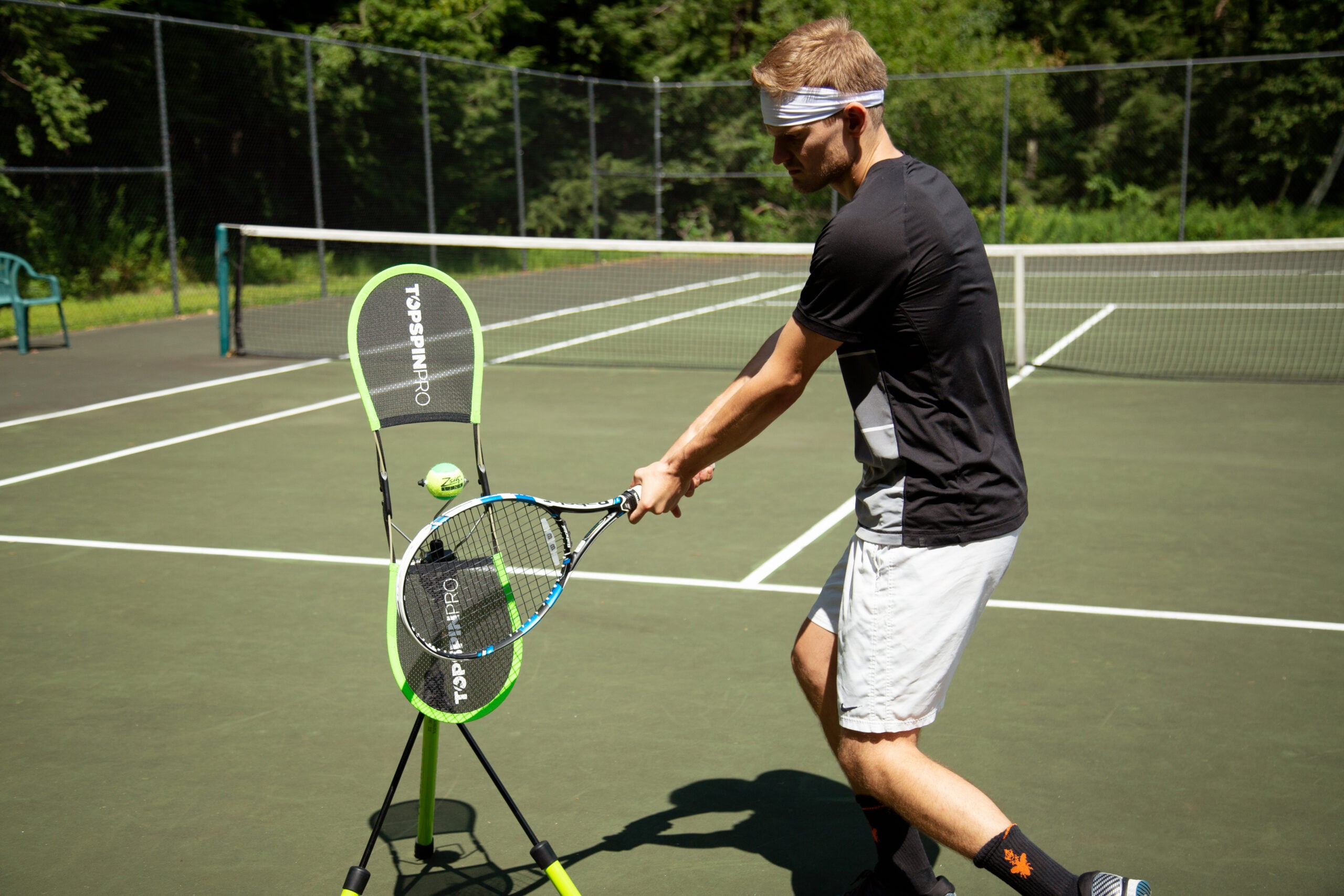
Four proven rules that transform swing speed into violent dip
Harnessing rotational physics requires translating biomechanical concepts into repeatable court behaviors. Executing these four principles anchors tennis topspin mechanics in muscle memory rather than erratic guesswork.
Maintain a disciplined closed racquet face during the drop phase
Before accelerating forward, the racquet must drop below the intended contact point. The fatal flaw of intermediate players during this unit turn is keeping the strings vertical or slightly open toward the back fence during the backswing. When the racquet drops below the ball, the hitting face must tilt downward toward the court surface at an angle between fifty and sixty degrees. This closed orientation guarantees that as the arm violently rises toward the ball, the string bed arrives perpendicular to the target at the exact moment of impact. If the face remains open during the drop, the player must artificially twist their wrist during the forward swing to avoid launching the ball into the stands, destroying swing path consistency and bleeding speed.
Drive the swing path on an aggressive low to high trajectory
Topspin cannot exist without vertical racquet movement. To impart forward rotation, the racquet head must travel along an inclined plane, rising steeply from beneath the ball to well above it. Elite ball-strikers routinely drop their racquet frame twelve to eighteen inches below the incoming ball height before contact. As the kinetic chain fires, the racquet ascends steeply through the hitting zone, brushing across the rear equator of the ball. This tangential friction converts forward kinetic energy into rotational momentum. A shallow swing path produces flat trajectory with minimal RPM; a steep vertical vector generates the heavy, looping arc that arches over the net and bites viciously into the baseline clay or hardcourt.
Exploit the lag and snap of forearm pronation through contact
The traditional coaching adage to roll your wrist over the ball has wrecked countless forehands. The wrist joint does not flap vertically over the ball at contact. Instead, the whipping sensation comes from dynamic forearm pronation combined with internal shoulder rotation. As the racquet head meets the ball, the forearm rotates naturally outward to inward, allowing the outer edge of the frame to bypass the hand after impact. Modern smooth polyester strings complement this motion through what physics defines as string bed snapback. Under high vertical friction, the main strings displace sideways across the cross strings and snap back into position in milliseconds, transferring extraordinary angular velocity to the ball.
Commit to high racquet head velocity across the forward finish
Topspin requires unwavering conviction. Paradoxically, the slower a player swings, the less spin they generate, and the more likely the ball is to sail long due to an elevated launch angle without aerodynamic Magnus pull. Generating heavy rotation requires tremendous racquet head acceleration precisely through the contact window. The stroke must never decelerate at the point of impact. The follow-through must extend fluidly across the torso, wrapping around the opposite shoulder or catching over the opposite hip on acute angle shots. Deceleration collapses the kinetic chain, causing the racquet face to flutter and reducing the rotational RPM necessary to pull the ball back into the court.
Common technical breakdowns that kill topspin efficiency
When players misunderstand tennis topspin mechanics, they frequently commit one of several mechanical errors that gut their power and control. The most prevalent error is arming the ball, relying solely on shoulder abduction and biceps flexion while leaving the hips and legs idle. Without ground force reaction and hip rotation, racquet acceleration plummets, forcing the player to hit flat pushes or thin, powerless slices that sit up invitingly in the center of the opponent’s court.
Another pervasive breakdown is contacting the ball too close to the torso or excessively late behind the hip line. For maximum topspin efficiency, contact must occur several inches in front of the forward hip. Late contact restricts forearm pronation, freezes the racquet head trajectory, and forces the wrist into awkward extension. Additionally, many recreational competitors choke their grip with excessive tension. Grip pressure should hover around a three or four on a scale of ten. Tension acts as an energy brake; a relaxed forearm allows the racquet to lag freely during the drop and whip through contact with unrestrained centrifugal force.
Strategic application and dominating the baseline battleground
Transforming mechanical precision into competitive dominance requires appreciating how topspin alters the spatial geometry of a tennis court. Flat shots travel low over the net and skid upon impact, offering opponents predictable rebound trajectories at comfortable waist height. In contrast, a ball infused with three thousand RPM of forward spin behaves like an explosive device upon touching the court surface. The forward spin bites into the surface friction, converting rotational energy into a steep upward and forward eruption.
This violent rebound pushes opponents back three to six feet behind the baseline, forcing them to strike balls at awkward shoulder height where generating offensive power is biomechanically inefficient. Furthermore, heavy topspin expands the usable angles of the court. Because the Magnus effect pulls the ball downward rapidly, players can aim sharply crosscourt, dragging rivals completely off the doubles alley while clearing the high outside edges of the net with immense safety.
Ultimately, refined tennis topspin mechanics allow aggressive players to swing at maximum velocity while expanding their margin for error. Rather than playing defense against gravity, the modern baseliner commands the atmosphere itself, turning air pressure into an unyielding ally that keeps the hardest-struck balls locked within the boundary lines.