Foley sound design mechanics and 4 proven secrets behind iconic movie realism
Cinematic realism rarely happens on set. Discover the physical acoustic techniques and studio secrets that master Foley artists use to make the unreal feel profoundly believable.
Mastering Foley sound design mechanics gives cinematic storytellers the uncanny power to transform everyday tactile friction into spellbinding acoustic reality. When an audience watches a lone wanderer cross a frozen landscape or winces at the bone-crunching impact of a tavern brawl, they assume the camera captured those sensations live. The reality is far stranger. Production microphones on a film set are engineered to isolate spoken dialogue while rejecting ambient noise. The crunch of boots, the slide of a katana from a wooden sheath, the wet patter of rain against an oilskin coat, and the delicate rustle of a silk gown are entirely absent from the raw shoot.
Those missing textures are reborn on a specialized soundstage. Dedicated performers stand in dark rooms watched by directional microphones, timing every footfall, clink, and brush to the projected moving image. Named after pioneer Jack Foley, this discipline blends athletic precision with acoustic illusion. It is a world where dry pasta conveys fracturing bones and a rusted metal folding chair produces the screech of opening dungeon gates. To appreciate cinema at its most visceral layer, one must explore the physical and psychoacoustic systems operating behind the microphone.
The Acoustic Architecture of Cinematic Illusion
When examining Foley sound design mechanics, we realize that a motion picture without post-production footsteps and movement feels eerily hollow. Human perception relies heavily on cross-modal sensory confirmation. When our eyes register a heavy leather boot striking wet flagstones, our neural pathways anticipate a dense, low-frequency thud coupled with a bright, liquid splash. If that auditory feedback is missing or arrives late by even two frames, the brain rejects the image as flat theatrical fabrication.
Location audio simply cannot capture these micro-events cleanly. Set microphones point strictly at actor mouths, hovering overhead on carbon-fiber booms. Any shoe scrape or hand gesture captured on set arrives contaminated by room echo, camera dollies, generator hum, and crew shuffling. Modern post-production teams strip the location track down to isolated vocal frequencies using spectral repair algorithms. This clinical cleaning leaves behind an acoustic vacuum that demands reconstruction from scratch.
Foley artists rebuild that sonic reality note by note. Unlike library sound effects, which editors drop into timelines as static wave files, Foley tracks are performed live. The artist breathes with the onscreen actor, matching the hesitation in a stride, the nervous tremor in a hand touching a doorknob, and the aggressive shift in weight during an argument. This kinetic synchronization creates an unbroken sensory tether between the audience and the image.
The Sensory Deception Inside the Recording Studio
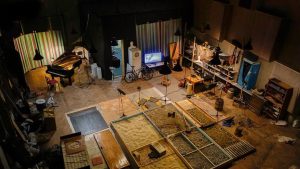
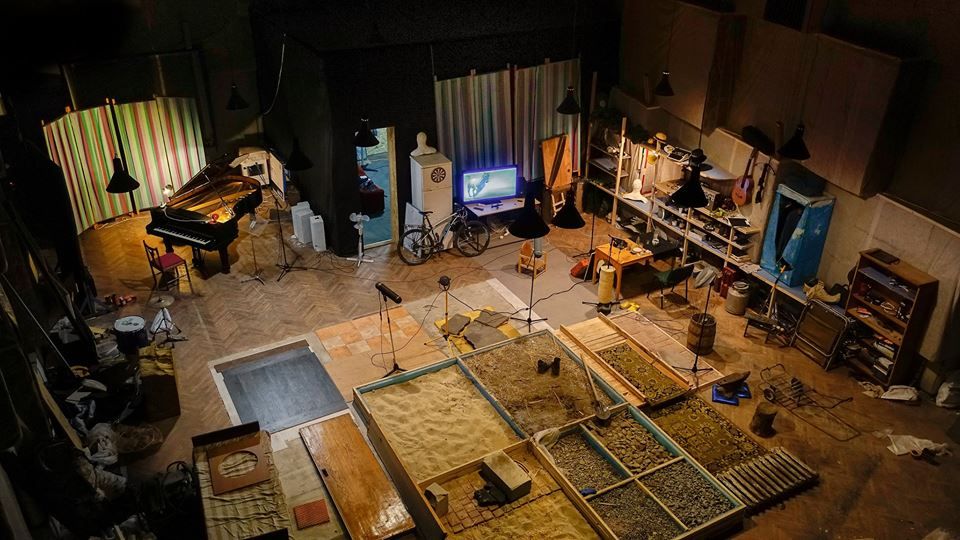
Step onto an authentic scoring and Foley stage, and the environment resembles an eccentric junkyard crossed with an acoustic laboratory. The floor is subdivided into distinct architectural pits filled with river gravel, loose limestone gravel, pine needles, red clay, splintered wood flooring, and poured concrete slabs. Prop racks line the perimeter, where Foley sound design mechanics transform ordinary domestic debris into high-stakes drama.
Foley performers do not search for the actual object seen on screen; they hunt for objects that convey the acoustic *truth* of what the audience imagines. A vintage telephone on screen may feature lightweight plastic components, but narrative tension demands that hanging it up sounds definitive, heavy, and angry. The artist might slam an iron horseshoe against a slate tile to produce the dramatic finality the scene requires.
Footwear serves as the primary instrument for any working Foley performer. A seasoned artist maintains a massive collection of shoes, from worn leather work boots and ballet slippers to stiff high heels with custom steel shanks. The shoe must match not only the actor’s onscreen silhouette but also their physical posture, age, and emotional state. A character paralyzed by dread walks with a dragging heel; a predator moves on balls of feet with zero heel impact.
Four Proven Secrets That Elevate Foley Artistry Above Ordinary Audio
Creating believable bespoke audio requires navigating psychoacoustics, materials science, and narrative dramaturgy. Elite Foley stages rely on practical techniques developed through decades of analog trial and error.
Hyperbolic Texturing Replaces Literal Realism
The first breakthrough in Foley sound design mechanics rests on the psychological phenomenon that natural physical events sound underwhelming when recorded cleanly. Real human bones breaking sound muffled, soft, and rubbery, largely muffled by surrounding muscle tissue and fluid. If a sound designer duplicated reality faithfully, a brutal fight sequence would lose its narrative punch.
Artists turn to hyperbolic texturing. To manufacture the sound of a catastrophic bone fracture, a performer crushes a bundle of stalky celery wrapped in wet chamois leather directly into an ultra-sensitive condenser microphone. The celery delivers the sharp, brittle snap of splintering calcified tissue, while the damp leather yields the wet, squelching resistance of torn flesh. The combination feels horrifically authentic to human ears precisely because it exaggerates acoustic details that real ears would miss from ten feet away.
Dynamic Acoustic Perspective Establishes Depth and Distance
Sound exists in three physical dimensions, and a flat recording immediately destroys the illusion of cinematic space. A microphone placed three inches from a leather belt produces an intimate, dry rasp rich in high-frequency transients and exaggerated proximity effect. That same movement recorded from twelve feet away in a live room captures natural air absorption and room boundary reflections.
Master Foley teams never adjust volume sliders in digital audio workstations to simulate distance. Instead, the artist and the boom engineer manipulate physical proximity. When a character recedes into the background of a cavernous hallway, the Foley walker physically steps back from the microphone while altering their attack. This captures the true frequency curve of distance, where high-frequency air dampening occurs naturally according to physical laws documented in the Audio Engineering Society technical archives.
Weight and Micro-Movement Convey Subconscious Character Psychology
A footstep is never merely a form of human locomotion; it is a direct window into dramatic temperament. Human beings alter their center of gravity, cadence, and toe strike based on anxiety, fatigue, confidence, and deceit, which explains why sophisticated Foley sound design mechanics focus so intensely on tempo and downforce.
Consider how tension builds in sports broadcasting when sudden momentum swings throw defensive plans into chaos. Similar narrative momentum shifts appear across competitive fields, much like the high-stakes tactical friction outlined in Chargers Schedule Shifts Reveal 4 Critical Clashes Rattling AFC West Fans, where subtle environmental and structural adaptations alter emotional expectations. In cinema sound, a Foley artist reflects this psychological instability through minute micro-movements: dragging a sole across gravel a millisecond longer, applying disproportionate pressure on an exterior heel strike, or allowing a leather jacket sleeve to brush violently against a torso during a sudden turn.
The Organic Imperfection Principle Outperforms Digital Presets
Commercial sound libraries contain hundreds of thousands of pre-recorded footsteps and door latches. Yet, when an editor populates a long scene using repeated digital clips, the human ear detects the repetition almost instantly. This subconscious revulsion is known in sound engineering as the machine-gun effect.
Human movement is governed by chaotic micro-variations. No two steps on snow ever sound identical because each step crushes a unique configuration of ice crystals, alters foot angle, and compacts different depths of slush. Foley artists exploit this organic imperfection by performing long, continuous passes without stopping. Their own physical fatigue, slight shifts in posture, and unpredictable friction between clothing fabrics inject authentic physical entropy into the audio track. The subconscious mind accepts this natural chaos without question.
Acoustic Physics and Spatial Calibration on the Soundstage
Applying these Foley sound design mechanics in a studio requires tailored acoustic treatment that differs sharply from traditional music spaces. A music studio often aims for pleasant natural reverberation. A Foley stage, conversely, demands extreme acoustic dryness paired with absolute isolation from environmental vibration.
The ambient noise floor of a world-class Foley room must dip below 15 dBA. Because artists frequently record delicate micro-events—like the blink of an eye, the slide of a finger across paper, or a tear dropping onto silk—the microphone preamplifiers must offer immense clean gain without introducing electronic hiss. Engineers position matched pairs of shotgun microphones and large-diaphragm condenser mics to capture both the directional impact and the ambient air mass surrounding the performer.
Surfaces are meticulously maintained. Gravel pits must be watered periodically to prevent dusty chalk clouds that clog microphone diaphragms and alter acoustic resonance. Water tanks must feature variable depths and sloping edges to prevent artificial standing waves from coloring aquatic sloshes. The entire stage functions as an instrument that responds dynamically to the performer’s body weight.
The Enduring Power of Tactile Human Performance
As computational image generation and algorithmic digital synthesis expand production pipelines, Foley sound design mechanics preserve the fragile bridge between human physical experience and cinema. While artificial intelligence can assemble mathematical approximations of impact, it cannot feel the emotional pulse of a dramatic performance.
The magic of the soundstage endures because it is fundamentally grounded in human empathy. A Foley artist watches an actor’s eyes on a screen, breathes in time with their chest, and channels raw narrative tension through their own hands, shoes, and props. Through this relentless physical dedication, simple objects—a rusted hinge, a damp cloth, a pair of worn leather boots—continue to craft the unseen foundation of cinematic wonder.