Emulsion sauce mechanics and 4 proven rules that guarantee breathtaking silky texture
Uncover the real science behind keeping fat and water permanently united in the pan. These four core rules demystify culinary physics so you never break hollandaise, vinaigrette, or mayonnaise again.
Mastering emulsion sauce mechanics separates amateur home cooks from seasoned culinary professionals whose sauces drape over a spoon like liquid velvet. Every sauce, from an unctuous béarnaise and glossy hollandaise to a thick garlicky aioli or delicate pan emulsion, relies on an improbable chemical truce between mortal enemies: fat and water. Left alone in a bowl, oil and vinegar or melted butter and citrus juice will furiously partition themselves within seconds. The lipid molecules float, the aqueous liquid sinks, and what should have been a luxurious sauce collapses into an unpalatable, greasy puddle.
Creating a permanent emulsion is never a matter of frantic arm workouts or muttering superstitious kitchen folklore about dripping oil drop by drop for an eternity. It is a rigorous exercise in kinetic physics, interfacial tension, and surfactant chemistry. When you understand the invisible forces holding billions of microscopic fat droplets suspended inside a continuous aqueous phase, your fear of split sauces disappears entirely. You stop guessing over a double boiler and start controlling fluid behavior with calm, repeatable precision.
Why Fat and Water Fight Every Microscopic Step of the Way
To tame any emulsion, you must first respect the profound thermodynamic hostility between polar and nonpolar substances. Delving into emulsion sauce mechanics reveals that water molecules form tight clusters bonded by hydrogen networks, actively repelling nonpolar lipid chains. Water molecules are intensely social; their positive and negative poles attract neighboring water molecules with tremendous force. Lipids, composed of neutral hydrocarbon chains, possess no such polarity. When you pour fat into water, the water molecules squeeze the oil out of the way so they can bond with each other, forcing the oil droplets to coalesce and float upward due to lower density.
Thermodynamics dictates that physical systems relentlessly seek their lowest energy state. A single large pool of oil floating atop water has far less surface area, and therefore significantly lower thermodynamic free energy, than billions of tiny oil droplets dispersed throughout that same liquid. When an overpowering physical force enters an established environment, it inevitably upsets traditional structural balance. Much like the seismic organizational disruption highlighted in Victor Wembanyama Sparks 5 Major Shockwaves in Historic NBA GM Survey, forcing two diametrically opposed phases to coexist without adequate support causes immediate, chaotic breakdown.
To keep fat suspended inside liquid without separating, you must introduce mechanical energy to break the oil into microscopic spheres, and you must deploy surfactants—chemical peacekeepers known as emulsifiers—that coat each droplet and prevent them from snapping back together.
Essential Principles for Taming Dispersed Droplets
A rigorous command of emulsion sauce mechanics demands an understanding of four interdependent culinary fundamentals. Skip any single step, and your sauce quickly destabilizes into a broken, curdled mess.
Rule 1 Establish Your Continuous Phase Before Adding Pure Fat
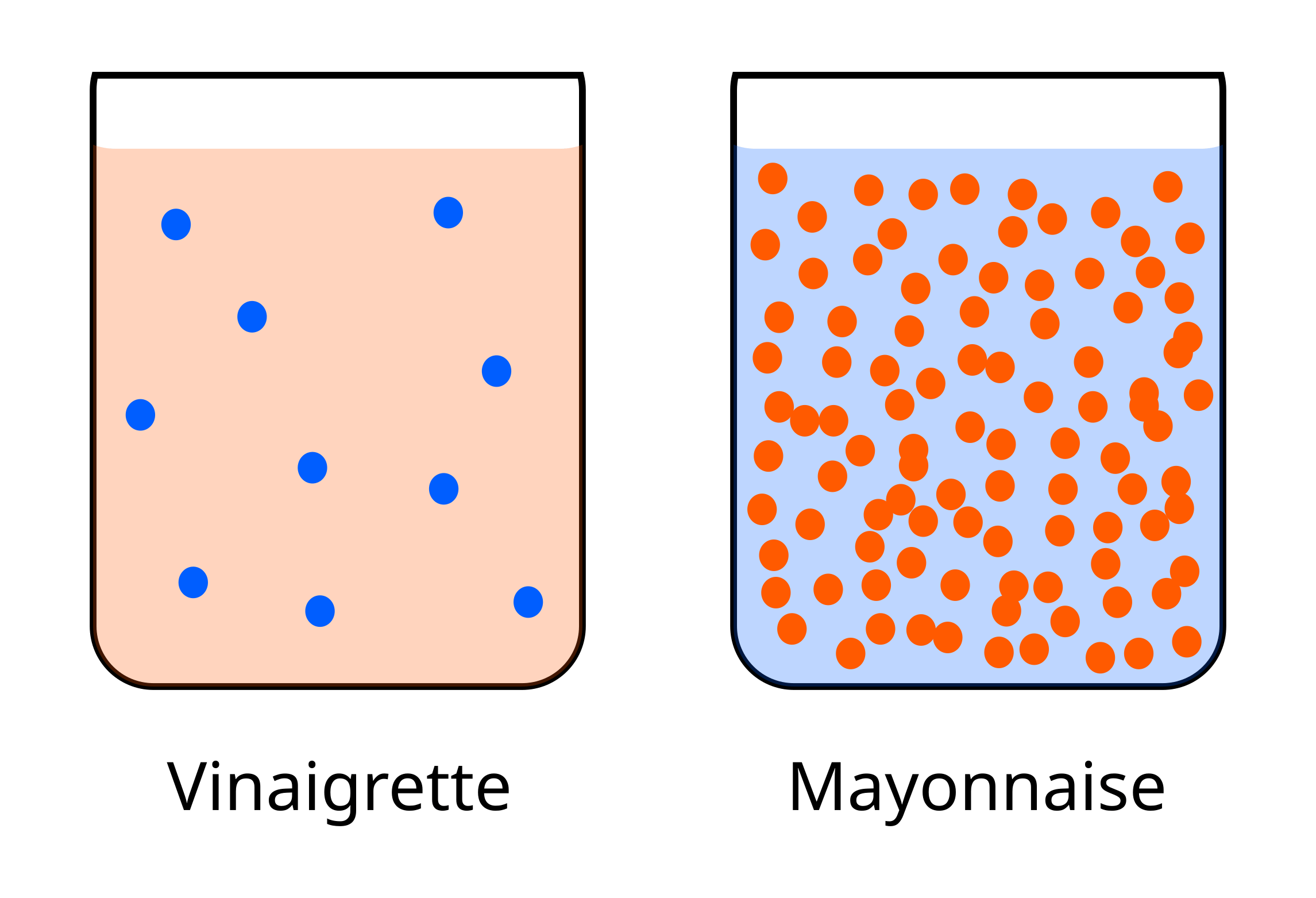
Every culinary emulsion consists of two phases: the dispersed phase (the liquid broken into microscopic droplets) and the continuous phase (the liquid that cushions and surrounds those droplets). In culinary staples like mayonnaise, vinaigrettes, and hollandaise, water forms the continuous phase, while lipid forms the dispersed phase. The gravest error cooks make is dumping fat into the bowl before properly building and stabilizing the continuous water-based base.
Your continuous base—whether it is lemon juice, vinegar, wine reduction, or pure water—must also contain your active surfactants before oil ever hits the bowl. According to research demonstrated by the Harvard University Science and Cooking Program, surface-active molecules such as the lecithin found in egg yolks possess an amphiphilic architecture: a hydrophilic (water-loving) head and a lipophilic (fat-loving) tail. By vigorously whisking your continuous phase alongside egg yolk or mustard first, you hydrate these surfactant molecules, orienting them so they stand ready to wrap around incoming fat droplets the microsecond they are sheared into existence. Starting with too little water starves the continuous phase, guaranteeing early saturation and imminent structural collapse.
Rule 2 Respect Temperature Windows to Protect Fragile Surfactants
Temperature controls the fluidity of your fats and the structural viability of your emulsifying proteins. Work too cold, and solid fats will crystallize into rigid structures that rupture surfactant films. Work too hot, and the very proteins keeping your droplets separate will denature and seize into scrambled lumps.
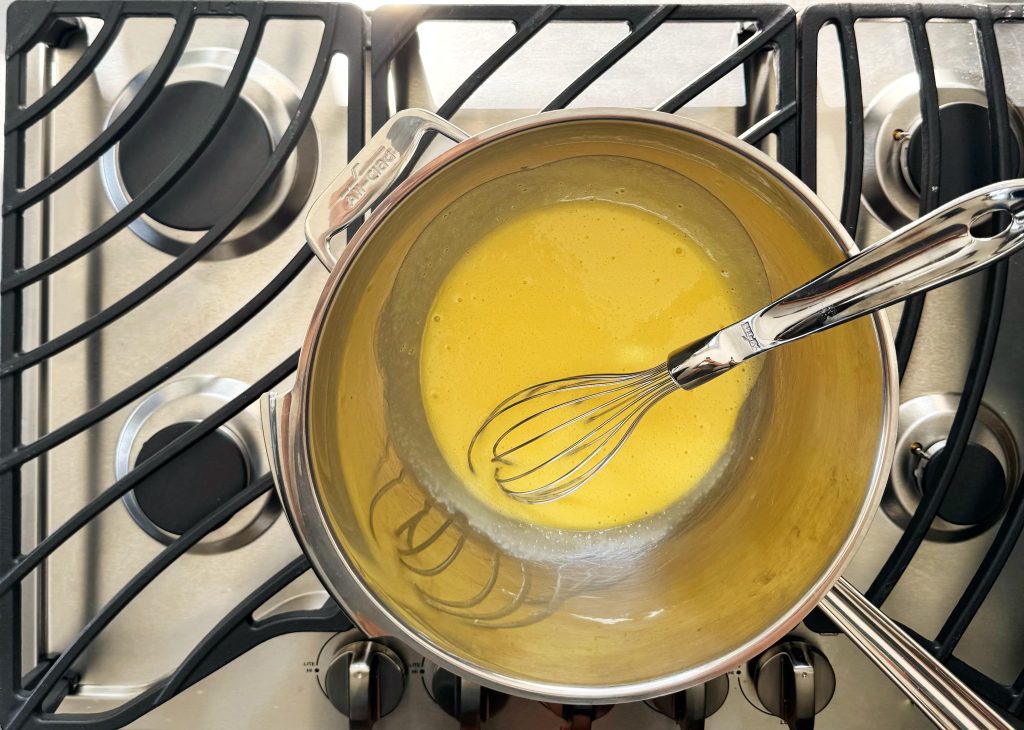
For butter-based warm emulsions like hollandaise and béarnaise, your operational zone sits strictly between 125°F and 145°F (52°C to 63°C). Butter fat stays fully molten and fluid down to roughly 110°F, while egg yolk proteins begin irreversible thermal denaturation around 150°F. If you expose your sabayon base to intense, direct pan heat, the yolk proteins cross-link into tight coagulated masses, expelling the water they once held and releasing trapped butter droplets to pool as liquid grease. Conversely, allowing a hollandaise to cool below 115°F causes clarified butter fat to nucleate into crystalline needles, physically shredding the micelle barriers. Regulate pan temperature by frequently pulling your bowl off the steam bath, using residual thermal inertia rather than aggressive direct stove heat.
Rule 3 Apply High Mechanical Shear to Shatter Droplet Diameters
Emulsifiers cannot do their job unless you physically crush the fat into unimaginably tiny droplets. When you pour oil in a lazy stream and stir idly with a fork, droplets remain large, buoyant, and prone to rapid coalescence. To build an impenetrable suspension, you must apply shear stress—the mechanical tearing force generated when two opposing layers of fluid slide past one another at high velocity.
Modern emulsion sauce mechanics proves that the smaller your droplets, the more viscous and velvety your finished sauce feels on the tongue. When oil droplets are sheared down to diameters below five microns, Brownian motion—the random thermal bombardment of surrounding water molecules—overpowers gravity, preventing fat from floating to the surface. An immersion blender or high-speed food processor generates monumental shear rates, tearing oil into billions of sub-micron spheres in a fraction of a second. If whisking by hand, ditch the gentle circular swirl; instead, whip side-to-side in an aggressive zigzag pattern across the bowl, driving maximum kinetic turbulence through the center of the mixture.
Rule 4 Monitor Viscosity Ratios to Prevent Catastrophic Inversion
There is a hard mathematical limit to how much oil a fixed volume of water can hold. As you incorporate more fat, the microscopic spheres become packed closer and closer together, grinding against one another and turning a runny liquid into a stiff, spoonable gel. However, once fat droplets occupy more than roughly 74% of the total emulsion volume, they hit maximum close packing. Beyond this threshold, droplets can no longer squeeze past each other without bursting their protective surfactant coats.
When this happens, the sauce suffers catastrophic phase inversion: the oil merges into a continuous ocean, and water gets trapped inside tiny dispersed droplets. Your lush mayonnaise suddenly turns into translucent, oily slop. The preventative measure is shockingly simple. As your sauce thickens toward that dangerous threshold, thin it by whisking in a few drops of water, lemon juice, or cream. Replenishing the continuous phase expands the fluid buffer between droplets, instantly lowering tension and restoring the capacity to absorb further fat.
Emergency Rescues for Broken Kitchen Sauces
A broken sauce is not ruined food; it is merely an unorganized system waiting for correct realignment. When your sauce splits into an oily greasy mess, applying emulsion sauce mechanics allows you to reconstruct the suspension from scratch rather than throwing away expensive ingredients.
The secret to reviving a broken hollandaise, mayonnaise, or vinaigrette is establishing a fresh, tiny continuous phase in a clean bowl. Whisk one tablespoon of water, lemon juice, or an additional fresh egg yolk until frothy. Then, treat your entire broken sauce—oil, herbs, and collapsed liquids alike—as if it were raw oil. Drizzle the broken mixture into the new base drop by drop while whisking with relentless vigor. The fresh surfactants and pristine continuous liquid instantly grab the incoming sheared fat, building a new, resilient matrix that effortlessly swallows the old, fractured sauce.
For cold vinaigrettes that have separated in the refrigerator, gentle heat and a single teaspoon of Dijon mustard or warm honey can act as an instant bridge. Mustard contains mucilage—natural polysaccharide complexes that dramatically thicken the water phase, slowing droplet migration and locking the oil in place for days.
The Unrivaled Sensory Architecture of Perfect Emulsions
The culinary magic unlocked by emulsion sauce mechanics goes far beyond mere structural stability; it fundamentally transforms flavor delivery. When fat is broken into billions of microscopic droplets, its collective surface area increases by several orders of magnitude. Every millimeter of your tongue encounters a balanced blend of lipid richness and water-soluble acidity at the exact same instant.
In an un-emulsified pan dressing, you experience alternating waves of sharp, searing acid followed by a greasy coating of fat that numbs your taste buds. In a balanced emulsion, however, fat softens the aggressive edge of acetic or citric acid without muting its brightness. Meanwhile, fat-soluble aroma compounds—from toasted black pepper in a cacio e pepe to tarragon leaves steeped in warm wine vinegar—are released slowly as the body heat of your mouth warms the emulsion and melts the lipid spheres.
Once you internalize emulsion sauce mechanics as an intuitive physical system rather than a superstitious recipe ritual, you gain complete freedom at the stove. You no longer follow recipes out of anxiety; you read the gloss, weight, and movement of your sauce in real time, steering delicate culinary chemistry toward absolute perfection.