Swimming Catch Mechanics and 4 Proven Rules That Build Devastating Underwater Power
Water is eight hundred times denser than air, yet most swimmers slip right through it without generating real grip. Discover how mastering the early vertical forearm catch unlocks effortless, elite propulsion.
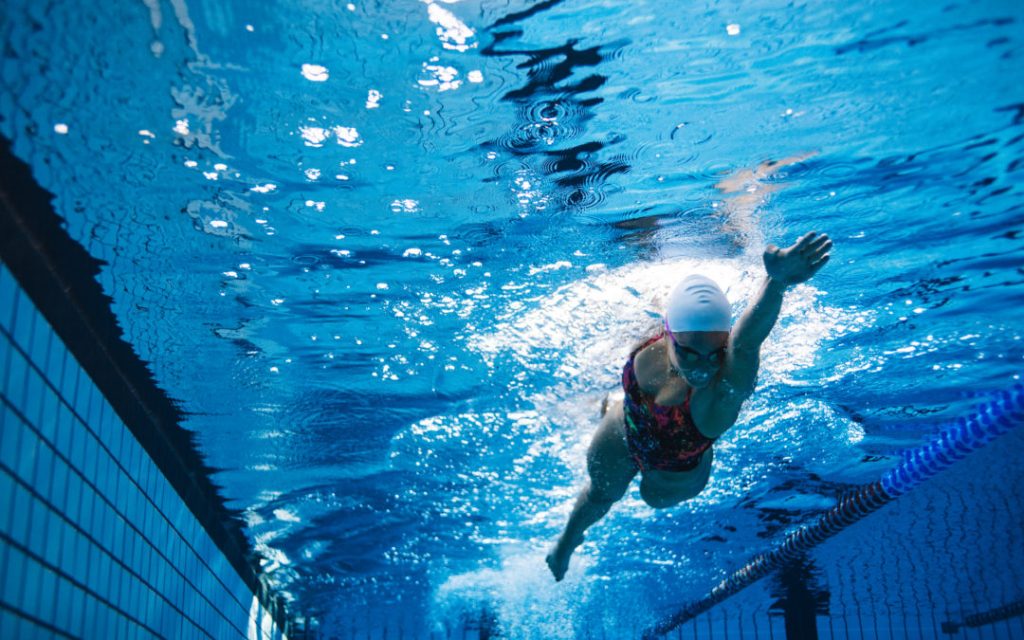
Mastering swimming catch mechanics transforms how an athlete moves through water, converting an exhausting, churning fight against resistance into pure, forward gliding velocity. Water is roughly eight hundred times denser than air. When a swimmer reaches forward at full extension, that density either feels like a frictionless surface slipping right through frantic fingers or like solid wet concrete waiting to be climbed. Most swimmers spend years thrashing their limbs faster, mistakenly believing that cadence alone dictates speed. In reality, propulsion in liquid is an exercise in grip. If the hand and forearm fail to establish purchase on the water during the initial milliseconds of the stroke, every ounce of muscular effort expended afterward is wasted turbulent churn.
The catch is not an entry; it is a decisive structural setup. It is the precise bridge where passive recovery ends and dynamic propulsion begins. When executed properly, the swimmer ceases dragging their hand backward through the pool and instead uses the locked hand and forearm as an immovable paddle, vaulting their entire torso past that anchored point.
The Hidden Fluid Dynamics That Make Water Work For You
Propulsion in aquatic environments operates under complex fluid principles that challenge terrestrial intuition. On dry land, foot friction against pavement provides an instantaneous equal and opposite reaction. In water, fluid yields under pressure. If you push downward or backward with raw force before setting an adequate surface plane, you simply accelerate water molecules out of the way, generating tiny, energy-draining whirlpools known as shed vortices.
Hydrodynamic lift and drag forces must work in tandem. Early aquatic biomechanists argued whether swimmers rely purely on drag, pushing water straight back like an oar, or on lift, slicing through water like an airplane wing. Modern peer-reviewed biomechanical research on hydrodynamic propulsion in competitive swimming demonstrates that elite propulsion uses unsteady fluid mechanics. The hand creates a starting vortex during the entry, and the forearm rapidly rolls over it, trapping high-pressure fluid behind the limb while low-pressure fluid races across the top of the forearm. This is why refined swimming catch mechanics rely on creating stable vortex structures rather than simply slapping water backward with an open palm.
When you rush the catch, you rupture this fragile fluid boundary. The water cavitates, slips past the wrist, and leaves the swimmer spinning their wheels in high-tempo exhaustion.
Why Most Swimmers Drop Their Elbows and Lose Velocity
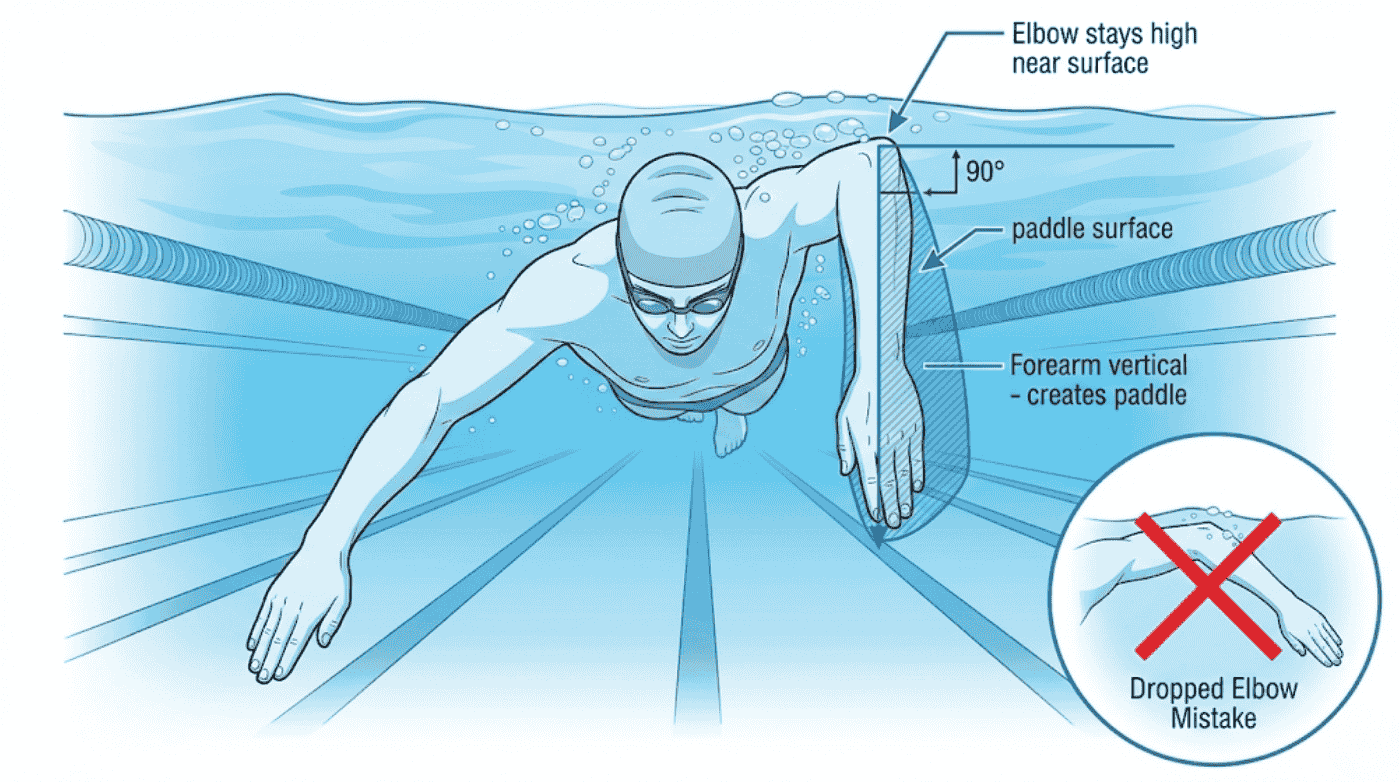
The single most destructive technical flaw in amateur and intermediate swimming is the dropped elbow. When the extended arm reaches forward, natural human instinct encourages pulling the hand downward and backward by bending the shoulder joint first. Doing so allows the elbow to point toward the bottom of the pool while the hand trails behind it. In this compromised position, the effective surface area pulling against the water shrinks to the size of a wrist and palm slicing horizontally, rather than an upright paddle pushing vertically.
A dropped elbow turns the swimmer into a sinking cylinder. Pushing down on the water during the initial stroke phase lifts the head and chest slightly, but physics demands a harsh penalty. As the chest rises, the hips and legs sink deeper beneath the surface, drastically increasing frontal drag. Instead of propelling the body forward, the swimmer spends enormous metabolic energy just staying afloat.
Furthermore, flaws in swimming catch mechanics often trace back to simple muscular exhaustion or impatience. Novice swimmers feel an urgent desire to feel heavy load instantly on their palms. Paradoxically, achieving true mechanical leverage requires a brief moment of patience at full extension, setting the joint angles first before engaging the primary movers.
Four Proven Principles That Deliver Unshakable Forward Propulsion
Rewiring this movement pattern requires replacing old kinesthetic habits with strict positional awareness. By breaking the stroke down into mechanical absolutes, these four rules demystify swimming catch mechanics by aligning joint angles with hydrodynamic laws.
Establish an Early Vertical Forearm Before Applying Heavy Force
The early vertical forearm, universally referred to as EVF, is the cornerstone of world-class swimming. As the fingertips slice into the water and extend forward, the elbow must stay high, floating near the surface of the pool while the wrist flexes and the forearm hinges downward. The elbow acts as a fixed pivot, not a pulling hinge.
Think of wrapping your arm over a large barrel resting just below the surface. The hand and wrist tip downward first, followed immediately by the forearm, until the entire segment from fingertip to elbow forms a ninety-degree angle relative to the surface of the water. Only after this vertical paddle is formed should you initiate backward acceleration. If you pull before achieving this vertical plane, you lose up to sixty percent of your potential propulsive surface area.
Anchor the Hand and Vault the Entire Body Forward
The mental model of the stroke dictates physical execution. Amateur swimmers imagine their hand pulling water toward their hip. Elite swimmers imagine reaching out, gripping a secure iron rung submerged in the pool, and pulling their body past that rung.
When swimming catch mechanics operate at peak efficiency, the hand enters the water, catches, and stays relatively stationary relative to the lane markers. The body travels over the hand. You can observe this phenomenon in overhead video analysis of Olympic champions. The hand barely moves backward in space through the middle of the stroke. Instead, the torso rolls, surges forward, and leaves the anchored hand behind as the hip snaps open.
Engage the Latissimus Dorsi Rather Than Isolating the Shoulder Joint
Attempting to power through the catch using the small muscles of the rotator cuff and anterior deltoid is a direct path to chronic impingement and shoulder pain. The shoulder joint is inherently unstable, designed for mobility rather than absorbing intense aquatic drag loads. The massive muscles capable of moving water effortlessly are the latissimus dorsi, the pectoralis major, and the core stabilizers.
By maintaining a high elbow during the setup, you naturally place the shoulder in slight internal rotation and broad abduction. This biomechanical positioning instantly pre-loads the lats. Integrating the back into your swimming catch mechanics shifts the mechanical strain away from delicate labral tissue and places it squarely upon the largest muscular engine of the upper body. The pull becomes an expansive, full-body lever driven by the rotation of the thoracic cage.
Maintain Fingertip Pitch to Prevent Lateral Energy Leakage
Propulsive force follows the angle of the hand. If your fingers point outward toward the lane line or inward across the centerline of your chest, fluid escapes sideways, creating lateral yaw that wiggles your hips off-center. Every sideways millimeter traveled by your core steals forward momentum.
Keep the fingertips pointing directly at the bottom of the pool throughout the entire catch and transition into the pull. The wrist should remain firm, neither hyper-extended backward nor curled tightly into a club. A micro-relaxation of the hand is vital. Cup the fingers slightly without stiffening them, and allow small gaps of a few millimeters between the fingers. Hydrodynamic boundary layer effects cause water to treat slightly parted fingers as a solid blade, effectively expanding your hand surface area without increasing muscular tension in the forearm.
Diagnostic Drills That Rewire Neuromuscular Sensation
Knowing the geometry of a stroke is useless without the neuromuscular pathways to execute it under fatigue. Developing true feel for the water demands targeted constraint drills that force the nervous system to adapt.
One of the most potent diagnostics is the closed-fist drill. By swimming with a clenched fist, you completely eliminate the hand as a propulsive surface. Swimmers who rely solely on their palms will immediately lose all traction, feeling their arms spin uselessly. To generate forward momentum with a fist, you are forced to hinge at the elbow and use the entire surface of your forearm to grab the water. After three hundred yards of fist swimming, opening the hand feels like strapping enormous swim paddles to your wrists.
Another indispensable exercise is sculling in the front quadrant. Floating horizontally with a pull buoy between your thighs, extend your arms forward and make sweeping, figure-eight motions with your hands, keeping your elbows high and wide. Feel the pitch of the hand alter the water pressure. Athletes across diverse disciplines understand that micro-adjustments in limb leverage yield massive competitive margins. When exploring tactical mastery, Alexandra Eala Seizes 3 Crucial Advantages in a Rapid Wuhan Open Surge by remaining biomechanically composed under extreme match pressure, proving that mechanical discipline under load separates elite performance from chaotic effort.
These diagnostic drills strip away distraction so you can isolate and polish swimming catch mechanics without relying on sheer arm strength to mask flawed leverage.
The Lifelong Pursuit of Effortless Hydrodynamic Grip
Great swimming often appears slow from above the surface. Elite swimmers glide through the lane with an almost leisurely rhythm, taking thirty strokes per lap while an amateur takes fifty strokes to cover the same distance in twice the time. That visual deception is the direct result of grip. The swimmer who holds water travels further per stroke cycle, spending less energy and creating zero chaotic splash.
Building an unyielding catch requires patience, technical humility, and constant proprioceptive feedback. It is easy to default to frantic arm-wheeling when the lungs burn and the pace picks up. However, sustainable progress in swimming catch mechanics demands continuous sensory mindfulness, ensuring that every time your fingertips plunge forward, your elbow locks high, your lats ignite, and the water becomes a solid launchpad propelling you toward the wall.