Tempering Chocolate and 4 Proven Rules That Guarantee Flawless Snap
Untempered chocolate turns dull, greasy, and soft at room temperature due to chaotic fat crystallization. Here is the underlying physics of cocoa butter polymorphism and the exact thermal rules required for professional gloss and snap.
Mastering the elusive science of tempering chocolate separates timid home bakers from confident artisans who command smooth confections that break with an unmistakable acoustic crack. Most kitchen enthusiasts treat melted chocolate like candle wax, assuming that heating a solid block and allowing it to cool naturally returns it to its original, pristine state. That flawed assumption reliably produces disappointment: a dull, grayish shell that softens at room temperature and melts onto your fingers before reaching your mouth. Melted chocolate is not a simple homogenous liquid. It is a dense, volatile suspension of roasted cocoa solids, microscopic sugar grains, and a remarkably complex vegetable fat known as cocoa butter.
Cocoa butter does not freeze or solidify in a uniform, predictable pattern. Instead, it exhibits polymorphism, a physical phenomenon in which a single chemical substance can solidify into several distinctly different crystal configurations. Each crystalline state possesses its own unique melting point, molecular density, and mechanical stability. When you heat chocolate indiscriminately, you dismantle the structural order that industrial chocolatiers spent hours establishing. Rebuilding that molecular architecture requires thermal precision, kinetic energy, and a firm grasp of phase change thermodynamics.
The Hidden Architecture of Cocoa Butter Crystals
The fat inside cocoa butter consists primarily of symmetrical triacylglycerols composed of palmitic, oleic, and stearic fatty acids. Because these molecular chains feature bends and elbows, they can nestle together in at least six distinct geometric arrangements, traditionally labeled Form I through Form VI. Each polymorph behaves differently under thermal stress. Form I melts at a frigid 63°F, yielding a fragile, greasy mush. Forms II, III, and IV melt sequentially higher between 70°F and 82°F, but they remain mechanically weak, prone to warping, and soft to the touch.
The fundamental objective of tempering chocolate is navigating this polymorphic minefield to encourage Form V crystallization exclusively. Also known as beta crystals, Form V is the crowning achievement of confectionery engineering. It packs tightly into an elegant, interlocking crystalline lattice that melts right at 93°F. That precise temperature sits just below human body temperature. This mechanical coincidence explains why well-tempered confections remain rigid on the counter yet dissolve into a luscious, satin pool the moment they touch your tongue.
Form VI exists on the opposite side of the spectrum, melting around 97°F. While extremely stable, Form VI cannot form directly from molten chocolate. It only develops over months or years of storage as Form V crystals slowly degrade and recrystallize into a dense, gritty matrix. As detailed in the Chemical & Engineering News research on cocoa butter crystallization, understanding how to lock fats into Form V while dodging the lower polymorphs is what separates structural mastery from culinary roulette.
Why Untempered Chocolate Falls Victim to Fat Bloom
When you melt chocolate and leave it to cool on a baking sheet at ambient room temperature, the chaotic brew of triglycerides freezes haphazardly. Forms II, III, and IV form spontaneously in loose, jagged clumps. Because these sub-optimal crystals leave excessive space between their molecular chains, the structure cannot compact efficiently. As the cooling mixture contracts irregularly, liquid fats get squeezed out toward the surface through microscopic fissures.
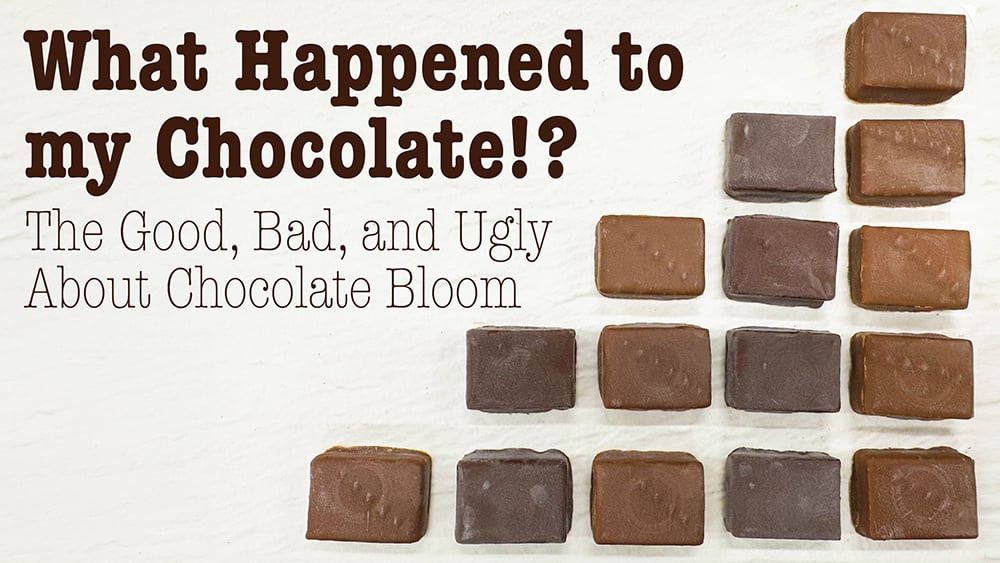
Skipping the deliberate steps of tempering chocolate leaves these erratic polymorphs unorganized. Over the next forty-eight hours, the unstable crystals begin shifting, attempting to reorganize themselves into lower-energy states. As free fat molecules migrate to the exterior and solidify upon contact with ambient air, they scatter light rather than reflecting it cleanly. The result is fat bloom: a chalky, pale, swirled residue that looks remarkably like fungal growth. While bloomed chocolate remains technically edible, its mouthfeel is ruined. The tongue registers coarse waxiness rather than silky dissipation, and the snappy bite is replaced by a wet crumble.
The Mechanics Behind Four Proven Rules for Pristine Crystal Formation
Harnessing the physics of cocoa butter does not require an industrial enrober or laboratory machinery. It demands that you honor four non-negotiable physical constraints. By guiding molten chocolate through a deliberate sequence of temperature thresholds and physical agitation, you systematically dismantle bad crystals, germinate healthy seed structures, and build a unified Form V network.
Complete Thermal Erasure of All Unstable Nuclei
Your primary task is wiping the slate completely clean. If you melt chocolate halfway, reserving solid clumps at lukewarm temperatures, you leave behind an unpredictable mixture of rogue crystals that will dictate the cooling pattern of the entire bowl. Dark chocolate must be brought to between 115°F and 120°F (46°C to 49°C), while milk and white chocolates, laden with dairy fats, require a lower ceiling between 110°F and 113°F (43°C to 45°C).
At this elevated thermal mark, every single pre-existing crystal lattice breaks apart into a blank liquid slate. You are dissolving the memory of the fat. Skimping on this initial melt stage is the single most common pitfall for amateurs. Leaving the liquid at 105°F might visually appear smooth, but microscopic clusters of inferior Form IV nuclei will survive, ready to replicate and corrupt your final set.
Deliberate Agitation During the Deep Cooling Phase
Once you dismantle the crystal population, you must bring the temperature down rapidly into the nucleation zone, reaching approximately 81°F to 82°F (27°C to 28°C). However, passive cooling in a quiet bowl produces coarse, irregular growth. Crystal formation is fundamentally a kinetic process. You must supply mechanical energy through continuous, rhythmic stirring.
As you sweep a silicone spatula through the cooling mass, shearing forces push triglyceride molecules against one another. This mechanical agitation speeds up crystallization by thousands of times compared to static rest. More importantly, constant movement prevents massive, isolated crystals from growing out of control. It distributes embryonic nuclei evenly throughout the emulsion, ensuring billions of microscopic Form V seeds develop in tandem rather than a few jagged crystals dominating the bowl.
Strategic Seeding with Pre-Formed Seed Crystals
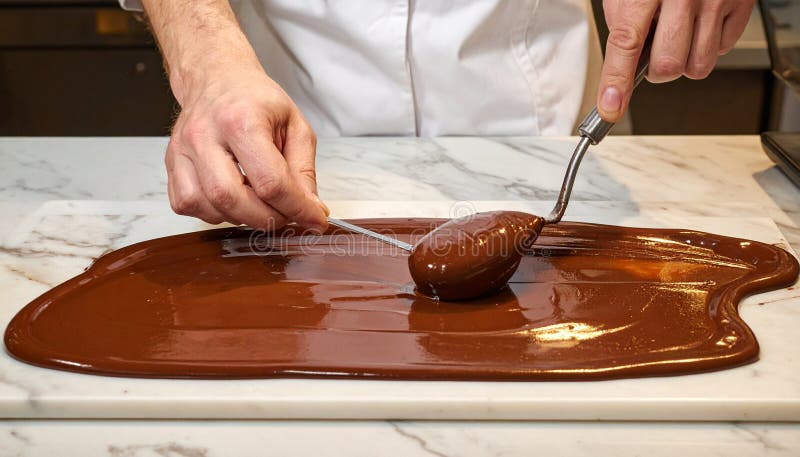
While marble slab tabling physically coaxes crystals into alignment via surface contact, the seeding technique remains the most reliable home method. When tempering chocolate through this method, you cool the melted pool to approximately 94°F, then introduce solid, pre-tempered pieces comprising roughly twenty percent of the total volume. These solid pieces already possess pristine, tightly ordered Form V lattices.
The solid shards act as structural blueprints for the surrounding liquid. As the unmelted seed slowly dissolves into the warm pool, it sheds billions of Form V templates. The liquid fats recognize these geometric patterns and begin locking into identical alignment around them, much like liquid water instantly freezing upon contact with an introduced ice crystal. You must continually stir while the seed melts, monitoring the bowl until the temperature hits 88°F to 89°F and the seed fragments have vanished.
Reheating Strictly Below the Beta Melting Ceiling
During the cooling and seeding phase, a small percentage of undesirable Form IV crystals inevitably germinate alongside your Form V network. To eliminate these inferior stragglers, you must gently nudge the temperature back up to the working window: 88°F to 90°F (31°C to 32°C) for dark chocolate, and 84°F to 86°F (29°C to 30°C) for milk and white varieties.
This reheating step exploit the precise melting differential between polymorphs. Form IV dissolves completely around 82°F to 84°F, whereas Form V resists heat up to 93°F. By holding your bowl precisely between 88°F and 90°F, you liquidate every remaining trace of weak Form IV crystal while leaving your sturdy Form V matrix intact. If your thermometer accidentally spikes to 94°F or beyond, you cross the point of no return. The Form V crystals will unravel into a chaotic fluid, forcing you to begin the entire cycle again from scratch.
The Acoustic Signature of the Clean Break
How do you verify success before pouring chocolate into expensive polycarbonate molds? The gold standard test relies on auditory and kinetic feedback. Dip the tip of an offset spatula or a strip of parchment paper into the tempered pool and place it on the counter at cool room temperature. Within three to five minutes, the liquid should matte over, losing its wet sheen and turning uniformly satiny.
When set, the film should lift cleanly off the paper without sticking or smearing. Flexing a finished bar should yield a crisp, sharp pop rather than a soft bend. The physics of sound in cooking often mirrors broader acoustic phenomena. Just as sound artists engineer sensory experiences through tactical resonance, as explored in Foley Sound Design and 4 Proven Secrets Behind Immersive Movie Audio, the crisp crack of cocoa butter signifies dense molecular packing. A flawless batch confirms that tempering chocolate alters structural acoustics just as dramatically as it refines surface sheen.
Practical Troubleshooting for Environmental Pitfalls
Ambient room conditions introduce erratic variables when tempering chocolate outside of an industrial laboratory. Your kitchen environment exerts a massive influence over how quickly energy leaves your bowl. If your workspace exceeds 74°F (23°C), the chocolate will refuse to set properly, even with flawless crystal seeding. The optimal room temperature sits strictly between 65°F and 68°F (18°C to 20°C) with low relative humidity.
Moisture is chocolate’s primary structural enemy. Cocoa solids and sugar particles are hydrophilic, whereas cocoa butter is hydrophobic. If even a solitary droplet of steam or stray water from a double boiler enters your bowl, the dry sugar particles instantly dissolve into concentrated syrup droplets. Surface tension causes these syrup beads to attract one another, instantly seizing the glossy fluid into a stiff, dull, grainy paste that cannot be salvaged for molding.
Dairy fats present another complication when working with milk or white chocolate. The short-chain fatty acids found in butterfat act as natural crystallization inhibitors. They physically get in the way of cocoa butter molecules, delaying lattice alignment and lowering the melting points across all polymorphic stages. When handling milk chocolate, lower every target temperature in your process by two to three degrees, and exercise patience during the seeding phase to give the fat chains adequate time to knit together.
The Tactile Intuition of Continuous Thermal Control
Experienced pastry chefs rarely rely solely on digital probe thermometers. They cultivate an intuitive sense for the viscosity, drag, and warmth of the bowl against their wrists. As chocolate moves into temper, it thickens subtly, gaining a velvety surface tension that coats the spatula differently than raw melted fat. The liquid changes from watery and free-flowing to cohesive and cushiony.
Once you internalize the physical phase changes behind tempering chocolate, the fear of streaky shells and limp bonbons vanishes completely. You stop viewing chocolate as a temperamental ingredient and start treating it as an adaptable, polymorphic material governed by reliable laws of physics. With precise temperature discipline, steady agitation, and clean seeding, flawless gloss and razor-sharp snap become repeatable, everyday achievements in your home kitchen.