Practical Special Effects Mechanics and 4 Proven Secrets to Create Unforgettable Cinema Illusions
Discover the engineering secrets behind Hollywood’s most convincing tactile illusions, from pneumatic animatronics to ballistic squibs. Learn how master artisans manipulate real physics to create movie magic that digital pixels cannot replicate.
Mastering practical special effects mechanics requires an instinctive grasp of physical friction, chemical volatility, and the subtle art of optical deception. Long before digital pixels conquered Hollywood workstations, cinema lived or died by the sweat, steel, and sawdust of workshop artisans. When an audience watches a rubberized monstrosity heave with pneumatic breath, their nervous system registers something that algorithms still struggle to replicate. They perceive genuine weight, atmospheric displacement, and the unyielding laws of gravity playing out across physical materials.
The human eye is an exquisitely sensitive lie detector. We evolved over millions of years to track micro-shadows, the unpredictable flutter of burning embers, and the exact resistance of flesh yielding to impact. When an illusion occurs directly inside camera range, lit by identical studio lamps and captured through the same optical glass as the actors, the brain relaxes its skepticism. That suspension of disbelief is not accidental. It is the calculated byproduct of mechanical engineering disguised as theatrical magic.
Why Real Photons Rebel Against Digital Perfection
Computer-generated graphics synthesize light through mathematical approximations, tracing synthetic rays across virtual polygons. While digital rendering engines have reached staggering heights of sophistication, they frequently produce an eerie, sterile cleanliness. In contrast, the underlying practical special effects mechanics that govern how photons interact with tangible matter carry inherent chaos.
Consider subsurface scattering. When warm key light strikes human skin, silicone, or pigmented gelatin, it does not bounce off a flat two-dimensional plane. Photons penetrate the upper layers, ricochet through microscopic cellular chambers, absorb hemoglobin hues, and exit at unpredictable angles. Building an animatronic puppet requires layering pigmented urethanes with varying durometers to mirror this chaotic luminescence. The optical bounce created by real polymer blends feels alive because it obeys the quantum mechanics of real light.
Furthermore, physical objects drag their surrounding environment with them. A mechanical jaw snapping shut creates a micro-gust of wind that rustles the hair of an adjacent performer. A detonating plaster wall expels genuine gypsum dust that hangs in the air, catching the backlight and altering the optical depth of the lens. These secondary phenomena provide the subconscious cues that anchor an impossible event to tangible reality.
The Kinetic Engineering Behind Pneumatics and Mechanical Rigs
Behind every convincing creature, crumbling bridge, or high-speed car flip lies an intricate network of fluid power. Hydraulic and pneumatic systems serve as the synthetic muscles of physical cinema. While hydraulics utilize non-compressible oils to produce immense, bone-crushing torque for massive set pieces, pneumatics harness compressed air to deliver lightning-fast, violent snaps.
Designing these systems demands surgical precision. A full-scale gimbal built to pitch a multi-ton spaceship cockpit must balance fluid pressure, structural fatigue, and fail-safe braking mechanisms. Just as an executive producer calculates financial volatility against long-term asset security—an equation explored deeply in our breakdown of Bond duration mechanics and 4 proven rules to conquer costly interest rate shocks—a physical effects supervisor must calculate kinetic stress tolerances against catastrophic mechanical failure. A blown hydraulic line during a dynamic stunt run does not just ruin a take; it jeopardizes the physical safety of cast and crew.
Operating these rigs requires a technician to act as a puppeteer-engineer, safeguarding stunt performers while tuning practical special effects mechanics under intense production pressure. Analog joysticks wired directly to proportional servo valves grant the operator tactile feedback. This allows them to modulate velocity mid-stroke to match an actor’s sudden improvisation, preserving the dynamic tension that makes cinematic action feel authentic.
Four Proven Systems That Define Tactile Special Effects Mastery
To understand how physical craft transforms raw materials into breathtaking cinematic moments, we must deconstruct the core practical special effects mechanics into four foundational engineering disciplines. Each system solves a distinct optical or kinetic riddle, operating at the crossroads of craftsmanship and pure applied physics.
Pneumatic Ram and Squib Mechanics for High Impact Ballistics
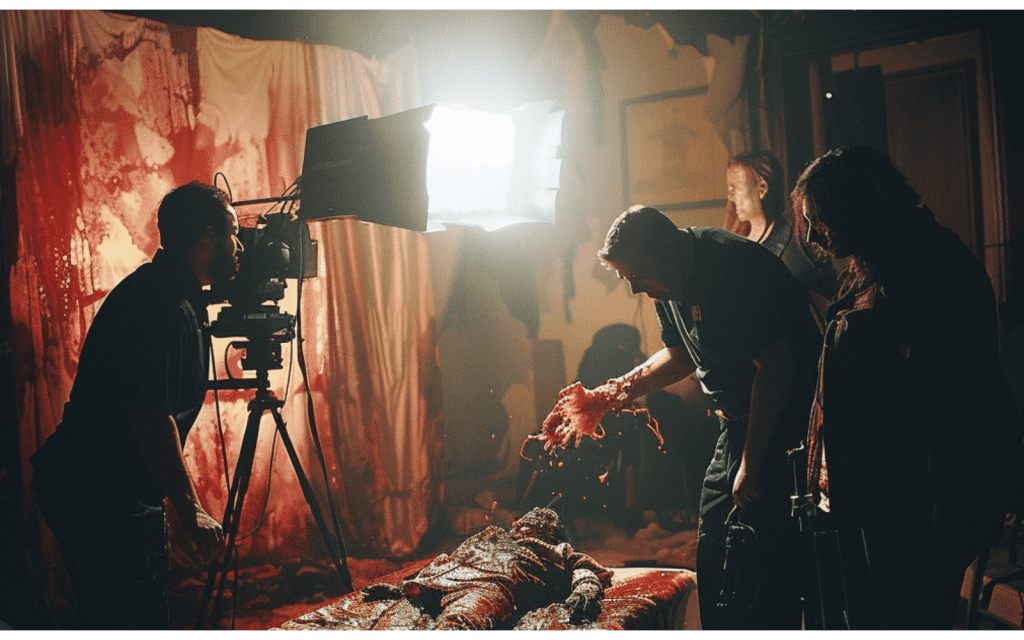
Simulating firearms without live ammunition is one of the oldest and most dangerous crafts on set. Ballistic squibs remain the gold standard for simulating bullet impacts on clothing, brick, and timber. Effects technicians mount miniature explosive charges packed into custom copper casings against protective steel shields taped directly to an actor’s body, placing an insulated barrier between burning propellant and human skin.
Above the squib, a small latex packet filled with cellulose-thickened artificial blood rests against a pre-scored garment seam. When triggered via a radio-frequency pulse, the charge vaporizes the packet in milliseconds, forcing the fluid outward in a directional conical spray. For wall hits and vehicle strikes, engineers swap explosive squibs for pneumatic gas-cannons that fire hardened ceramic projectiles at specific coordinates, producing chalky dust plumes and splintering wood with millisecond synchronization.
Subsurface Silicone Formulation for Hyper Realistic Animatronic Flesh
The golden age of rubber monsters relied heavily on foam latex, a temperamental material baked in industrial ovens that suffered from rapid environmental degradation. Modern mechanical creature designers utilize platinum-cure silicone polymers blended with deadening agents. These plasticizers alter the molecular bonds of the polymer, stripping away the synthetic rubbery snap and replacing it with the sluggish, fleshy recoil characteristic of biological mammalian muscle.
Beneath this synthetic dermis sits an intricate armature fabricated from aerospace-grade aluminum, carbon fiber struts, and miniature aircraft control cables. Micro-servos mounted inside the cranial cavity pull these cables, sliding the silicone skin over lubricated skull forms. Because silicone lacks intrinsic structural memory when deadened, artists install internal elastic anchors that mimic human fascia, ensuring that facial expressions stretch, crease, and reset without bunching or wrinkling unnaturally.
Forced Perspective Miniatures and Split Diopter Optical Geometry
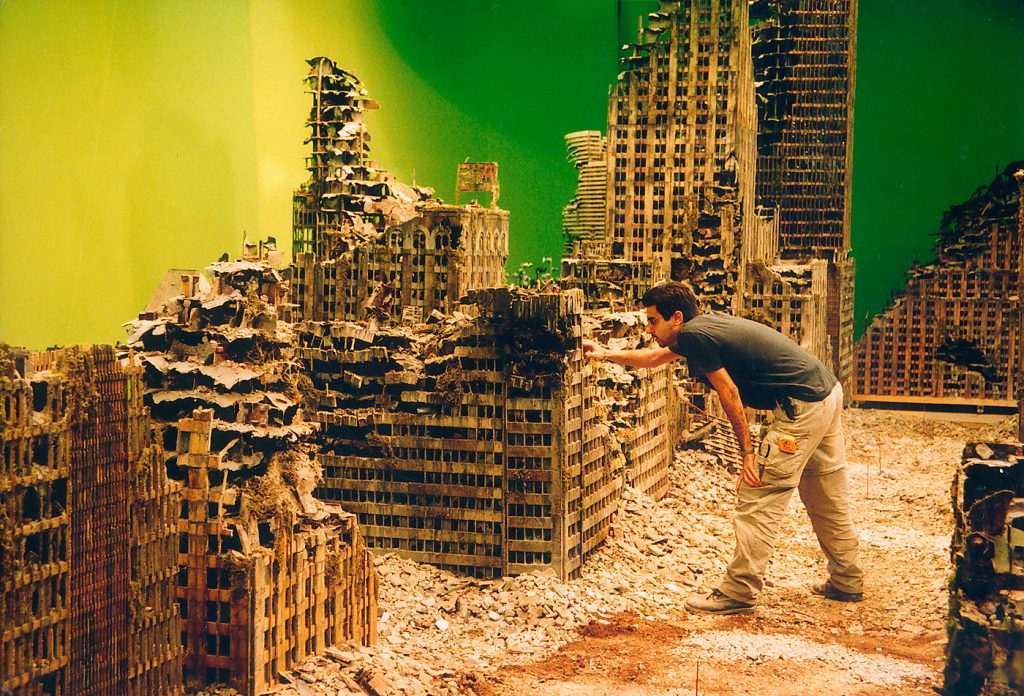
Before massive digital green screens became ubiquitous, visual effects directors relied on the mathematical precision of forced perspective miniatures. By placing scaled-down physical architectural models closer to the camera lens while positioning human performers deep in the background, a small table-top model can be made to appear as a towering fortress stretching across an alpine horizon.
Achieving this trick requires blending practical special effects mechanics with clever camera geometry and optical depth manipulation. Cinematographers stop their lenses down to pinhole apertures to expand depth of field, flooding the stage with thousands of foot-candles of light to expose the emulsion. When optical limitations make sharp focus across both planes impossible, operators introduce split-diopter glass to the matte box, allowing two distinct focal planes to remain crystal clear in a single frame.
Breakaway Glass and Controlled Pyrotechnic Velocity Control
Every cinematic bar brawl or explosion-shattered window relies on brittle chemical engineering. Real annealed glass breaks into lethal daggers, while tempered glass shatters into thousands of blinding cubes that behave unpredictably. Instead, the industry relies on breakaway glass made from thermoplastic polymers like piccolastic resin, or specialized brittle polymers that shear along engineered fault lines.
These clear synthetic panes mimic the refractive index of window glass while fracturing under minimal kinetic impact into dull, lightweight fragments. When synchronized with pyrotechnic detonations, technicians pair breakaway elements with slow-burning deflagrating propellants rather than high-order explosives. Black powder and smokeless formulations produce brilliant orange flame fronts with low shockwave pressure, delivering cinematic visual grandeur without generating dangerous acoustic or concussive trauma on soundstages.
The Psychological Weight of Physical Danger on Film Sets
There is an unquantifiable psychological charge that electrifies a scene when actors interact with physical phenomena. When an explosion ignites on a practical set, the cast does not perform a rehearsed simulation of panic; their sympathetic nervous system instantly discharges adrenaline. Pupils dilate, vocal cords tighten, and balance instinctively shifts toward self-preservation.
Digital post-production can insert an asteroid impact or an alien swarm into an empty studio, but it cannot manufacture the subtle physical feedback of a wind turbine pushing grit into an actor’s tear ducts. Audiences instinctively respond to the tangible weight of practical special effects mechanics because they sense the unvarnished interaction between human bodies and physical environments. The light of a propane fire illuminating an actor’s face possesses a radiant temperature and color rendition that digital keying simply cannot mimic without exhaustive, frame-by-frame manipulation.
This organic unpredictability extends to the camera operators themselves. When an actual explosive charge detonates or a stunt vehicle slides through a wall, the camera operator must physically counteract the shockwave, instinctively adjusting pan and tilt to track erratic kinetic motion. These micro-corrections introduce an authentic documentary texture that modern computational algorithms cannot convincingly simulate.
The Enduring Future of Handmade Cinema Engineering
The narrative that physical movie effects would be driven into extinction by computer algorithms has proven remarkably false. Instead, the highest echelons of modern visual storytelling have embraced an enlightened hybrid philosophy. Rather than replacing physical fabrication, digital tools now serve as invisible handmaidens to practical artistry.
Digital cleanup artists effortlessly paint out safety wires, pneumatic hoses, and hydraulic control linkages, liberating mechanical sculptors from having to conceal bulky support structures within the puppet. Stunt teams can launch physical rigs at unprecedented velocities, confident that digital paint crews will remove the high-tensile steel cables stabilizing the apparatus. Furthermore, motion picture innovators frequently consult historical patents documented by the Academy Science and Technology Council to modernize early century mechanical patents using cutting-edge CNC machining and 3D printing.
Cinema remains, at its foundational core, an optical carnival trick. As audiences develop an intuitive immunity to frictionless, hyper-smooth virtual spectacles, the appetite for raw physical texture continues to surge. Ultimately, mastering these practical special effects mechanics ensures that cinematic wonder remains rooted in authentic human ingenuity, keeping storytelling firmly tethered to the laws of our physical world.