Maillard reaction mechanics reveal 4 proven rules to unlock deep flavor and perfect crusts
Surface browning is not mere coloration but a sophisticated symphony of molecular transformations. Unravel the thermal and chemical rules that govern culinary crusts and turn simple ingredients into complex savory feasts.
Mastering Maillard reaction mechanics transforms an ordinary sear into an unforgettable culinary masterpiece, separating clumsy home attempts from restaurant-quality golden-brown perfection. That intoxicating smell of a steak hitting a scorching skillet, the crisp crust of a rustic loaf of sourdough, and the rich depth of roasted coffee beans all trace their lineage back to the same molecular phenomenon. Discovered in the early twentieth century by French physician Louis-Camille Maillard, this non-enzymatic browning network is often mistaken for simple caramelization. Yet it operates under vastly different parameters, weaving together amino acids and reducing sugars into hundreds of newly synthesized aroma compounds that define how humans perceive savory richness.
Understanding this transformative chemical dance changes how you approach the stove. Rather than viewing heat as a blunt instrument to cook food through to the center, skilled cooks treat surface heat as a targeted catalyst. When applied with intention, thermal energy initiates structural realignments that yield crunchy textures, glistening mahogany surfaces, and mouth-watering aromas. By demystifying the precise conditions under which these molecules collide and mutate, you gain absolute command over every skillet, grill grate, and roasting pan in your kitchen.
The Molecular Alchemy Behind Culinary Browning
At its core, this transformation is not a single tidy reaction but an intricate cascade of thousands of chemical reactions happening simultaneously. When protein-dense foods meet sufficient heat, the nucleophilic amino groups of free amino acids attack the electrophilic carbonyl groups of reducing sugars. This initial condensation leads to an unstable N-substituted glycosylamine, which quickly rearranges through what food chemists classify as the Amadori rearrangement. As documented in the American Chemical Society analysis on meat browning chemistry, this cascade produces hundreds of newly synthesized volatile aroma compounds alongside dark pigments called melanoidins.
From this pivotal turning point, the pathway fractures into an astonishing maze of reactive intermediates, including dicarbonyl compounds and reductones. These unstable molecules undergo rapid dehydration, fragmentation, and condensation with other amino compounds present in the food matrix. As the cascade accelerates, it produces melanoidins alongside volatile aroma molecules like pyrazines, furans, oxazoles, and thiophenes. Each class contributes distinct sensory notes ranging from nutty, savory, and roasted to earthy, meaty, and buttery. A deeper look into Maillard reaction mechanics shows that small fluctuations in thermal energy and chemical precursors completely rewrite the aromatic profile of a dish, altering whether a crust tastes gently toasted or sharp and bitter.
Moisture Versus Temperature In The Battle For Crust
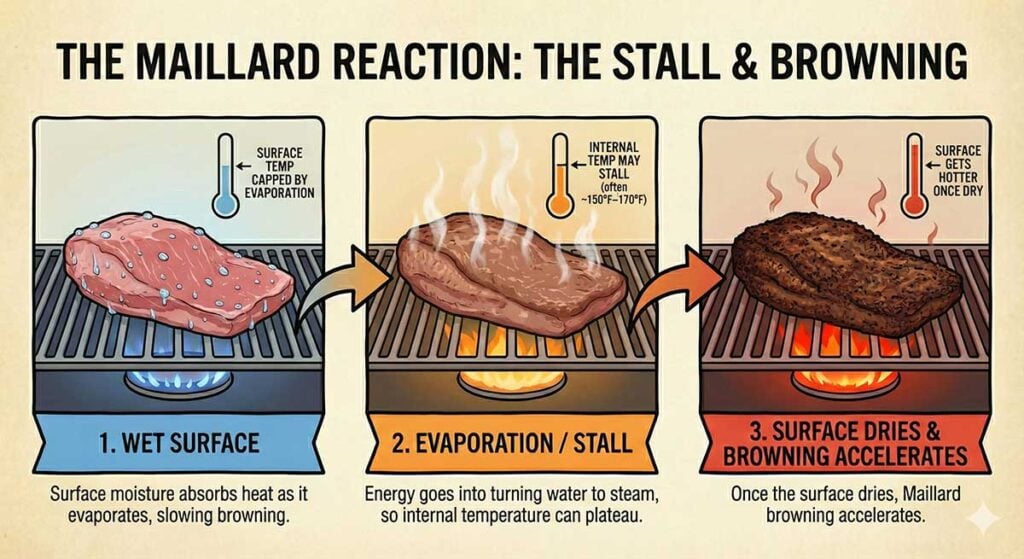
Water is the absolute nemesis of high-heat browning. The laws of thermodynamics dictate that liquid water cannot exceed its boiling point of 212 degrees Fahrenheit (100 degrees Celsius) under normal atmospheric conditions until it completely phases into steam. Because rapid browning reactions require surface temperatures hovering between 280 and 330 degrees Fahrenheit (140 to 165 degrees Celsius), surface moisture acts as an immovable thermal brake. As long as water sits on the perimeter of your protein or vegetable, every calorie of thermal energy pumped into the pan goes strictly toward vaporizing that moisture rather than driving molecular transformation.
This fundamental physical hurdle explains why a wet steak turns an unappealing, rubbery gray rather than developing a deeply savory, mahogany crust. When cooks disregard Maillard reaction mechanics, the skillet drops below the critical threshold, leaving the meat to stew in its own expelled juices. The cook then leaves the food in the pan longer hoping for color, which inadvertently overcooks the delicate interior before the exterior ever has a chance to brown. Escaping this moisture trap requires deliberate moisture management before food ever touches hot steel.
Four Proven Rules To Command Flavor And Texture
Unlocking consistent restaurant-level results does not depend on blind intuition or expensive cookware alone. Applying these core Maillard reaction mechanics allows cooks to dictate heat transfer with surgical precision and guarantee exceptional results every time.
Surface Dryness Decides Thermal Fate
The simplest and most overlooked preparatory step in the kitchen is absolute surface dehydration. While many home cooks pat meat with a paper towel immediately before tossing it into the oil, this superficial dab leaves microscopic water pockets within the exterior cell layers. To truly prime proteins for instantaneous crust formation, leverage uncovered refrigeration. Placing salted meat on an elevated wire rack in the cold, dry air of a refrigerator for several hours pulls subsurface moisture inward while evaporating exterior dampness completely. This creates a thin, desiccated outer skin known as a pellicle. When this bone-dry exterior meets hot fat, heat transfer occurs instantly without wasting thermal energy on boiling moisture, creating an explosive crackling crust within seconds.
Thermal Mass Outweighs Raw Flame Power
A common kitchen misconception assumes that a roaring stove burner guarantees an exceptional sear. In reality, the thermal mass of the cooking vessel plays a far more influential role. Lightweight aluminum or flimsy stainless-steel skillets surrender their stored heat the moment cold meat makes contact. The surface temperature plummets, extinguishing the thermal drive required for rapid browning. Heavy cast iron and carbon steel pans possess immense volumetric heat capacity. While they take longer to preheat, they act as massive thermal reservoirs. When cold food drops in, the skillet resists thermal shock, maintaining the elevated temperatures needed to drive Amadori rearrangements without hesitation.
Alkaline Environments Accelerate Molecular Rearrangements
The rate of chemical browning is hyper-sensitive to pH levels. In an acidic environment, amino groups become protonated, carrying a positive charge that prevents them from executing nucleophilic attacks on carbonyl sugars. Conversely, elevating the pH slightly unlocks these amino groups, expediting the initial condensation phase dramatically. This chemical trick explains why traditional Bavarian pretzels are dipped in a lye or baking soda bath before baking, producing a glossy, deep brown sheen in a fraction of normal oven time. Savvy chefs harness this principle by adding a tiny pinch of baking soda to caramelized onions or ground meat. This subtle pH adjustment aligns directly with foundational Maillard reaction mechanics, driving efficient flavor synthesis while saving significant time at the stove.
Sugar And Protein Ratios Direct The Spectrum Of Aromas
Different ingredients yield wildly varying flavor bouquets during cooking because of their unique carbohydrate and amino acid profiles. Cysteine and methionine, which are sulfur-rich amino acids found predominantly in animal tissue, interact with sugars to synthesize meaty, savory, and roasted thiols and thiazoles. Plant proteins rich in proline, meanwhile, foster distinct freshly baked bread and biscuit aromas. Understanding this biochemical partnership allows home cooks to intentionally balance surface coatings. Brushing poultry with maltose or milk powder provides both reducing sugars and concentrated whey proteins, priming the skin for intense, uniform golden pigmentation long before the underlying meat turns dry.
Crucial Distinctions Between Caramelization And Deep Browning
Culinary literature often blurs the line between caramelization and the Maillard cascade, using the terms interchangeably to describe anything turning golden brown. However, their internal chemistries are fundamentally distinct. Caramelization is the pure thermal pyrolysis of carbohydrates in the total absence of nitrogen-bearing amino acids. It requires much higher baseline temperatures, typically starting around 320 to 356 degrees Fahrenheit (160 to 180 degrees Celsius) depending on the sugar, breaking sucrose or fructose down into diacetyl, furans, and maltol.
In contrast, the Maillard pathway relies on the vital interplay between sugars and amino acids, operating comfortably at lower temperatures down to 280 degrees Fahrenheit. Much like how understanding how bond yield mechanics reveal 4 essential forces that dictate modern market valuations allows investors to see beyond daily price swings, grasping thermal transfer lets you anticipate how food behaves before it even touches the pan. Recognizing these distinctions ensures you do not mistake scorched, bitter sugars for the complex, savory sweetness of well-engineered amino browning.
Common Searing Pitfalls That Ruin High Heat Cooking
Even experienced cooks frequently succumb to bad habits that sabotage crust development. Overcrowding the pan is the most frequent blunder. Packing too many steaks, chicken thighs, or roasted vegetables into a single vessel traps escaping steam against the pan floor, instantly transforming a dry sear into a soggy boil. Food needs ample breathing room so evaporating moisture can dissipate immediately into the surrounding air.
Another persistent error is frantic food manipulation. Constantly nudging, flipping, or lifting proteins interrupts direct thermal conduction from the skillet surface. For optimal conduction, food must maintain steady, uninterrupted contact with the cooking surface until the developing crust naturally releases from the metal. Furthermore, a nuanced view of Maillard reaction mechanics disproves the myth that you must only flip a steak once. While initial contact must remain unbroken long enough to set the crust, subsequent frequent flipping actually produces a more even thermal gradient throughout the interior while preventing surface burning.
Building Lifelong Mastery At The Stove
Exceptional cooking is rarely a mystery dictated by genetic talent or proprietary kitchen secrets. It is fundamentally an exercise in governing thermodynamics, surface moisture, and molecular kinetics. When you understand the triggers and thresholds that govern how sugars and proteins interact, you stop relying on blind timers or arbitrary recipe instructions. You begin reading the tactile cues of sizzling fat, listening to the pitch of evaporating moisture, and watching the precise hue of color development across your pan. Ultimately, internalizing these subtle Maillard reaction mechanics elevates everyday cooking into a repeatable art, ensuring that every meal delivers extraordinary depth.