Fosbury Flop Biomechanics Reveal 4 Proven Forces Behind Impossible High Jumps
High jump records changed forever when athletes abandoned forward leaping to sail backward across the bar. Explore the fascinating physics that allow an elite jumper’s body to clear heights while their center of mass travels directly underneath.
Mastering Fosbury flop biomechanics requires an athlete to embrace a deeply counterintuitive truth about human motion. For the better part of a century, track and field competitors launched themselves face-forward over the high jump crossbar. They scrambled upward using the scissors kick, coiled tightly in the Western roll, or hurled their chests parallel to the wooden beam in the straddle technique. These methods felt logical, aggressive, and undeniably natural. Looking toward where your body travels is the most foundational survival instinct wired into human neurology. Throwing your head and spine backward into empty space while sprinting at full speed seemed, on paper, like pure athletic folly.
Yet when an unorthodox jumper named Dick Fosbury sailed backward over the bar to capture an international gold medal in Mexico City, he shattered decades of conventional jumping doctrine. Spectators initially laughed at the strange technique, but the chuckles evaporated when the crossbar remained undisturbed at record heights. What casual observers mistook for an uncoordinated flail was actually an astonishing triumph of structural anatomy and Newtonian physics. When coaches and sports scientists began dissecting Fosbury flop biomechanics through high-speed cinematography and force plates, the underlying data revealed why this backward leap reigned supreme. It did not merely refine jumping; it exposed a physical loophole in gravity.
The Counterintuitive Secret of the Submerged Center of Mass
To understand the sheer dominance of backward clearance, one must examine the physical reality of the human center of mass. The center of mass represents that singular geometric balance point where the entirety of a body’s weight is mathematically concentrated. In an upright, standing human, this point hovers silently within the pelvic bowl, slightly behind the navel. Once a high jumper’s spikes break contact with the synthetic track surface, their center of mass transforms into an unalterable ballistic projectile. Free flight is governed entirely by gravitational acceleration. No mid-air flailing, violent twisting, or supreme act of will can alter the parabolic arc that the center of mass must trace through the stadium air.
In classical techniques like the straddle or the scissors, the athlete’s torso and limbs remained stacked relatively close to that balance point. To successfully clear a crossbar set at 2.30 meters, a straddle jumper had to exert enough explosive energy to lift their actual center of mass several centimeters above that fiberglass barrier. The athlete’s abdomen essentially rode atop the peak of the trajectory like freight lashed to a flatbed truck. Every single gram of bone and muscle had to be hoisted cleanly over the physical obstacle in a unified mass.
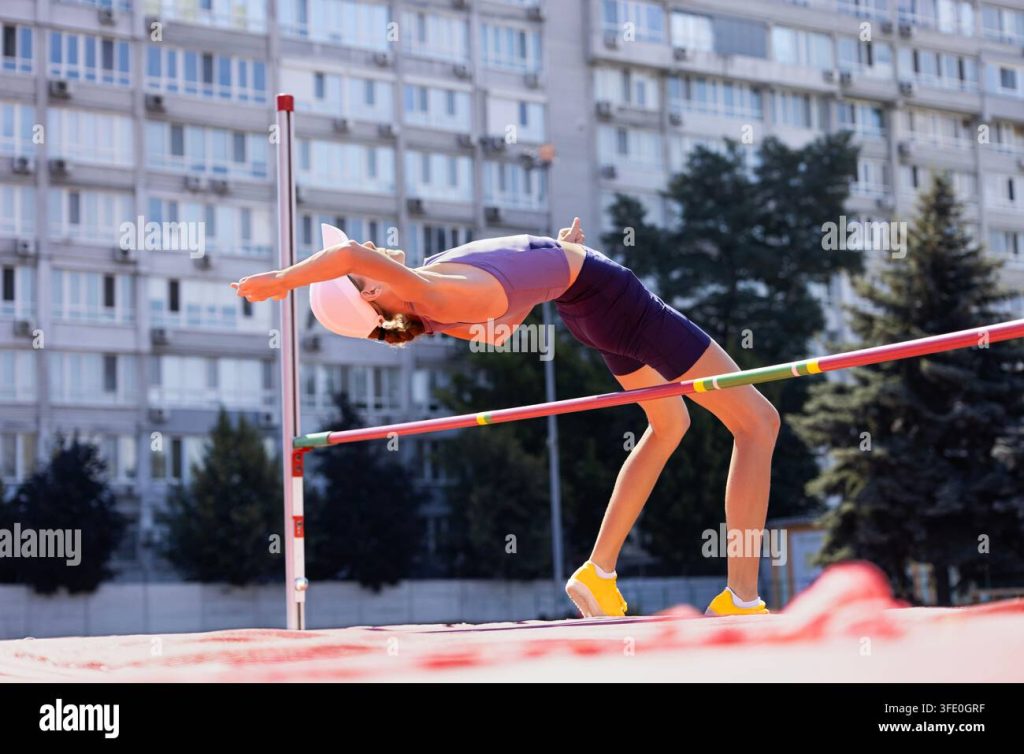
The backward clearance method systematically dismantling this energetic tax is what makes the technique truly brilliant. By hyperextending the spine into a dramatic hyperbolic arch, an athlete bends their body around the crossbar rather than hauling their entire weight over it. At the exact apex of the leap, the jumper’s head and shoulders have already dipped toward the landing pit, their hips crest the bar, and their lower legs hang suspended below. Because human mass is dynamically distributed along this curved crescent, the calculated center of mass actually shifts completely outside the physical boundaries of the human body. In a mechanically flawless execution, the center of mass travels directly through empty space underneath the crossbar while the segmented body loops cleanly above it.

Four Biomechanical Pillars That Drive Flawless Bar Clearances
A deep dive into Fosbury flop biomechanics demonstrates that the leap is not a single explosion, but a series of interconnected physical events. Flawless flight requires meticulous sequencing, where kinetic energy harvested from the horizontal run is weaponized into vertical height and rapid aerial rotation.
Centripetal Velocity Along the Curved Approach Run
The magic of the jump begins long before the athlete takes flight. Jumpers utilize a distinctive J-shaped approach path, starting with four or five strides in a direct linear sprint to build raw momentum, followed by four or five rapid strides along a tightly controlled curve. Traveling along this arc introduces centripetal acceleration, demanding that the athlete lean their entire body inward toward the center of the turn. This inward lean lowers the body’s center of mass without requiring a conscious, energy-wasting squat during the final strides.
As the athlete approaches the takeoff zone, this inward lateral lean forces the ground reaction vector to pass at an angle through the ankle, knee, and hip joints. Because the jumper is leaning away from the crossbar while traveling at high speed, the sudden cessation of that curve at takeoff initiates an instantaneous righting reflex. The athlete gains passive rotational energy simply by standing up against the inertia of the turn, establishing the foundation for aerial rotation without sacrificing forward momentum.
Ground Reaction Force Conversion at the Plant
The moment of takeoff represents one of the most violent decelerations in human athletics. The takeoff foot plants firmly into the track surface roughly arm’s length from the nearest upright, oriented at an acute angle to the plane of the bar. This plant foot acts as an immovable mechanical strut. Just as endurance cyclists exploit aerodynamic slipstreams where bicycle drafting aerodynamics mechanics reveal 4 proven secrets to conserve massive energy over grueling distances, high jumpers exploit reactive ground forces to avoid wasting a single watt of forward kinetic energy.
Modern Fosbury flop biomechanics rely on the penultimate stride lowering the hips slightly without bleeding forward speed. When the takeoff leg extends, the quadriceps and calf tendons undergo extreme eccentric loading before instantly firing in a stretch-shortening cycle. Concurrently, the non-takeoff knee and both arms drive violently upward toward the sky. This coordinated vertical impulse creates immense downward pressure against the track, yielding an equal and opposite ground reaction force that converts horizontal sprint velocity into explosive vertical trajectory.
Angular Momentum and Spinal Hyperextension Arching
Once the takeoff foot leaves the track, the athlete enters a state of zero net external torque, meaning their total angular momentum is permanently conserved until they hit the foam landing mat. The jumper must manipulate their moment of inertia across multiple body axes to achieve two distinct spatial rotations simultaneously. They must rotate backwards to present their spine to the bar, while also twisting along the longitudinal axis so their shoulders align perpendicular to the runway.
The athlete commands this complex aerial maneuver through cervical spine extension. By tilting the head backward and fixing their gaze on the back of the landing pit, the jumper triggers a neurological chain reaction along the spinal erectors. The cervical tilt naturally prompts the thoracic and lumbar spine to follow, pushing the pelvis toward the sky in an aggressive arch. By widening the distance between the limbs and the rotational axis, the athlete slows down unwanted twisting while accelerating the somersault that carries the hips cleanly over the obstacle.
Segmented Unfurling and the Dynamic Heel Snap
Reaching the pinnacle of the jump is only half the battle, because the trailing calves and heels represent the most common cause of a failed attempt. If the athlete maintains the arched crescent shape throughout the entire flight, the legs will inevitably drag across the bar on the descent. Clearing the lower extremities demands a rapid, highly coordinated shift in physical geometry known as the snap.
The moment the sacrum crosses the plane of the bar, the jumper abruptly tucks their chin firmly to their chest. This sharp neck flexion alters the muscular tension along the posterior chain, immediately causing the hips to drop into flexion. As the pelvis sinks toward the foam pit, the hamstrings and quadriceps rapidly unfurl, kicking the lower legs straight upward into the air. This dynamic coordination highlights why Fosbury flop biomechanics reward neuromuscular timing far more than raw brute strength. The heels whip over the fiberglass bar with millimeters of clearance, completing a segmented, wave-like passage across the threshold.
Catastrophic Flaws That Shatter Vertical Lift and Trajectory
Because the mechanics of the flop are so tightly coupled, the slightest timing error during the approach or takeoff amplifies into disaster at the bar. The most pervasive error in developmental Fosbury flop biomechanics occurs when an athlete anticipates the bar clearance too early. Inexperienced jumpers frequently lean their shoulders backward toward the bar before the takeoff foot has finished driving into the track. This premature lean abruptly destroys vertical impulse, sending the jumper flat along a low, horizontal trajectory directly into the bar standard.
Another frequent breakdown involves cutting the arc during the final three strides of the approach. When a runner flattens their curve to face the bar directly, they eliminate centripetal acceleration entirely. Without that inward lean, they lose the centrifugal forces needed to initiate passive rotation, forcing them to actively throw their shoulders sideways mid-jump. The resulting leap lacks both the vertical clearance to surpass elite heights and the aerial stability required to land safely on the upper back.
Finally, joint stiffness at the plant serves as the ultimate arbiter of jumping performance. If the ankle or knee of the takeoff leg buckles under the staggering impact of the plant, the kinetic chain fractures. The stored elastic strain energy within the Achilles tendon and patellar tendon dissipates as thermal friction rather than upward propulsion. Rigorous biomechanical research published in the Journal of Applied Biomechanics underscores that isometric ankle stiffness during the first 50 milliseconds of ground contact dictates the ultimate vertical velocity an athlete can generate.
The Unbroken Kinetic Chain of Human Flight
True jumping mastery emerges when an athlete stops viewing the Fosbury technique as a series of isolated postures and begins treating it as an unbroken kinetic continuum. Every single phase of the movement serves as an energetic prerequisite for the phase that follows. The straight-line sprint generates the raw kinetic baseline, the curved strides load the body with centripetal potential, the plant foot transforms that momentum into vertical lift, and the arched flight pattern redistributes mass around gravity’s uncompromising barrier.
What makes this athletic movement universally celebrated across sports science is its complete harmony with classical mechanics. Dick Fosbury did not discover a way to bypass the laws of gravitation; he discovered a way to collaborate with them. By systematically moving the anatomical center of balance outside the human frame, the technique proved that human ingenuity can elevate performance even when physical biology reaches its ceiling.
Ultimately, the enduring brilliance of Fosbury flop biomechanics lies in how an eccentric individual challenge dismantled decades of dogma. When athletes dare to turn their backs on traditional assumptions, physics often provides the most astonishing rewards. Every towering clearance witnessed on modern track runways remains an enduring monument to the power of biomechanical innovation.