Foley Sound Design Mechanics and 4 Proven Secrets to Create Shocking Cinematic Immersion
Discover how master Foley artists manipulate everyday materials and physical acoustics to craft believable cinematic soundscapes. Uncover the proven acoustic principles that turn silent sets into gripping sensory experiences.

Mastering Foley sound design mechanics transforms silent cinematic footage into a visceral sensory experience that tricks the human brain into feeling physical reality. When an audience watches an actor trek across a windswept glacial ridge or handle an antique revolver in a dimly lit parlor, virtually none of the production audio captured on location survives into the theatrical release. Boom microphones on live sets are calibrated to isolate human dialogue while rejecting ambient noise. Every secondary sonic texture, from the rustle of a heavy wool overcoat to the rhythmic crunch of packed gravel beneath boot soles, must be physically engineered and performed from scratch inside a specialized acoustic facility.
The craft traces its heritage back to Jack Donovan Foley, a radio pioneer who realized during the transition to synchronized sound film that pre-recorded sound effects sounded hollow, flat, and detached from human movement. Instead of relying on static library tracks, Foley projected silent film footage onto a screen and performed prop manipulations in exact temporal sync with the actors on screen. Today, that discipline has evolved into a sophisticated blend of psychoacoustics, materials engineering, and athletic choreography. Sound artists manipulate surprising everyday objects inside meticulously baffled pits to fabricate sounds far more convincing than the authentic event itself.
Why Pre-Recorded Digital Audio Libraries Fail the Human Ear
Modern editing suites house petabytes of pristine digital sound effects recorded at ultra-high sample rates. Yet, any experienced supervising sound editor will attest that populating a scene entirely with pre-recorded digital assets inevitably yields a cold, mechanical, and disjointed mix. The human auditory cortex is an exquisitely sensitive diagnostic instrument, honed over millions of years of evolutionary survival to detect minute spatial anomalies, material inconsistencies, and repetitive phase signatures.
The profound genius of Foley sound design mechanics lies in psychoacoustics rather than literal recreation. When an editor pastes the same sampled footstep audio file repeatedly along a timeline, the listener instantly detects the identical transient response and harmonic profile. Real locomotion never repeats identically. With every human stride, weight shifts across the heel, ball, and toe in response to emotional urgency, physical fatigue, and terrain variations. Physical Foley performance introduces organic micro-variations in velocity, friction, and decay that algorithmic randomized playback engines struggle to replicate.
Furthermore, digital sample libraries strip away acoustic context. A footstep recorded in an isolated vocal booth possesses no physical relationship to the visual room geometry depicted on screen. Sound waves interact dynamically with clothing fibers, hand angles, and ambient air. Recreating these interactions physically allows the performance to mirror the visual framing seamlessly, fusing picture and sound into an indivisible theatrical illusion.
Four Proven Principles That Deliver Breathtaking Auditory Realism
Deconstructing Foley sound design mechanics reveals a disciplined union of physics, choreographic timing, and material science. To build tracks that integrate invisibly beneath dialogue without drawing unwanted scrutiny to the technical illusion, veteran artists rely on four foundational acoustic principles.
Resonant Material Coupling for Tactile Weight
The cardinal rule of the Foley stage states that the authentic object rarely sounds like what the audience expects to hear. A real sword drawn from a leather scabbard makes an underwhelming, muffled scrape. Audiences, conditioned by decades of cinema, expect a sharp, singing metallic hiss that conveys deadly sharpness. To create that sensation, sound artists scrape an antique kitchen cleaver against a resonant steel rod, capturing the high-frequency friction while simultaneously thumping a dense leather belt to supply low-end heft.
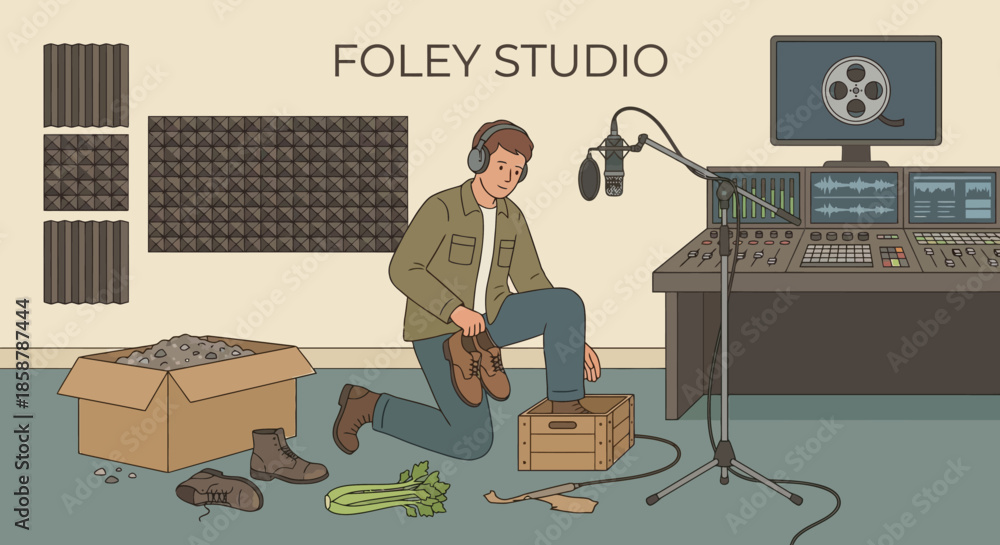
Similarly, snapping fresh celery ribs, crushing dense cabbages, and twisting frozen chicken carcasses generate the sickening, visceral crunch of broken limbs and hand-to-hand combat hits. The key to convincing material coupling is isolating the transient peak—the immediate impact spike—from the sustained body and resonant decay. By selecting props with natural harmonic resonance that matches the physical density seen on screen, performers supply the visceral tactile weight that pure synthetic generation consistently lacks.
Temporal Micro-Shifts That Match Kinetic Human Movement
Amateur audio editing aligns sound transients precisely with visual contact frames. If a fist strikes a jaw at frame twenty-four, the novice places the audio waveform peak exactly on frame twenty-four. Veteran artists know this creates an unnatural, synthetic sensation. Light travels instantaneously over short distances, whereas acoustic waves propagate through air at roughly 343 meters per second. In real environments, our brains process sight and sound with subtle temporal offsets.
Moreover, human movement begins long before physical impact occurs. A footstep does not start when the boot sole slaps the earth; it begins with the subtle pre-scuff of the toe, the flex of ankle leather, and the settling of fabric. Master performers cultivate an intuitive kinesthetic sensitivity, leaning into physical actions fractions of a second ahead of the picture. This micro-temporal intuition is an indispensable cornerstone of Foley sound design mechanics, ensuring that every rustle of denim or thud of leather feels anchored to live action rather than pasted on top of an edit.
Dynamic Frequency Carving Across the Spectral Canvas
A feature film soundtrack must balance competing elements across the audible spectrum, from low-frequency explosions and sweeping orchestral strings to delicate whispered dialogue. Foley tracks occupy a particularly vulnerable zone within the midrange frequencies where human speech intelligibility lives. If Foley recordings carry excessive mud between 250 and 500 Hertz, or piercing sibilance between 3 and 6 kiloHertz, they swallow the spoken lines whole.
Acoustic performers achieve frequency separation at the physical source long before digital equalizers touch the channel. When performing clothing rustles, known in the industry as cloth movement, artists swap modern synthetic garments for vintage, naturally worn fabrics like broken-in denim, raw silk, and soft chamois leather. These organic textiles produce smooth, broad-spectrum friction without the harsh, high-frequency rustle of nylon or polyester. By carving acoustic space naturally through prop selection, artists leave the dialogue channel clear while bathing the track in lush tactile detail, corroborating Audio Engineering Society research on tactile acoustic perception.
Spatial Acoustic Matching Using Room Impulse Geometry
Even the most expressive physical performance falls apart if its acoustic perspective clashes with the camera lens. A close-up framing demands an intimate, dry recording with noticeable proximity effect, highlighting the delicate friction of fingerprints against glass. Conversely, a wide shot framing characters in a cavernous stone cathedral requires significant air, early reflections, and natural room decay.
Foley stages counter this challenge by employing variable acoustic architecture alongside multi-microphone arrays. Custom stages feature motorized acoustic baffles, modular absorption panels, and variable flooring pits containing river rock, wet mud, fractured slate, and hollow wood planking. Artists don hypercardioid shotgun microphones positioned overhead to mimic the boom operator’s angle, paired with distant boundary microphones to capture the room’s natural diffuse sound. Matching the microphone’s physical distance and directional pattern to the camera lens ensures that the listener unconsciously accepts the sound as an intrinsic property of the filmed environment.
Rigorous Post-Production Workflows and Studio Confidentiality
Creating world-class tactile audio requires intense physical discipline and meticulous file management. A standard two-hour narrative film requires hundreds of distinct Foley tracks, categorized across footsteps, cloth passes, specific hand props, and specialized environmental interactions. Track sheets must correspond perfectly to visual reel changes, timecode shifts, and locked editorial cuts.
During major studio productions, sound stages operate under stringent confidentiality protocols comparable to Press embargo mechanics and 4 proven rules to prevent devastating media leaks, guaranteeing that sensitive rough-cut stems and proprietary asset libraries stay secure prior to global theatrical distribution. Sound stages frequently work with watermarked visual prints stripped of final visual effects and high-profile plot twists to prevent piracy. In this high-stakes environment, artists must deliver world-class acoustic performances while honoring stringent physical and digital security protocols.
When supervising sound editors misjudge Foley sound design mechanics, the final mix betrays its theatrical illusion. If footsteps sound detached or prop movements lack physical mass, audiences become aware of the screen as an artificial barrier. Flawless execution requires continuous coordination between the Foley artist on the floor, the tracking engineer behind the mixing console, and the dialogue re-recording mixer balancing the final dub.
The Timeless Artistry of Physical Performance in Modern Soundstages
While computer-generated imagery, artificial intelligence synthesis, and digital modeling continue to transform visual post-production, the physical art of Foley remains remarkably resistant to complete automation. Algorithms can generate a synthetic approximation of a ceramic cup landing on a mahogany table, but an algorithm cannot judge the emotional weight of a character who places that cup down with trembling grief versus barely suppressed fury.
In an era dominated by algorithmic automation, traditional Foley sound design mechanics remind us that human tactility cannot be computed. The craft thrives on the imperfect, expressive nuances of human motor skills—the subtle pause, the uneven drag of a heel, the delicate brush of a finger against paper. By transforming discarded scrap, worn leather, and kitchen produce into the sonic architecture of imaginary worlds, Foley artists safeguard the beating, human heart of cinematic storytelling.