Baseball Curveball Mechanics Reveal 4 Proven Forces That Shatter Batter Timing
A devastating curveball looks like it tumbles off an invisible table right before crossing home plate. The truth combines fluid dynamics, rotational friction, and human optical limits to fool the sharpest eyes in sports.
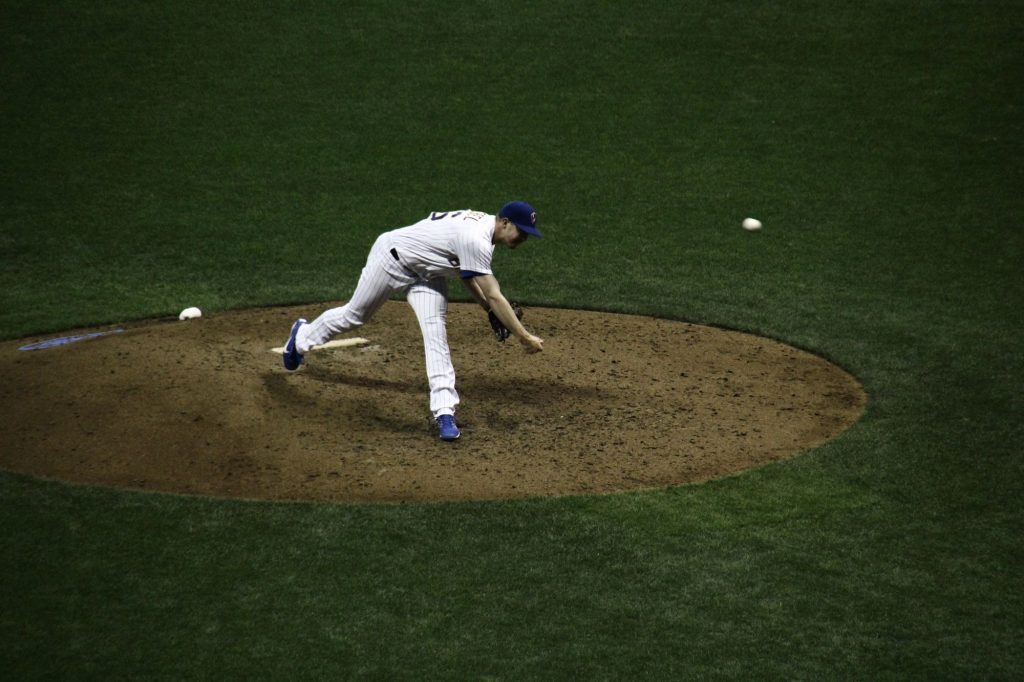
Mastering baseball curveball mechanics requires unraveling a physics paradox that has puzzled hitters for over a century. When an elite pitcher snaps off a breaking ball, the leather sphere seems to coast smoothly before plunging off an imaginary cliff directly above home plate. Batters regularly swear that the ball suddenly drops twelve inches in the blink of an eye, vanishing beneath the plane of their wood. Yet high-speed cameras and stadium radar trackers reveal a starkly different reality. The baseball does not make an abrupt, right-angle dive. Instead, it carves a continuous, parabolic arc through the air from the moment it leaves the fingertips. The illusion of a sudden snap is a marvel of human visual processing colliding violently with aerodynamic forces.
Understanding this pitch demands stripping away baseball superstition and examining the raw atmospheric forces at work over sixty feet and six inches. From release to the catcher’s mitt, a pitch takes roughly four hundred milliseconds to arrive. In that fractional sliver of a second, the batter must identify pitch type, predict rotational trajectory, calculate impact timing, and initiate a full-body swing that takes nearly two hundred milliseconds to execute. By manipulating airflow and eye tracking, pitchers turn atmospheric friction into an almost unhittable weapon.
The Perceptual Illusion of the Dropping Ball
The sensation that a curveball breaks late comes down to the way human eyes track high-speed movement. When a batter watches a baseball leave the pitcher’s release window, their visual system engages smooth pursuit tracking. The eyes lock onto the object, calculating its speed and direction based on visual cues and past muscle memory. However, human ocular muscles can only track an approaching object up to a certain angular velocity. Once the baseball enters the final twenty feet of its flight, the angular speed explodes, exceeding the physiological limit of the human fovea.
At that critical threshold, the batter’s brain switches from active pursuit to predictive extrapolation. The brain assumes the ball will continue along the gentle path it observed during the first forty feet of flight. But because the downward force of gravity and rotational deflection compounds over time, the physical ball deviates progressively further from that mental baseline. When the eyes catch up in the hitting zone, the discrepancy between the predicted location and the actual position is enormous. Hitters do not perceive a gradual curve. They register a jarring discontinuity that feels exactly like a sudden drop off a table edge.
Aerodynamic Lift and the Magnus Acceleration Reality
The core engine driving this flight path is the Magnus effect, a physical principle named after German physicist Heinrich Gustav Magnus. When any sphere spins as it moves through a fluid like air, it drags a thin layer of air along its surface known as the boundary layer. On a standard fastball thrown with backspin, the bottom of the ball rotates in the direction of the oncoming airflow, while the top rotates against it. This disparity slows the air beneath the ball and accelerates the air over the top, creating low pressure above and high pressure below. That upward Magnus force partially counteracts gravity, generating what hitters describe as a rising fastball.
A curveball turns this equation completely upside down. By applying forward topspin, the pitcher causes the top surface of the baseball to spin into the oncoming wind while the bottom moves in reverse. The air traveling across the top slows down, while the airflow underneath accelerates smoothly. This pressure imbalance generates downward Magnus force, actively pulling the ball toward the turf. When dissecting how spin alters trajectory, the underlying baseball curveball mechanics transform ordinary atmospheric friction into an unyielding offensive weapon.
The mathematical result is devastating. Under pure gravity, any falling object accelerates at roughly 32 feet per second squared. When an elite pitcher imparts heavy topspin at more than 2,500 revolutions per minute, the downward Magnus force adds significant additional acceleration. Instead of falling at 1g, the baseball can plunge toward the plate under an effective acceleration approaching 1.5g to 2g. Systemic breakdowns often emerge when athletes try to compensate for invisible mechanical forces, a phenomenon visible across competitive sports—whether observing strategic pressure points when examining the Seahawks Record Under Scrutiny As 3 Crucial Factors Shake Sunday Night Football narrative or watching a clean-up hitter swing wildly over a ball in the dirt.

Four Proven Forces That Make a Curveball Unhittable
An extraordinary breaking ball is never the result of arm strength alone. It requires the pitcher to balance four specific aerodynamic and sensory forces at the exact instant of release.
1. The Seam Airflow Imbalance
A regulation baseball is far from a smooth sphere. It features 108 double-stitched red cotton seams raised slightly above the cowhide surface. Modern high-speed telemetry proves that baseball curveball mechanics exploit asymmetrical boundary layer separation across the raised cotton-stitched seams. When the seams spin through the air, they trip the thin boundary layer from smooth laminar flow into chaotic turbulent flow earlier on one side of the ball than the other.
This phenomenon, known in modern sports science laboratories as seam-shifted wake, generates an aerodynamic force independent of pure Magnus lift. If the orientation of the seams causes the air wake to detach prematurely on the upper quadrant, the resulting wake deflects upward. According to Newton’s third law, deflecting that wake upward produces an equal and opposite downward reaction force on the ball itself. Pitchers who align their grip so the seams continuously slice through the air at an asymmetrical angle gain extra inches of break that do not appear on standard spin-rate calculators.
2. Finger Pressure and Rotational Axis Tilt
The rotational axis determines which way the ball breaks. A pitch with a pure 12-to-6 rotational axis drops straight down, behaving like a rock dropped off an overpass. A pitch with an axis tilted to 1-to-7 or 2-to-8 exhibits both vertical drop and horizontal sweep away from a same-handed batter. Controlling this axis requires surgical pressure distribution between the index and middle fingers.
The middle finger does nearly all the heavy lifting. As the arm accelerates forward, the pitcher hooks the raised seam with the pad of the middle finger, using the thumb underneath as a passive fulcrum. The index finger merely rests alongside the ball to provide lateral stability without dampening rotational velocity. During the release phase, the middle finger pulls down violently against the seam, rolling the leather off the index side to establish an unyielding forward axis tilt.
3. Angular Velocity and Active Spin Efficiency
Raw spin rate gets headlines, but rotational speed without axis alignment is useless. Pitch-tracking data demonstrates that elite baseball curveball mechanics rely on maximizing active spin efficiency rather than raw rotational speed alone. If a pitcher produces 2,800 revolutions per minute but half of that spin is gyroscopic—spinning like a spiral football along the axis of flight—that portion of the rotation produces zero Magnus force.
Active spin refers solely to the rotation perpendicular to the trajectory vector. To maximize break, elite pitchers strive for spin efficiency ratings above eighty-five percent. This requires keeping the hand firmly behind the ball rather than sweeping around the side, ensuring that almost every ounce of kinetic energy generated by the torso and shoulder translates into transverse rotational torque.
4. Saccadic Blind Spots and Perceptual Collapse
The final and most lethal component takes place entirely inside the hitter’s central nervous system. Because the human eye cannot continuously follow an object moving faster than roughly one hundred degrees of visual angle per second, the hitter must execute a rapid eye movement known as a saccade to jump their gaze from the release point down to the anticipated contact zone.
During a saccade, the brain temporarily suppresses visual input to avoid motion blur, a neurological phenomenon known as saccadic masking. If the pitcher designs the curveball so its maximum aerodynamic deviation coincides with this physiological jump, the batter’s visual field momentarily blanks right when the trajectory shifts most aggressively. The hitter swings where their optical predictive engine calculated the ball should be, only to hit thin air as the sphere crashes into the dirt.
The Biomechanical Cost on the Kinetic Chain
Generations of youth coaches spread destructive training myths regarding baseball curveball mechanics, urging young pitchers to violently twist their wrists at release. That instruction has ruined countless elbows. An athlete cannot manually snap their wrist sideways at ninety miles per hour without subjecting the ulnar collateral ligament to catastrophic stress forces. In truth, the human forearm does not pronate or twist aggressively to create topspin; it remains naturally supinated throughout the delivery phase.
In a biomechanically sound curveball, the wrist remains locked in a stable, slightly flexed position. The hand tracks directly through the arm slot, allowing the fingers to rip down the front of the ball naturally. The spin is generated by the hand path and the grip, not by an isolated jerk of the joint. Ground reaction forces travel from the back leg, through the hips, into the thoracic spine, and out through the fingers. When that kinetic chain is sequenced correctly, verified by aerodynamic flight research documented by NASA Glenn Research Center on fluid boundaries and rotational drag, the arm absorbs minimal excess torque while maximizing energy transfer to the sphere.
Refining Release Architecture on the Pitching Mound
Modern pitching laboratories teaching baseball curveball mechanics abandon vague verbal cues in favor of tactile grip feedback and forearm orientation. Throwers typically utilize one of two foundational grips: the traditional horseshoe grip or the spike curve. In a spike curve, the pitcher digs the fingernail or knuckle of the index finger directly into the leather, which lifts the index pad completely off the ball. This removes all opposing friction from the secondary digit, allowing the middle finger to apply unilateral torque against the seam with uncompromising force.
The release cue is equally vital. Elite instructors often tell pitchers to visualize driving the back of their hand directly toward the target or thinking about pulling down a window shade. These mental models prevent the elbow from dropping below the shoulder plane, ensuring the forearm stays on a consistent delivery line that mirrors the pitcher’s primary fastball. When the arm slot and release point are indistinguishable from a four-seam fastball, the batter is forced to rely on early visual processing, falling directly into the aerodynamic trap.
The Enduring Mastery of Rotational Flight
No pitch in baseball captures the imagination quite like a devastating breaking ball. It is a masterclass in deception, turning atmospheric friction, rotational inertia, and human sensory biology into an unhittable physical reality. The batter stands with elite reflexes, honed across tens of thousands of repetitions, yet remains utterly powerless against the laws of fluid motion. From high school diamonds to the major leagues, the mastery of baseball curveball mechanics stands as the ultimate synthesis of biomechanical harmony and aerodynamic force.