Tennis serve mechanics and 4 proven secrets to build explosive power
Tired of arming your serve and battling shoulder pain? Discover the true kinetic chain physics that turn an erratic delivery into a lethal baseline weapon.
Mastering elite tennis serve mechanics demands an appreciation for pure physics rather than raw muscular force. When club players watch a professional strike a blistering ace, they often see a blur of upper-body violence. The arm looks like a whip, snapping forward with frightening velocity. Yet, if you isolate the shoulder and bicep in a biomechanics laboratory, you quickly discover that those muscles contribute less than a quarter of the total ball speed. The serve is never an isolated arm swing. It is a synchronized, full-body kinetic event that begins with the soles of your shoes gripping the hardcourt surface and culminates in an instantaneous transfer of momentum through the string bed.
Without understanding the underlying science, countless athletes spend decades fighting their own physiology. They muscle the ball across the net, straining delicate rotator cuff tendons and courting chronic elbow inflammation while wondering why their flat deliveries lack penetrating depth. Unlocking effortless power requires unlearning intuitive instincts. It means stepping away from brute strength and allowing your skeletal framework to operate as a coordinated system of elastic levers.
The unbroken kinetic chain that governs true ball velocity
Every dynamic athletic motion depends on kinetic summation, the principle where energy generated by large, slow body segments transfers progressively into smaller, faster segments. When you break down dynamic tennis serve mechanics, the human body operates as a linked whip where energy flows sequentially through eight distinct anatomical stations. The sequence begins with ground reaction force. As your knees bend into deep flexion, your legs drive downward into the court. The ground pushes back with equal and opposite force, sending kinetic energy surging upward through your calves, quadriceps, and glutes.
From the lower limbs, that energy travels across the pelvic girdle. As the hips rotate forward from an angled loading stance, they pull the torso along behind them. This introduces the critical phenomenon known as hip-to-shoulder separation. Your pelvis uncoils toward the net while your upper torso remains coiled sideways, stretching the oblique abdominals and latissimus dorsi like a pulled compound bow. This elastic stretch stores immense potential energy in the core muscles.
As the torso snaps forward and tilts upward, that energy surges into the shoulder complex, up the humerus, through the elbow, and into the forearm. According to a landmark peer-reviewed biomechanical analysis of the tennis serve, the legs and trunk generate more than fifty percent of the total kinetic energy delivered at impact. If any single link in this chain hesitates or fires out of order, the entire energy wave dissipates. The arm is forced to compensate for the lost momentum, producing high joint stress and anemic ball speed.
4 proven secrets to transform your delivery on the court
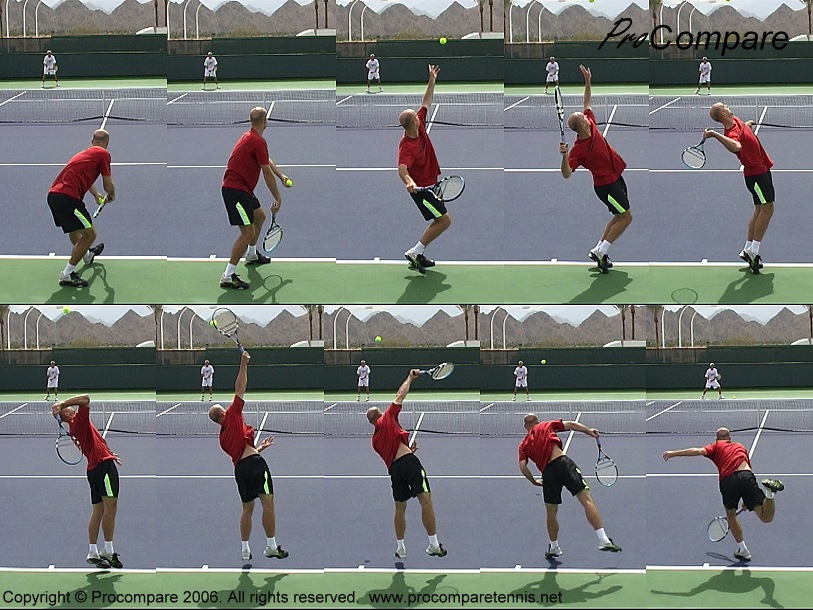
Applying these principles requires refining your tennis serve mechanics into distinct, reproducible phases that work in harmony with natural joint architecture rather than against it.
Master the trophy pose to store maximum elastic energy
The trophy pose is the architectural cornerstone of the entire delivery. It is not an idle pause or an ornamental posture; it is an active, coiled loading state designed to maximize mechanical advantage. In a flawless trophy position, your back hip drops slightly while your front hip pushes forward toward the net post, creating an angled pelvic slope. Simultaneously, your dominant shoulder drops below the non-dominant shoulder, forming a steep diagonal tilt.
This dual-angle alignment sets up the famous cartwheel motion that modern servers use to attack the ball from beneath. The hitting elbow stays level with or slightly below the shoulder line to avoid impingement, while the non-hitting arm extends vertically upward toward the sky, stabilizing the ribcage. Poise and balance here are fundamental. Just as regal balance and unshakeable poise command undivided attention when Catherine, Princess of Wales Stuns the World Across 4 Major State Banquet Moments, an elite server commands the baseline through deliberate, unhurried posture before unleashing explosive kinetic power. Rushing out of this loaded position short-circuits elastic storage and ruins shot timing.
Optimize the toss trajectory for a forward impact window
An erratic ball toss destroys more sound mechanics than any other technical flaw. The toss should never be viewed as a vertical heave; it is a precision placement that dictates your body’s forward momentum. For a penetrating first serve, the ball must be placed twelve to eighteen inches inside the court boundary, slightly to the right of your head for a right-handed server, roughly at the one o’clock position.
Placing the ball forward forces your center of mass to travel across the baseline during the upward strike. This dynamic shift guarantees that your entire body weight reinforces the impact. Furthermore, the height of the toss should match your natural swing rhythm. Tossing the ball excessively high forces an awkward, static pause at the bottom of the racket drop, bleeding off the stored elastic energy within your muscles. A controlled toss that peaks barely an inch or two above your maximum contact reach creates a seamless, rhythmic swing where the racket meets the ball at the apex of its upward journey.
Execute genuine forearm pronation instead of wrist snapping
A widespread misconception in amateur tennis serve mechanics is the idea that power comes from a violent wrist snap. In reality, attempting to flex the wrist forward at impact is an anatomical dead end that leads directly to flexor tendonitis and erratic directional control. Elite power and spin come from rapid forearm pronation combined with internal shoulder rotation.
As the racket ascends from the deep drop behind your upper back, it travels on edge, slicing upward toward the sky like an axe blade. Milliseconds before contact, the radius bone rotates over the ulna, spinning the racket face outward to meet the back of the ball flat. Immediately following contact, the hitting face turns outward toward the lateral fence. This pronation movement occurs at speeds exceeding two thousand degrees per second in professional competitors. It feels counterintuitive to beginners because the strings are not facing the target until the final fraction of a second, but it is the singular biomechanical engine of world-class racket head speed.
Decelerate safely to protect your rotator cuff and spine
Hitting a tennis ball at maximum velocity creates tremendous explosive force, but the human nervous system will only allow the body to accelerate as fast as it knows it can safely decelerate. If your decelerator muscles are weak or your follow-through path is cramped, your brain automatically throttles your swing speed to protect the shoulder joint from catastrophic dislocation.
A healthy deceleration pattern requires the hitting arm to cross the body naturally, finishing near the opposite hip with the racket tip pointing downward and back. Meanwhile, the non-hitting side must yield, allowing the torso to complete its natural rotation without jarring the lumbar vertebrae. The back leg kicks backward into the air behind you, functioning as a physical counterweight that keeps your chest upright and prevents you from collapsing forward onto your knees. Proper deceleration turns an otherwise violent impact into a smooth, pain-free dissipation of force.
Why traditional coaching cues often sabotage your rhythm
Outdated instruction frequently misinterprets foundational tennis serve mechanics, leading players to develop dangerous compensation patterns. One classic offender is the command to scratch your back with the racket. When recreational players hear this cue, they freeze their arm in a tight, static bend behind their neck, dropping the elbow and pushing the racket forward like an overhead press. This eliminates the natural elastic loop and places immense shear stress on the anterior shoulder capsule.
The racket drop should never be a static position. It is an active, continuous pendulum swing driven by the sudden upward drive of the legs and hips. When the legs thrust upward, the racket naturally lags behind due to inertia, falling deeply between the shoulder blades while the arm muscles remain completely relaxed.
Another damaging cue is instructing players to keep their head up without explaining thoracic extension. Staring rigidly at the sky by craning the cervical spine compresses the neck vertebrae and restricts shoulder internal rotation. True upward sightlines come from arching through the upper back and thoracic spine while the neck remains neutral. Aligning your skeletal frame correctly eliminates neck strain and opens up the chest for unrestricted overhead movement.
Building a repeatable routine for supreme pressure points
When match pressure peaks at break point down, sound tennis serve mechanics rely entirely on neuromuscular automation. Under acute psychological stress, fine motor skills degrade rapidly. If your mind is cluttered with technical checkpoints about elbow angles or toss release heights, your kinetic chain will lock up and produce a hesitant, double-faulted delivery.
Consistency begins long before the toss leaves your fingertips. Establish a rigid pre-serve ritual: bounce the ball an identical number of times, reset your grip with your non-dominant hand, inhale deeply to release thoracic tension, and select a precise target in the service box. Once the ritual concludes, narrow your mental focus to a single external sensation, such as driving your chest up through the ball or letting the racket edge slice cleanly through the air.
Physical power in tennis is not an act of will; it is an act of coordination. By aligning your training with genuine tennis serve mechanics, you transform an exhausting motion into a fluid weapon that yields free points match after match, keeping you dominant and injury-free for a lifetime on the court.