Foley sound design mechanics and 4 proven secrets behind iconic cinema audio
Discover how master Foley artists transform celery, leather, and gravel into visceral cinematic worlds. Unpack the mechanical science and psychological principles that bring screen audio to life.

Mastering Foley sound design mechanics allows cinematic storytellers to transform mundane household objects into the terrifying bone-snaps and soaring wingbeats that define modern film. When audiences sit in a darkened theater, they surrender to a sensory illusion that feels entirely authentic. Yet almost none of the kinetic audio heard during an intimate close-up or a chaotic duel was captured on set during principal photography. The production boom mic focuses strictly on capturing dialogue with pristine vocal intelligibility, intentionally filtering out ambient room flutter and rustling garments.
This production constraint leaves scenes acoustically hollow. When an actor draws a sword, sips black coffee from a porcelain cup, or runs across a frozen lake, the original set recording yields only a sterile, muffled murmur. Rebuilding that visceral sonic world falls entirely on the Foley artist. Far from simply slapping noise over footage, a deeper look into Foley sound design mechanics demonstrates why pristine on-set audio cannot carry the emotional weight of a scene alone. It is an intricate craft combining physical acoustic engineering, deep psychoacoustics, and frame-accurate physical performance.
The tactile illusion hiding in plain acoustic sight
Sound designers operate under a fundamental paradox where literal truth rarely produces cinematic realism. If you place a laboratory microphone beside an actual human fist striking a cheekbone, the captured waveform is disappointingly thin. The human body produces a wet, dull slap with minimal low-frequency resonance. If that literal recording played during an intense action sequence, the audience would instinctively reject it as weak, unconvincing, and anticlimactic. The brain demands an audio event that matches its psychological expectation of force rather than its biological reality.
This discrepancy led pioneer Jack Foley to experiment with theatrical props during the transition from silent films to talkies at Universal Studios. He discovered that human ears process layered frequencies as single conceptual events when synchronized precisely with visual action. At its core, the underlying Foley sound design mechanics rely on acoustic resonance rather than visual literalism. A snapped stick of cold celery delivers the high-frequency fracture of cartilage. A raw flank steak slapped against concrete supplies the visceral mid-range impact of tearing muscle. A leather glove packed with moist cornstarch provides the deep low-frequency crunch of boot heels grinding into virgin snow.
By decomposing everyday visual motions into their constituent acoustic components, artists manipulate dynamic ranges in ways production sound mixers can never achieve on set. Every movement becomes an isolated multi-track performance, tailored specifically to mirror the emotional psychology of the visual narrative.
The physical science of sympathetic psychoacoustics
The magic of post-production sound rests on sympathetic resonance and the brain’s integration of sensory data. When visual stimuli flash across our retinas, our auditory cortex prepares to decode an expected vibration. If the transient attack of that vibration matches the visual impact within three frames, roughly forty milliseconds, the brain melds them into a singular perception. If the sound lags by even four frames, the illusion shatters instantly.
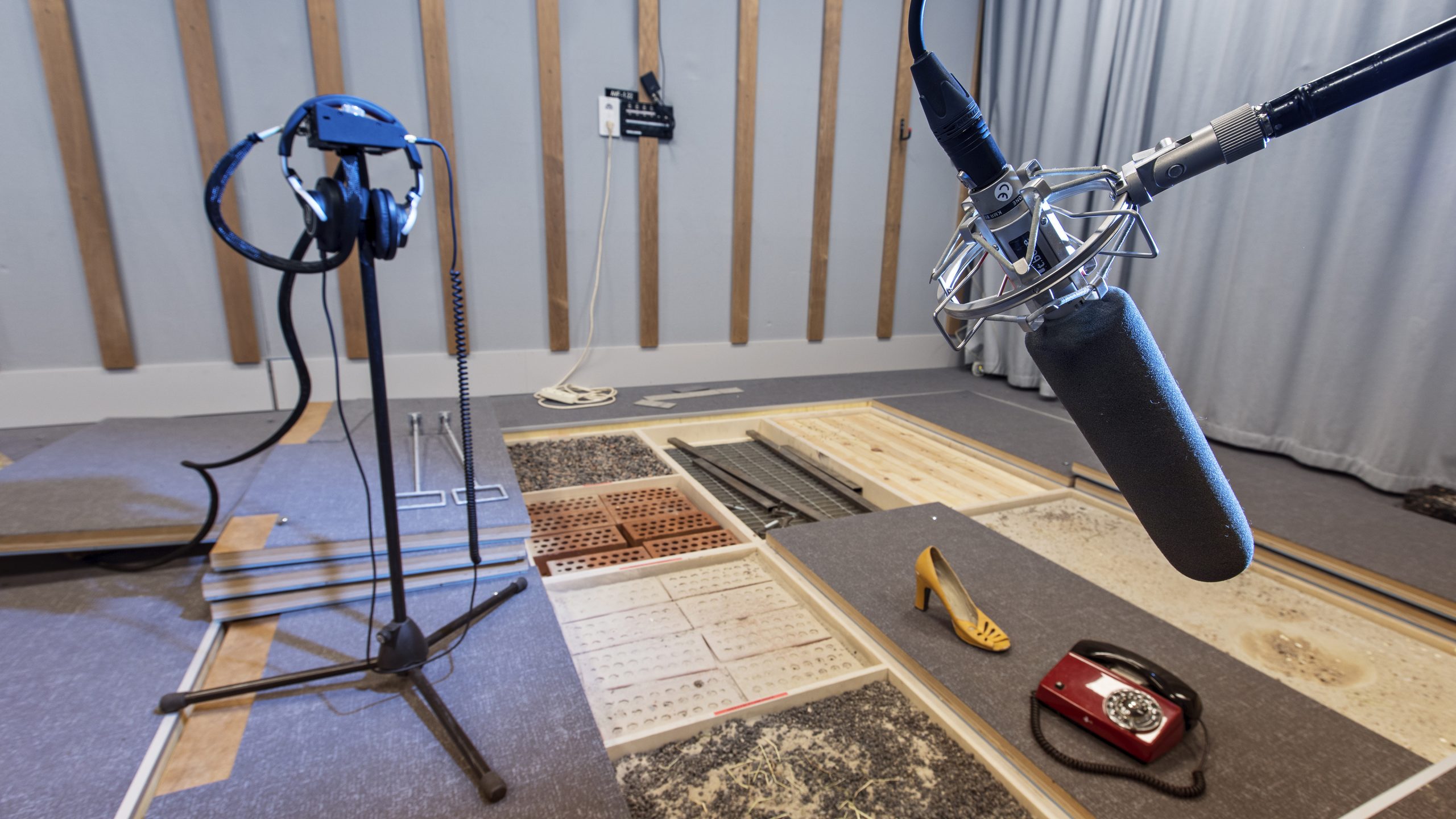
Acoustic engineers examine sound waves through three critical phases: the initial transient spike, the tonal body sustain, and the harmonic decay. When a heavy wooden door slams shut in an old mansion, the mechanical event produces a sharp initial slap as wood strikes the jamb, followed by a low-frequency pressure wave reverberating through hollow panels. Foley pits are meticulously constructed using suspended subfloors, concrete isolation walls, and diverse surface materials to allow performers to manipulate these three acoustic phases in real time.
By understanding how sound travels across varying material boundaries, sound recordists control boundary reflections and room modes before audio signals ever reach a digital audio workstation. Capturing physical kinetic energy without phase anomalies or digital latency requires an uncompromising dedication to acoustic isolation and manual mic technique.
Four proven principles that transform raw noise into cinema magic
Constructing believable acoustic textures requires more than an eccentric prop collection. It relies on a repeatable methodology that balances physical tactile mechanics with emotional storytelling.
Mastering kinetic weight and physical material impedance
Props should never be chosen based on what they represent visually; they must be selected purely for their acoustic impedance and structural density. A miniature plastic toy sword sounds like flimsy plastic no matter how heavily a mixer compresses the audio track. To produce the lethal scrape of ancient Damascus steel clearing a leather scabbard, artists pull antique iron trowels across textured slate tiles.
Here, applied Foley sound design mechanics demand an obsession with surface texture and mechanical resistance. When voicing heavy creature steps, standard combat boots on gravel fail because human mass cannot replicate several tons of lumbering bone and muscle. Artists compensate by dropping dense sandbags wrapped in thick rubber sheeting from specific heights, generating a devastating initial displacement wave that rattles subwoofers with authentic downward inertia.
Sculpting spatial depth through mic proximity and room decay
Flat audio is the hallmark of amateur sound design. A single directional microphone positioned at a static distance makes every footstep and fabric shuffle feel uncomfortably glued to the foreground of the mix. True cinematic depth requires the deliberate manipulation of the proximity effect and ambient room reflections.
Performers achieve this by dynamically altering their distance from custom-designed microphone pairings. A hypercardioid condenser mic positioned twelve inches from a prop captures microscopic transients such as fingernails tapping against a brass key. Simultaneously, a wide-diaphragm room mic set twelve feet back against a reflective wall captures the natural acoustic decay of the studio space. Balancing these two tracks provides mixers with immediate physical depth, allowing characters to recede into background shadows without losing structural detail.
Syncing emotional cadence with micro velocity variations
Mechanical footsteps are the fastest way to expose an artificial soundscape. Every human gait is an emotional barometer. An anxious character does not simply walk faster; their center of gravity shifts forward onto their metatarsals, resulting in lighter heel strikes, shorter ground-contact duration, and frantic fabric scuffs across inner thigh seams.
World-class Foley artists do not watch feet on the monitor; they watch the actor’s hips and shoulders. By mirroring the physical torso dynamics of the on-screen performer, the artist captures subtle micro-velocity variations. The friction between an arm rubbing against a wool coat must swell and diminish in cadence with the actor’s breathing. This kinesthetic empathy binds the audio performance to the actor’s physical presence, delivering an emotional coherence that no static sample library could ever replicate.
Layering hybrid frequencies to create hyperreal visceral textures
Real-world sounds are rarely monochromatic. An arrow whistling through air and piercing a wooden shield contains high-frequency whistling wind, mid-frequency aerodynamic flutter, a sharp acoustic splinter transient, and a low-frequency thud as kinetic energy dissipates into the grain. Capturing that impact as a single acoustic event produces a muddy, indistinct mess.
Instead, artists build composite events out of distinct, layered physical passes. One pass isolates the thin whoosh using a bamboo cane swished inches from a capsule. A second pass captures a razor-sharp hatchet sinking into green pine wood to deliver the splitting transient. A third pass drives an oak mallet into a dense phone book to generate pure low-end shock. While modern editors blend classic Foley sound design mechanics with subtle digital harmonic excitation during final mixdowns, the foundational weight relies entirely on the acoustic interplay of these distinct physical recordings.
Critical production mistakes that destroy sonic credibility
Even seasoned sound engineers can stumble into critical traps when handling physical acoustic recordings. The most common error is the literal prop trap: attempting to record the exact physical object shown on screen rather than searching for the material that best communicates its mass and emotional weight. Filming a character leafing through an ancient parchment scroll often sounds thin on set because old paper is surprisingly brittle. Artists swap the authentic prop for stiff butcher paper soaked in oil and dried, yielding a rich, crackling texture that registers instantly in the cinema.
Another fatal pitfall is frequency masking and unchecked dynamic compression. When an inexperienced engineer smothers Foley tracks with heavy limiters to make them punchy, they obliterate the natural decay tails that inform the human brain about the physical room size. Much like the rigorous verification detailed in our guide to Newsroom Fact Checking Mechanics and 4 Proven Rules to Stop Catastrophic Media Disasters, an audio track requires ruthless editorial scrutiny before it ever reaches the audience. Every layer must possess its own distinct frequency pocket to prevent phase cancellation from turning an energetic brawl into a wash of pink noise.
The enduring power of tactile organic performance
As computational audio synthesis and algorithmic generative sound engines evolve, some assume physical Foley studios will eventually fade into history. Yet synthetic algorithms inherently smooth out the erratic micro-imperfections that define real-world physical contact. A computer program can calculate the mathematical friction of leather moving against corduroy, but it cannot intuit the hesitation of a terrified character grasping a cold brass doorknob.
Ultimately, the psychological grip of Foley sound design mechanics stems from how the human brain integrates multisensory cues. When human beings touch, strike, slide, and manipulate real materials in real spaces, they generate non-linear chaotic acoustic behaviors that synthetic models struggle to capture. As documented extensively by the Motion Picture Sound Editors organization, tactile nuance remains the irreplaceable heartbeat of narrative immersion. Understanding and respecting timeless Foley sound design mechanics ensures that every punch, footstep, and whisper hits with visceral authenticity, grounding even the most fantastical cinema firmly in the realm of raw human experience.