Ice hockey forechecking mechanics and 4 proven tactics that crush opponent breakouts
A devastating forecheck is not built on reckless collisions, but on surgical angles and relentless geometric compression. Uncover the perennial physics and positional disciplines that dismantle clean breakouts before opponents can escape their own zone.
Mastering ice hockey forechecking mechanics turns an unpredictable defensive scramble into a suffocating pressure trap that shuts down opposing transitions before they develop. Casual spectators often mistake a relentless forecheck for sheer aggression, picturing heavyweight wingers hurtling full-tilt into the end boards to deliver bone-crushing checks. That romanticized image misses the true craft. Modern hockey is a high-speed chess match contested at thirty miles an hour on slick, low-friction sheets of frozen water. When five skaters swarm forward without geometric discipline, they do not create turnovers; they surrender odd-man rushes.
At its highest level, defensive puck pressure is an exercise in applied spatial mathematics. The team without possession must systematically shrink the playable surface of the two-hundred-foot rink, transforming wide-open neutral ice into a claustrophobic alleyway where the puck carrier runs out of time, options, and momentum. To command the flow of a game, teams do not merely chase the rubber disc. They dictate where that disc can travel by cutting off passing lanes with active sticks, matching lateral speeds, and forcing panicked retrieval decisions behind the goal line.
The underlying physics of spatial compression on ice
To grasp why elite forechecks dismantle even the most talented defensive pairings, one must examine the friction and inertia that govern movement on skates. Steel blades slicing through ice generate microscopic meltwater films, eliminating most lateral resistance while demanding deliberate edge work to decelerate or pivot. Consequently, understanding modern ice hockey forechecking mechanics requires looking past the collision and studying the angles of pursuit. When an attacking forward approaches a puck carrier on a curved vector rather than a straight bee-line, they immediately eliminate half of the ice surface.
This positional funneling is known as cutting the rink in half. By steering the puck carrier toward one side of the ice with body positioning and an outward-reaching stick blade, the lead forechecker converts a three-hundred-and-sixty-degree breakout landscape into a cramped, one-hundred-and-eighty-degree corridor. Principles codified by the USA Hockey coaching development framework emphasize that the stick on the ice serves as an active barrier just as much as a player’s physical frame. If an attacker positions their blade squarely in the diagonal passing lane, the opposing defenseman cannot execute a crisp tape-to-tape cross-ice feed without floating a soft saucer pass that invites aerial interception.
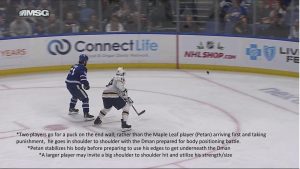
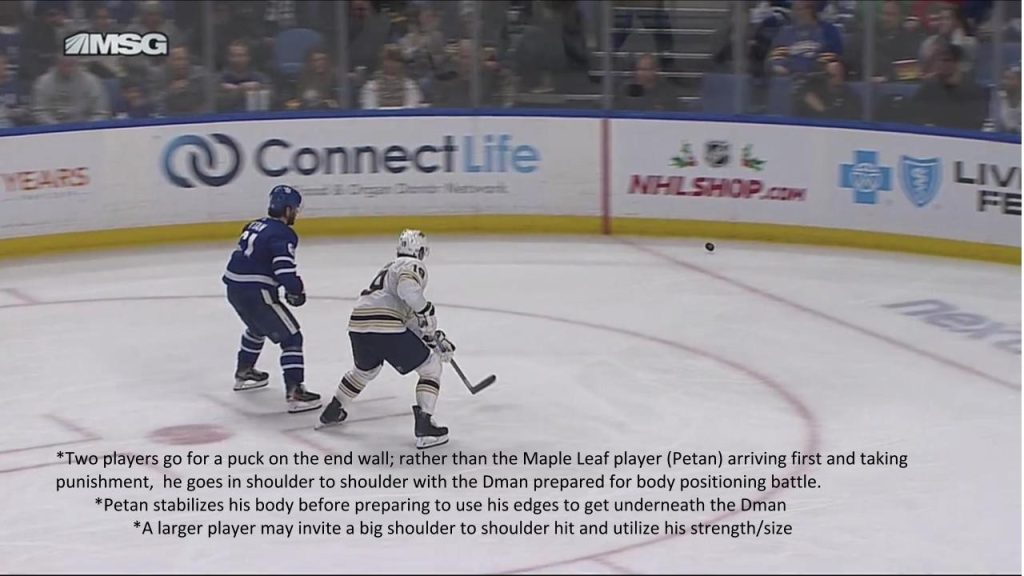
Furthermore, acceleration dynamics dictate that a stationary defenseman retrieving a dumped puck along the end boards is at an immediate kinetic disadvantage. The attacking forward enters the offensive zone carrying forward momentum, while the defenseman must retrieve, swivel their head to assess threat vectors, brake to absorb the puck, and execute an explosive crossover stride to escape. That microsecond gap creates a critical window of vulnerability where calculated stick lifts, board pins, and stick-on-puck challenges wrest away possession.
Why undisciplined hustle destroys defensive structure
Effort without coordination is the primary engine of defensive catastrophes on the rink. When an overeager forward charges directly at the puck carrier without calculating their approach speed, they fall prey to basic evasion mechanics. A skilled puck-handling defenseman simply waits for the attacker to commit their weight, executes a quick cutback against the grain, and uses the forward’s own forward inertia to leave them trailing behind the play like an exhausted spectator.
The underlying geometry of ice hockey forechecking mechanics breaks down when players skate in straight lines. A linear charge opens up a wide passing lane directly behind the charging player, allowing the puck carrier to slide a simple bank pass off the glass or hit a center curling low in support. Once that initial layer of pressure is bypassed, the remaining four defending skaters are suddenly caught in no-man’s land, caught between retreating toward their own blue line and stepping up to contest the puck.
True pressure does not rush blindly toward contact. Instead, it hovers at the edge of the puck carrier’s peripheral vision, closing distance incrementally while preserving the ability to pivot laterally. The best forecheckers keep their feet moving with short, choppy strides, maintaining an active core balance that allows them to mirror the opponent’s hips. If the puck carrier spins left, the forechecker’s inside edge digs deep into the ice, shutting off the escape route before it opens.
Four proven tactical systems that dismantle clean breakouts
Every team adapts its spatial containment based on player personnel, rink dimensions, and opponent habits, but mastering these four pillars of ice hockey forechecking mechanics allows a unit to dictate the game’s tempo under any circumstances.
The 1-2-2 neutral zone funnel that suffocates lateral ice
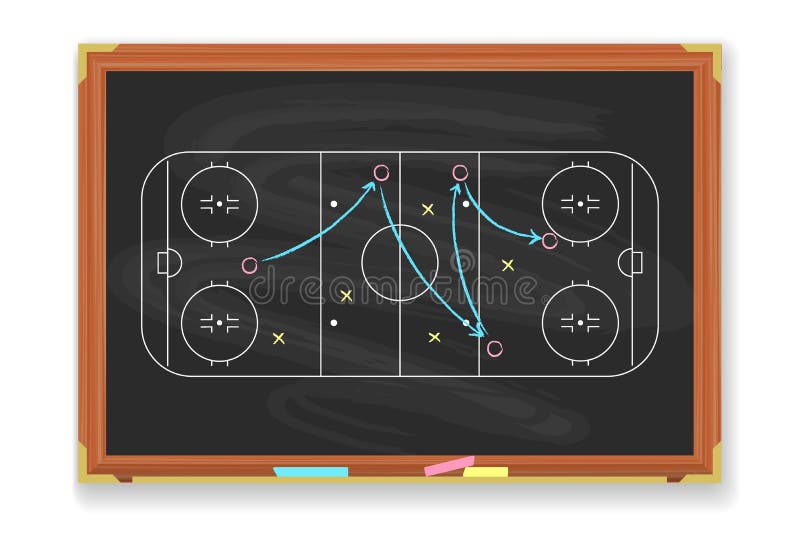
The 1-2-2 system represents the quintessential conservative forecheck designed to choke breakout speed before it crosses center ice. In this formation, the first forward presses deep into the offensive zone with an arc-shaped route, steering the puck carrier toward a designated wall. Behind this lone pursuer, two forwards position themselves near the blue line, straddling the neutral zone like sentries. The final two defensemen hold back near center ice to protect against long stretch passes.
Because the lead forward eliminates the reverse pass behind the net, the opposing defenseman is forced to initiate a breakout along the strong-side boards. The moment that pass is attempted, the strong-side neutral-zone forward steps down hard to contest the reception, while the weak-side forward slides across to choke off the center ice passing lane. The resulting bottleneck forces chip-outs and high turnovers that lead directly to odd-man counterattacks.
The 2-1-2 aggressive press that overwhelms retrieval defensemen
When an opposing defensive corps struggles under physical duress or lacks quick puck-moving mobility, the 2-1-2 system delivers relentless punishment. Instead of sending a single lone hunter, this system deploys two forwards deep below the goal line simultaneously. The first forward initiates contact or forces a hurried rim around the glass, while the second forward crashes the half-wall to intercept the clearing attempt.
Meanwhile, the third forward sits high in the slot, forming an apex that watches the battle unfold. This high forward serves as both a primary scoring option upon an immediate turnover and the first layer of defensive recovery if the puck squirts loose. This intense double-pronged attack forces defensemen to make rushed decisions under full contact, stripping away their composure and inducing blind giveaways right in front of their own crease.
The 1-3-1 left wing lock that traps transition lanes
Originally perfected by defensive-minded European tacticians and later adapted across North America, the 1-3-1 neutral zone alignment creates a defensive wall across the ice that completely halts transition rhythm. The solo forechecker attacks deep to disrupt initial possession, but the real trap lies across the blue line, where three skaters line up in a horizontal barrier. Typically, the left wing drops back alongside the two defensemen, forming a dense secondary barrier that denies entry through the middle of the rink.
Opponents attempting to carry the puck through this web encounter three coordinated sticks and zero open ice, forcing them into predictable dump-and-chase scenarios where the lone free safety defenseman can cleanly recover possession. This strategic structure squeezes all creativity out of opposing playmakers, and that spatial compression represents the core genius of modern ice hockey forechecking mechanics on Olympic and standard sheets alike.
The weak side pinch that seals the half wall exit
The most daring weapon in an attacking team’s tactical toolkit is the aggressive defensive pinch. As an offensive cycle wears down the opposing defense, the puck often rattles up the side boards toward the blue line. Rather than retreating conservatively toward the neutral zone, the strong-side defenseman charges downhill along the boards, using their body and stick to seal the puck inside the offensive zone.
This maneuver requires perfect synchronization from the high-slot forward, who must immediately rotate out to the blue line to cover the vacated defensive position. By cutting off the puck along the half wall, the team sustains uninterrupted offensive zone time, wearing down exhausted defenders who have already been trapped on the ice for sixty seconds or more.
How elite teams balance defensive recovery against sudden turnarounds
The greatest danger of applying relentless forward pressure is the constant threat of the counter-punch. When five skaters lean forward into an aggressive forechecking posture, they gamble that their stick work and spatial angling will deny a clean first pass. If that first pass slips through the net, the entire attacking structure is suddenly caught facing the wrong direction, sprinting desperately to catch an opposing transition rushing toward an exposed goaltender.
Discipline during breakdowns separates championship squads from reckless pretenders. Elite units operate on strict rotational protocols where no forward chases deep below the goal line unless a teammate has already occupied the high slot to cover the safety valve. As demonstrated when analyzing how VGK endures 4 costly breakdowns against Tampa Bay in Las Vegas showcase action, a single mistimed pinch by an overzealous defenseman turns an offensive zone cycle into a catastrophic odd-man rush against.
Indeed, without synchronization across all five skaters, aggressive ice hockey forechecking mechanics can backfire and expose defensemen to catastrophic counters that leave netminders completely unprotected against two-on-one and three-on-one odd-man transitions. Maintaining structural integrity requires players to possess the maturity to abandon a lost forecheck, skate backward into defensive recovery lanes, and re-establish a disciplined neutral zone posture rather than lunging into low-percentage stick checks.
The cognitive instincts behind perpetual offensive pressure
Beyond systems, formations, and edge work, perpetual puck pressure relies on lightning-fast cognitive processing. An elite forechecker reads the opponent’s eyes, blade angle, and shoulder orientation well before the puck leaves the blade. By decoding these physical tells, the forward begins skating to where the puck must go rather than where it currently sits.
Patience plays a counterintuitive role in this aggressive craft. Top forecheckers frequently employ subtle decoy angles, deliberately leaving a passing lane open for a fraction of a second to bait the opposing defenseman into making the pass they desire. The moment the defenseman commits their hands to that passing motion, the forechecker snaps their stick into the lane, deflecting the puck into the corner and pinning the surprised defenseman against the glass.
Ultimately, executing relentless ice hockey forechecking mechanics transforms physical effort into predictable, repeatable territorial control. When executed with geometric discipline, active communication, and surgical skating angles, the forecheck ceases to be a blunt defensive tool. It becomes the sharpest offensive weapon in hockey, crushing the opponent’s will to play from the very first drop of the puck.