News verification mechanics and 4 proven rules that prevent disastrous reporting failures
In an era of hyper-fast digital feeds, the difference between an authoritative scoop and a catastrophic retraction rests on disciplined tradecraft. Here is how modern newsrooms systematically dissect, challenge, and corroborate raw information before it reaches the public.
Mastering modern news verification mechanics separates legitimate reporting from chaotic digital hearsay when breaking events flood networks with contradictory claims and unvetted footage. In the relentless rhythm of the information landscape, the pressure to publish instantaneously operates like an intoxicating narcotic. Yet beneath the speed runs a hazardous undercurrent. A single uncorroborated tweet or manipulated video can destroy decades of institutional authority within minutes. Real investigative rigor is not a mystical gut instinct. It is an exacting discipline built on forensic verification protocols.
When an unexpected alert detonates across the wires, seasoned editors step into a structured triage mode. They understand that what arrives first is almost always incomplete, frequently exaggerated, and occasionally fabricated. Fact-gathering requires treating every assertion, document, and recording as an unsolved puzzle. The reporters who endure across decades are not those who tweet the fastest, but those whose dispatches withstand the scrutiny of dawn.
The Invisible Machinery Behind Every Validated Headline
Behind every clean, definitive sentence in an authoritative news dispatch lies an unseen lattice of cross-checks, background queries, and technical examinations. Information arrives at an editorial desk through chaotic pipelines: encrypted leaks, raw emergency radio chatter, amateur smartphone captures, corporate press releases, and tip lines. Processing this raw stream requires strict information hygiene. Every item must be detached from its emotional framing and assessed solely on verifiable substance.
At its core, the foundational reality of news verification mechanics is that information is presumed tainted until proven authentic. Verification desks do not ask whether an account sounds plausible; they aggressively test every possible avenue of falsification. The standard guidelines articulated in the American Press Institute verification principles emphasize that discipline of verification is precisely what separates professional journalism from entertainment, advocacy, or casual commentary. If a claim cannot produce an origin trace, a secondary corroborating source, and tangible documentary support, it remains locked in editorial quarantine.
This vetting architecture is built on multiple checkpoints. Reporters interrogate the provenance of digital files, scrub documents for hidden revision layers, and interview primary witnesses while deliberately withholding critical details to see if the subject spontaneously mentions them. That meticulous filtering process operates out of public view, allowing readers to digest clean, unambiguous reality without wading through the hazardous debris of raw rumor.
The Latency Penalty Between Velocity and Absolute Certainty
The contemporary news ecosystem suffers from an intrinsic tension between publication velocity and evidentiary certainty. Social platforms algorithmically prioritize sensationalism, rewarding accounts that declare sweeping conclusions seconds after an incident occurs. For traditional newsrooms, this creates an agonizing latency penalty. Every minute spent calling an official bureau, parsing flight tracking records, or consulting forensic imagery analysts feels like an eternity while competitors broadcast speculative gossip.
Yet velocity without verification represents an existential hazard. Once an incorrect premise enters the collective stream, it spreads exponentially. Retractions, no matter how prominently displayed, reach only a fraction of the audience exposed to the initial falsehood. During fast-moving unrest or volatile civic events, speculative coverage inflames real-world danger. In complex social landscapes, like the unrest examined in Why Are They Protesting in France With 4 Critical Flashpoints Igniting Nationwide Turmoil, unvetted rumors regarding crowd sizes, police conduct, or institutional responses can dramatically warp public perception and distort ground realities.
Resilient media organizations treat speed as an outcome of efficiency rather than a compromise of standards. By establishing streamlined verification pipelines, specialized fact-checking units shave crucial minutes off their confirmation workflows without bypassing fundamental validation checks. The goal is never to win a race to publish an error; it is to arrive first with the facts that matter.
Four Essential Protocols That Guarantee Factual Bulletproofing
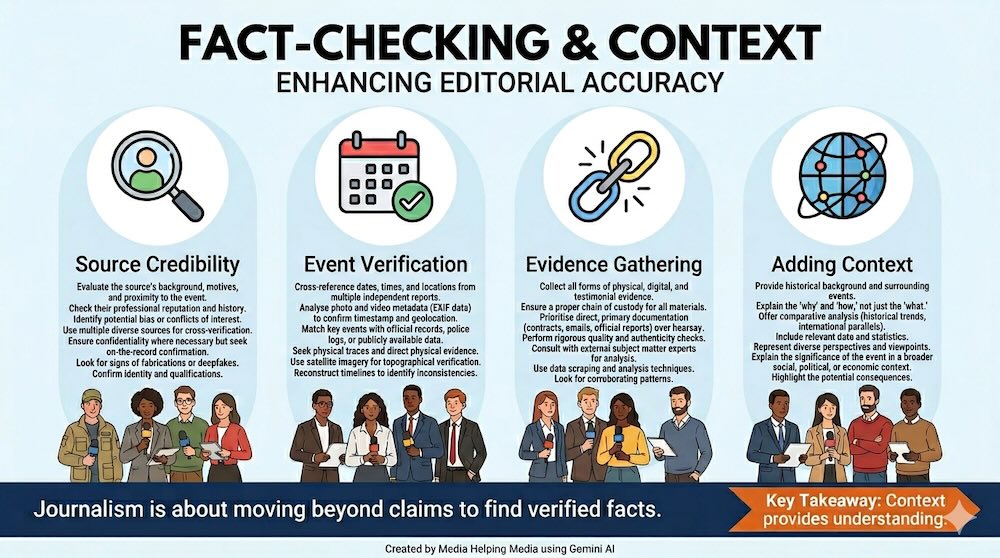
Surviving the relentless velocity of breaking coverage demands systemic safeguards rather than casual intuition. Relying on sound news verification mechanics transforms frantic deadline reporting into an unassailable record by routing every incoming signal through four non-negotiable operational filters.
Reverse Source Tracing and Upstream Attribution
The first defensive wall involves locating the patient zero of any claim. Viral narratives typically thrive through circular aggregation, where publication A quotes blog B, which quotes an anonymous account that originally misread an official statement. Reporters must systematically strip away secondary and tertiary reporting until they reach the primary genesis point. If the trail terminates at an anonymous aggregator or an inaccessible source with zero historical footprint, the claim stops dead. True attribution requires speaking directly with primary actors or inspecting foundational source records rather than trusting intermediate summaries.
Metadata Forensics and Environmental Cross Referencing
Visual and auditory evidence must undergo rigorous technical cross-examination. Smartphone footage and digital imagery leave forensic footprints within their Exchangeable Image File Format (EXIF) data, revealing device profiles, sensor configurations, and timestamps. Even when bad actors strip metadata via social compression, open-source intelligence analysts analyze shadow angles against solar positioning calculators, compare architectural landmarks against satellite grids, and cross-reference background license plates or street signs. This forensic layer of news verification mechanics ensures that digital artifacts match historical weather records and geographic terrain before an image is broadcast as current evidence.
Multi Channel Independent Corroboration
A solitary source, no matter how decorated or apparently neutral, is never adequate for high-stakes assertions. True corroboration demands independent convergence across multiple distinct channels. An official statement must align with physical documentation; an eyewitness testimony must match time-stamped radio traffic or immutable municipal data. Crucially, multiple sources reciting the exact same talking points from an identical briefing packet do not represent independent corroboration; they represent coordinated distribution. Genuine confirmation occurs when disparate observers with zero communication between them independently document identical facts from differing perspectives.
Adversarial Red Teaming Before Publication
Before any major revelation or volatile breaking story goes live, the draft should undergo adversarial stress testing. A senior editor or designated desk reporter assumes the mindset of a hostile skeptic whose sole assignment is to dismantle the piece. They interrogate the gaps: What if the primary source is executing a personal vendetta? Could this satellite photograph show a different facility altogether? Does the quoted statistic omit baseline variables? This internal friction forces reporters to shore up vulnerabilities, eliminate subjective conjecture, and eliminate structural weaknesses prior to public release.
Cognitive Traps and the Psychology of Newsroom Hallucinations
Even seasoned journalists stumble into traps when cognitive fatigue collides with powerful narrative biases. Newsrooms are populated by human beings who naturally crave narratives that validate existing worldviews or confirm widely anticipated outcomes. When an unverified leak aligns seamlessly with what an editor already suspects to be true, critical defenses drop. The narrative feels right, and that psychological resonance masquerades as verification.
Sophisticated disinformers deliberately exploit these cognitive blind spots. They construct forged documents or staged videos specifically tailored to confirm prevailing media expectations, betting that the rush to be vindicated will override customary scrutiny. Whenever editorial teams compromise on news verification mechanics to chase algorithmic traffic spikes, the inevitable fallout dismantles years of earned credibility. Recovering from an avoidable mistake takes months of painstaking public transparency, while the initial lapse remains permanently weaponized by critics seeking to undermine all independent reporting.
Resisting this psychological drift requires institutionalized humility. Editors must actively celebrate reporters who walk into news conferences to declare that a viral story is completely unfounded. Killing a false narrative before it pollutes the newsroom is just as valuable to the public good as publishing a massive scoop.
Building a Resilient Architecture for Information Integrity
Information technology will continue to advance, lowering the cost of generating convincing synthetic media, deepfake voice clones, and falsified public records. As synthetic assets become indistinguishable from raw footage to the naked eye, traditional casual review is obsolete. The future of news credibility belongs entirely to organizations that view verification as an engineering discipline rather than an afterthought.
News desks must invest heavily in cryptographic verification, public ledger tracking, and specialized open-source intelligence methods. Yet advanced digital tools remain worthless without the stubborn human skepticism that forms the soul of classic muckraking. Technology can map the pixel shifts in a forged video, but it cannot evaluate the secret motives of an anonymous leaker or knock on doors in a remote town to verify an address. Institutional adherence to news verification mechanics remains the only durable firewall separating public journalism from weaponized noise, anchoring democratic dialogue in provable, shared reality.