Tennis serve mechanics and 4 proven principles that unlock explosive power
Raw arm strength never creates a truly devastating tennis serve. Real velocity comes from an uncoiling kinetic chain, precise biomechanics, and effortless rotational energy.
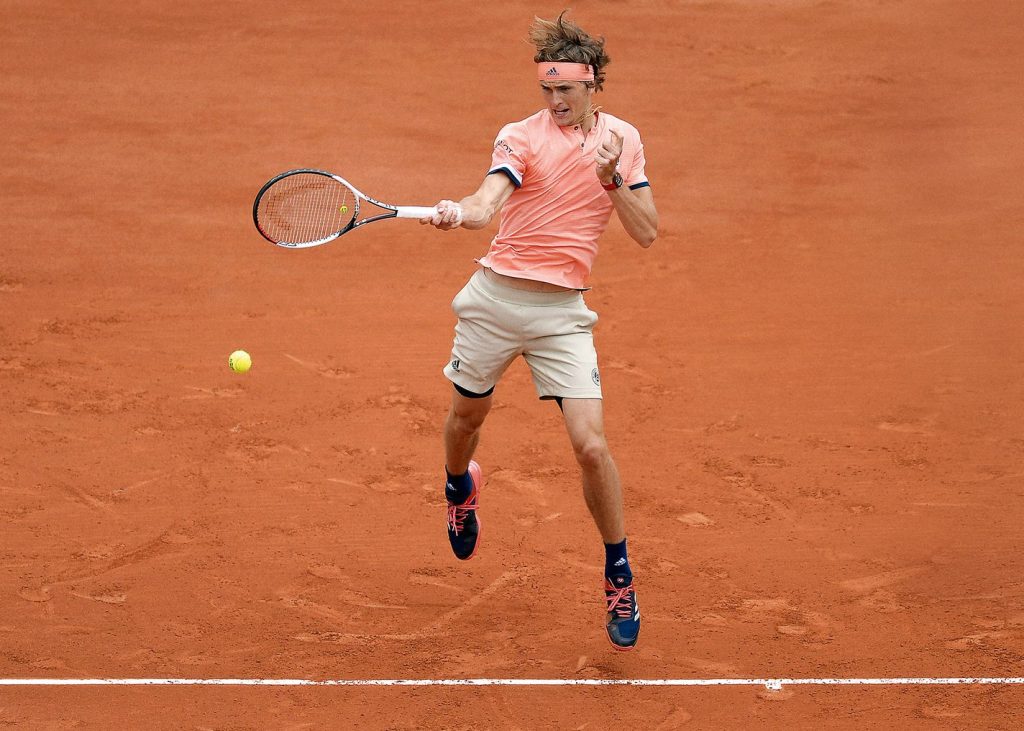
Mastering tennis serve mechanics requires unlearning the intuitive urge to muscle the ball across the net with sheer upper-body strength. When recreational players step up to the baseline, they frequently view their hitting arm as a rigid lever meant to bludgeon the ball through pure muscular strain. Professional servers operate under an entirely different mechanical reality, treating the body as an interconnected series of segmented links. The racket head rips through the contact zone at extraordinary speeds not because the shoulder is abnormally strong, but because every bodily segment accelerates and decelerates in an exquisitely timed neuromuscular sequence.
Understanding this movement changes everything. The human body produces speed through summation of speed, passing momentum upward from large, slow muscle groups into small, lightning-fast joints. When an athlete misinterprets this sequence, velocity evaporates, consistency plummets, and the rotator cuff absorbs devastating eccentric loads. Unlocking reliable pace and heavy rotation demands an intimate appreciation of physics, kinetic sequencing, and joint alignment.
The Physics of Elastic Energy and Human Levers
Every dynamic overhead motion relies on kinetic chaining, where mechanical energy originates at the ground and travels through the musculoskeletal structure before escaping into the projectile. Understanding the underlying physics transforms how athletes view tennis serve mechanics from an isolated swinging action into a continuous transfer of stored kinetic energy. When your feet press into the court surface, the ground delivers an equal and opposite force that travels upward through the lower extremities.
This upward wave is not merely a transfer of rigid force; it relies heavily on the stretch-shortening cycle of muscle tissue and elastic tendons. When a muscle group stretches under load immediately before contracting, it stores strain energy within its collagen matrix. Releasing that stretch immediately produces a far more explosive contraction than any static muscular effort could dream of achieving. In an elite serve, elastic stretch occurs across multiple planes simultaneously, twisting through the abdominal wall, coiling across the chest, and bowing backward through the spine.
The racket acts as the final terminal lever in this anatomical whip. By creating an immense distance between the racket head and the rotating torso, a server creates an extended radius of gyration. When the core decelerates sharply, the principle of conservation of angular momentum forces the terminal segments, namely the forearm and the racket, to accelerate exponentially through contact.
How the Kinetic Chain Transfers Force from Ground to Strings
The progression of energy across the kinetic chain operates like falling dominoes, where each link must finish its job and begin to brace before the next link can fire cleanly. The sequence initiates at the ankles and knees, moving through the hips, lumbar spine, thoracic core, scapula, shoulder, elbow, wrist, and fingers. According to a comprehensive biomechanical analysis of the tennis serve, over fifty percent of total kinetic energy and force delivered to the tennis ball comes directly from the lower body and trunk rotation.
If any intermediate link in this biological sequence fails to engage, the entire transfer collapses. When an athlete attempts to hit hard without bending their knees or rotating their pelvis, the proximal chain stays dormant. The distal joints must then overcompensate to make up the missing velocity. This compensatory overdrive is the exact reason why amateur players develop chronic shoulder impingement and medial epicondylitis. Efficient power generation feels surprisingly effortless to the athlete because force is distributed across dozens of large muscles working in synchronized harmony rather than three or four small muscles working to exhaustion.
Four Proven Principles That Maximize Velocity and Racket Acceleration
Refining tennis serve mechanics requires isolating the specific mechanical hinges that generate racket head acceleration without introducing structural strain. By zeroing in on these four distinct technical fundamentals, any dedicated player can replace frantic arm swinging with deep, fluid elasticity.
Ground Reaction Force and Deep Knee Flexion
Power originates in the dirt. Deep knee flexion does not simply lower your center of gravity; it loads the quads, hamstrings, and gluteal complexes like compressed industrial springs. Whether you prefer a platform stance with stationary feet or a pinpoint stance where the back foot slides forward, the loading mechanism remains identical. Both knees should flex downward until the quadriceps reach approximately fifty to sixty degrees of flexion.
The explosive drive out of this squat must travel upward and forward into the court rather than straight into the sky. As the legs uncoil, the hips drive diagonally upward, creating an upward propulsion vector that tilts the pelvic girdle. This explosive ground push creates the necessary kinetic lift that pulls the torso upward and allows the hitting shoulder to operate high above the baseline plane.
The Dynamic Trophy Coil and Deep Racket Drop
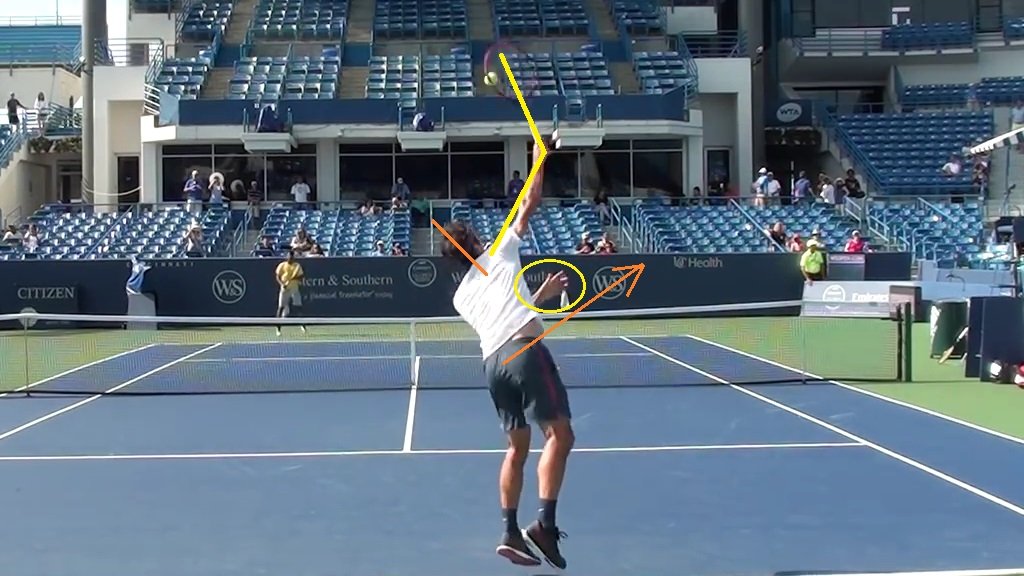
The traditional coaching phrase regarding the trophy pose frequently misleads players into pausing at the top of their motion. In high-level execution, this position is never static; it is a dynamic, continuous coil. The non-dominant shoulder reaches high toward the ball while the hitting shoulder drops down and back, establishing an exaggerated shoulder-over-shoulder tilt reminiscent of a cartwheel.
From this tilted coil, the racket drops behind the back into deep external rotation. Many developing players manually push the racket into their spine, but a true racket drop is passive. As the chest explodes forward and the shoulder girdle begins its violent horizontal rotation, the heavy racket head lags behind naturally due to inertia. This creates extreme eccentric loading across the pectoralis major and subscapularis muscles, storing potent elastic tension that will snap the racket upward milliseconds later.
Shoulder Internal Rotation and True Forearm Pronation
Perhaps the most misunderstood component of the serve is the motion occurring at the wrist and forearm. Beginners often believe they should snap their wrist forward in a flexion movement to drive the ball downward. This myth destroys timing and leads directly to chronic tendon damage. True acceleration relies on rapid internal rotation of the humerus accompanied by forearm pronation.
During pronation, the forearm rotates internally on its longitudinal axis, turning the palm from facing outward to facing diagonally toward the side fence immediately after ball impact. This rotational snap is the crowning element of elite tennis serve mechanics, generating the final burst of speed without destroying the fragile joint tissues. Much like the foundational kinetic whip examined in our guide on Curveball pitching mechanics and 4 proven rules that generate unhittable break, the overhead athletic movement relies on rapid internal rotation rather than active muscular pushing.
Ball Toss Precision and Forward Angular Momentum
An erratic toss destroys even the most refined kinetic sequence. If the ball enters the hitting window even six inches too far back or wide, the body must instantly abandon its natural uncoiling pattern to rescue the strike point. The toss must be placed consistently inside the baseline, generally at an angle that corresponds to roughly one o’clock for a right-handed server.
By placing the toss slightly into the court, the server forces their center of mass to travel across the baseline during the swing. This forward translation blends linear momentum directly into angular momentum. Gravity pulls the athlete downward into the court as the swing carries them forward, ensuring that bodyweight reinforces every ounce of rotational torque delivered by the upper torso.
Fatal Biomechanical Faults That Bleed Power and Cause Rotator Cuff Injury
When an athlete misunderstands tennis serve mechanics, the body automatically compensates by forcing the rotator cuff to generate power it was never designed to produce alone. The most widespread technical error is the notorious waiter tray serve, where the racket face opens early toward the sky during the loading phase. When the strings face upward prematurely, the shoulder cannot access internal rotation. The server ends up pushing the ball like a shot put, placing colossal shear stress on the anterior capsule while bleeding fifty percent of available racket velocity.
A second major structural flaw involves arching the lumbar spine backward rather than flexing the knees. Bending from the lower back gives a false illusion of loading, but it severely pinches the lumbar vertebrae and leaves the ground reaction forces untapped. Severe lower-back hyper-extension combined with rapid torsional rotation is a primary cause of stress fractures among competitive junior players. The thoracic spine should extend, and the knees must bend, but the lower back must remain braced by strong abdominal engagement.
Finally, rushing the delivery cycle ruins the transfer of momentum. Players often panic when the toss reaches its zenith, triggering the arm before the lower body has completed its upward drive. When the arm fires prematurely, the kinetic wave from the legs arrives too late, crashing harmlessly into an already extended torso. Peak synchronization demands calm timing where the swing feels almost lazy until the precise moment of uncoiling.
Deliberate Training Drills That Rebuild Muscle Memory Without Joint Strain
To rebuild efficient tennis serve mechanics, athletes must isolate distinct kinematic phases before attempting full-speed deliveries from the baseline. Attempting to overhaul six physical movements simultaneously while trying to hit an ace across the net invariably ends in cognitive overload and mechanical regression.
Begin with the continuous throwing drill using an ordinary football or weighted plyometric ball. Stand sideways in your serving stance and focus entirely on throwing the object high and deep across the court using an uncoiling torso and hip drive. Because your hand is gripping a ball rather than an extended racket frame, your brain naturally selects the most biomechanically efficient kinetic path, using shoulder internal rotation and a relaxed elbow naturally.
Next, practice edge-on shadow swings. Take your racket with a strict Continental grip and swing slowly in front of a mirror, ensuring the leading edge of the racket frame cuts through the air like an axe blade until the final microseconds before the imaginary contact point. The strings should only turn toward the target through natural forearm pronation at the last conceivable instant. This eliminates the waiter tray habit by reinforcing correct forearm geometry without the distraction of striking an actual ball.
Synthesizing Fluidity and Neuromuscular Rhythm on Court
True power on the tennis court is an emergent property of relaxation and mechanical alignment, never the product of brutal straining. The hardest hitters in tennis history move with an ethereal, effortless grace that looks deceptively casual on high-speed cameras. Their speed comes from total neuromuscular freedom, allowing joint levers to whip unhindered through an unrestricted arc of motion.
Ultimately, repeatable tennis serve mechanics depend on quiet confidence and predictable neuromuscular timing rather than frantic exertion. Release the grip tension in your fingers, establish a rhythmic breath during your bounce routine, and trust the kinetic cascade to do the heavy lifting for you. When the ground pushes upward, the hips clear, and the forearm pronates cleanly through the strike, you will discover heavy, unreturnable power you never knew your frame possessed.