Foley sound design mechanics and 4 proven methods that create unforgettable cinematic realism
Discover how master Foley artists reconstruct the physical world in soundproof isolation using unconventional props, acoustic psychology, and precise kinetic timing. Uncover the tactile engineering behind cinema’s most believable moments.

Mastering Foley sound design mechanics allows cinematic storytellers to transform sterile studio sets into visceral, tactile worlds that hold viewers spellbound from opening frame to final credit. When an audience watches a trench coat whip against a windy alleyway or cringes at the bone-crunching impact of a tavern brawl, they assume the production microphone captured that sonic truth on location. In reality, almost nothing heard in modern cinema existed during the actual film shoot. Production microphones are tuned ruthlessly to capture clean human dialogue, filtering out the rustle of denim, the scuff of leather soles, and the clinking of porcelain cups as background noise. Reconstructing that lost tactile world is the legendary craft of Foley art, a discipline situated directly at the intersection of acoustic physics, biomechanics, and pure theatrical illusion.
Named after early sound pioneer Jack Foley, this sonic discipline is far more sophisticated than simply smashing watermelons or stomping on hardwood planks. It is an intricate architectural science where human motor skills meet spatial psychoacoustics. Every subtle hand movement against a fabric swatch or deliberate weight transfer across broken slate sends distinct pressure waves into sensitive condenser capsules. Understanding the physical mechanics behind this art form unlocks a deeper appreciation of why cinema feels real to our nervous system even when every single frame is an elaborate construction.
The Psychoacoustics of Reconstructed Cinematic Sound
The human brain possesses an astonishingly sensitive system for processing environmental audio. Evolution fine-tuned our ears to gauge the mass of an approaching predator, the brittleness of dried twigs underfoot, and the density of physical barriers long before visual confirmation is possible. In cinema, if the sound of a closing door lacks lower mid-range resonance, the mind instantly categorizes the prop as hollow plywood rather than solid oak. This is why the core principles of Foley sound design mechanics rely as much on cognitive science as they do on physical props.
When an audio artist steps onto a recording stage, their goal is not literal duplication but psychological persuasion. Counterintuitively, literal recordings of everyday objects often sound thin, unconvincing, and foreign through modern playback speakers. Real gunshots frequently register as flat, papery pops because recording equipment clips their explosive transient peaks, whereas a carefully constructed composite of cracking timber, compressed air releases, and resonant metal strikes registers to the viewer as devastatingly authentic. According to Audio Engineering Society research papers on acoustic perception, human listeners evaluate realism based on transient attack, textural decay, and frequency balance rather than photographic fidelity. The artist manipulates these acoustic variables to satisfy the subconscious expectations of the human ear.
The Anatomy of a Professional Foley Recording Stage
A professional Foley stage is one of the most eccentric architectural environments in the entertainment industry. Unlike music recording spaces that prioritize pleasant natural reverberation, a Foley live room is designed for near-total acoustic neutrality. The room is heavily treated with broadband bass traps, acoustic diffusers, and thick absorption panels to achieve an extremely short decay time. Eliminating room reflections ensures that the recorded sound contains zero baked-in environmental space, allowing the post-production re-recording mixer to place that sound within any simulated environment, whether an expansive cathedral or a cramped submarine corridor.
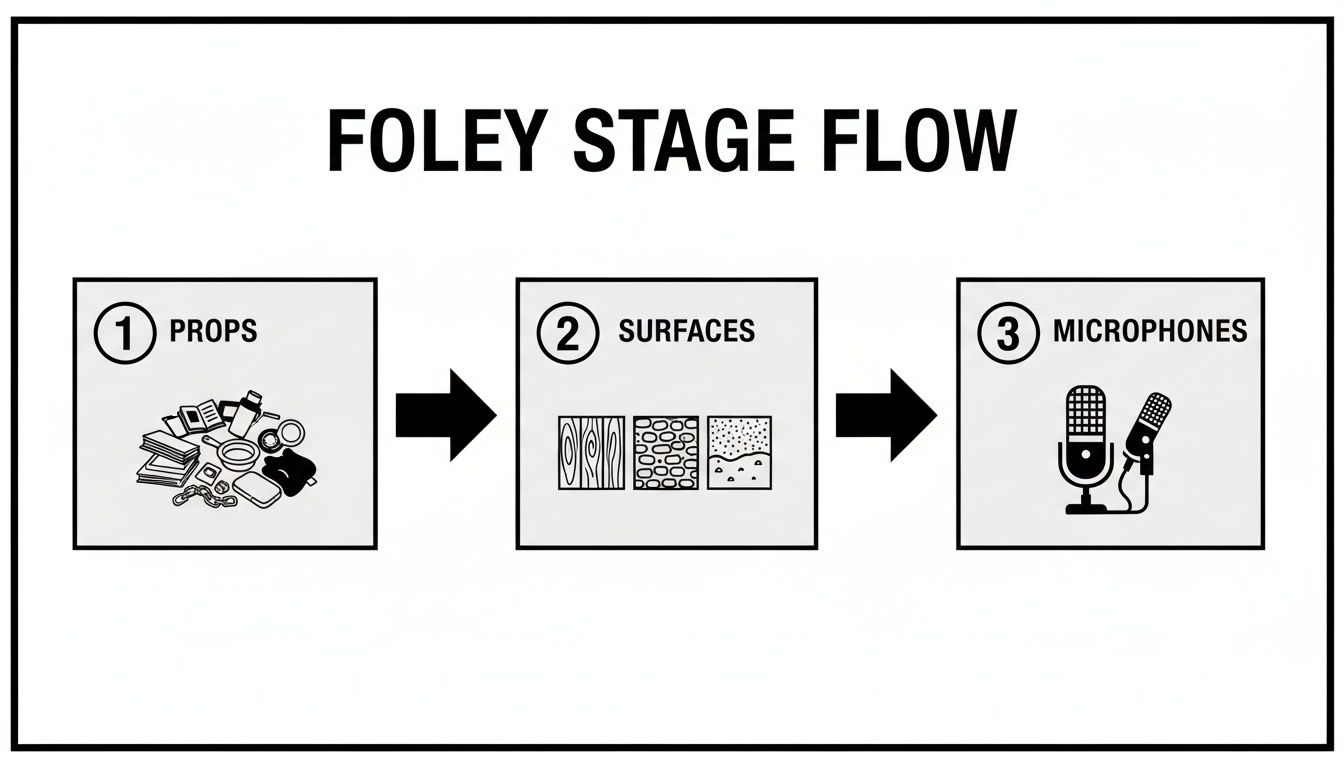
Before stepping onto the stage, one must understand how Foley sound design mechanics interact with modern studio acoustics. The floor of a dedicated Foley stage is divided into a mosaic of specialized pits, each roughly one meter square. These shallow basins contain materials such as pea gravel, crushed granite, fine beach sand, wet mud, aged pine floorboards suspended over an air cavity, and solid slabs of honed marble. Surrounding these pits are vast shelves packed with thrift store castoffs: antique rotary phones, heavy brass keys, vintage metal lunchboxes, lengths of rusted automotive chain, and tailored garments composed of silk, corduroy, and oiled leather. The room is a physical archive of textures, waiting for calibrated kinetic energy to bring it to life.
Four Proven Principles of Believable Foley Architecture
Every master audio practitioner relies on four foundational pillars of Foley sound design mechanics to craft believable soundscapes that seat an audience directly inside the narrative frame. By mastering these acoustic methodologies, sound artists ensure that every movement resonates with weight, emotional intent, and physical authority.
Layering Textural Density Over Pure Volume
Amateur audio production frequently confuses loudness with physical impact. Professional Foley artists operate with the understanding that impact is an illusion produced by layering contrasting frequencies and material textures. A single punch thrown in an action sequence is almost never a single sound event. It is constructed through three distinct acoustic layers: the transient whip of displaced air before contact, the fleshy compression of impact, and the low-frequency bone resonance that vibrates through the victim’s skeleton.
To build this composite, an artist might snap a stalk of fibrous celery wrapped in a damp leather chamois right against the microphone capsule to produce the cartilage break, followed by striking a dense side of wet beef with a wooden mallet for the blunt weight. By separating the high-frequency crunch from the low-frequency thud and blending them with millisecond precision, the performer creates a visceral, multidimensional hit that feels dangerous without overloading the audio bus.
Microphone Proximity and Visual Spatial Matching
An acoustic recording must mirror the visual focal length of the camera lens. If an actor on screen is framed in an extreme wide shot traversing a snowy mountain ridge, a pristine, hyper-detailed footstep recorded three inches from a microphone will violently break audience immersion. The ear perceives close-proximity high frequencies that contradict the visual distance of forty yards.
To solve this discrepancy, veteran artists work dynamically with their recording engineers, constantly altering physical distances and off-axis angles. For distant perspectives, the artist steps away from the capsule, allowing air dissipation to naturally attenuate the brittle top-end frequencies while capturing the diffuse room bloom. For intimate close-ups—such as a character nervously picking at a fingernail or tracing a letter with a fountain pen—the microphone is positioned mere inches away to capture the microscopic scraping details that draw the listener into psychological intimacy.
Prop Metaphor and Dynamic Sensory Exaggeration
Literal props almost never produce the cinematic sound audiences expect. The actual object seen on screen is often made of fiberglass, foam rubber, or lightweight plastic to ensure safety and ease of transport on set. Foley performance requires finding sonic metaphors: non-literal items whose physical properties yield rich, emotive acoustics when stressed under studio conditions.
A leather glove squeezed rhythmically creates the creak of a ship’s timber hull. A heavy car door hinge salvaged from a salvage yard provides the menacing groan of a medieval iron dungeon gate. Two pine cones rolled firmly between the palms generate the snapping bone structure of an awakening monster. The performer analyzes the emotional subtext of the scene rather than the literal object, selecting materials that heighten suspense, horror, or tactile comfort through intentional sensory exaggeration.
Human Performance Sync and Organic Kinetic Timing
No sample library or automated software algorithm can duplicate the complex, micro-timing variations of a human body moving through space. Footstep tracking, known in the trade as Foley walking, is an athletic performance that requires the artist to mirror every nuance of an actor’s gait, posture, footwear, and emotional condition on a real-time monitor.
Athletic choreography on screen demands an instinctive understanding of inertia and body weight. When tracking high-stakes movement—whether a combat scene or the intense physical maneuvering captured when RCD Espanyol Faces 3 Critical Tactical Tests in a Thrilling Clash Against Atletico Madrid—the artist must mimic the deceleration, pivot, and turf drag of professional athletes. A tired character drags their heels with delayed heel-to-toe roll; an aggressive character strikes the ball of the foot with rapid downward velocity. By leaning forward or backward in the pit, the Foley walker shifts their own mass, imparting real kinetic inertia into the acoustic recording.
Costly Studio Errors That Destroy Sonic Immersion
When amateur productions attempt to shortcut Foley sound design mechanics, the illusion immediately shatters under clinical listening conditions. One of the most widespread errors is over-compressing transient sounds such as footsteps or prop handling. Excessive dynamic compression raises the ambient noise floor and squashes the vital micro-peaks of sound, rendering footsteps as mechanical thumps rather than dynamic human steps.
Another fatal flaw is failing to conduct dedicated cloth passes. In cinema, human movement is characterized by the quiet friction of clothing rubbing against itself as an individual breathes, shifts their weight, or turns their head. Leaving these layers out produces a jarring phantom presence where actors walk on screen as disembodied shoes without an accompanying torso. Recording a separate, full-length cloth pass using fabrics matched to the wardrobe on screen binds the entire mix together, masking the clinical silence between dialogue lines.
The Enduring Human Artistry Behind Tactile Sound
Despite massive advancements in machine learning, artificial intelligence, and digital synthesis, the physical Foley stage remains an irreplaceable cornerstone of cinematic post-production. Technology can synthesize waveforms, but it cannot read the sorrow in an actor’s drooping shoulders or intuitively drag a fingernail across a rusted tin can at the exact fraction of a second when tension peaks.
Ultimately, the study of Foley sound design mechanics reveals that great cinema sound is an emotional language disguised as physical debris. By understanding the acoustic mechanics of mass, friction, and kinetic timing, the Foley artist continues Jack Foley’s century-old legacy, proving that human touch, imagination, and a handful of unusual props remain the ultimate machinery of cinematic wonder.