Sourdough fermentation mechanics and 4 proven rules that create breathtaking artisan bread
Behind every blistered crust and open crumb lies a dynamic ecosystem of wild yeasts and bacteria competing for fuel. Understanding the biochemical mechanics of fermentation frees you from rigid timers and turns artisan baking into an intuitive art.
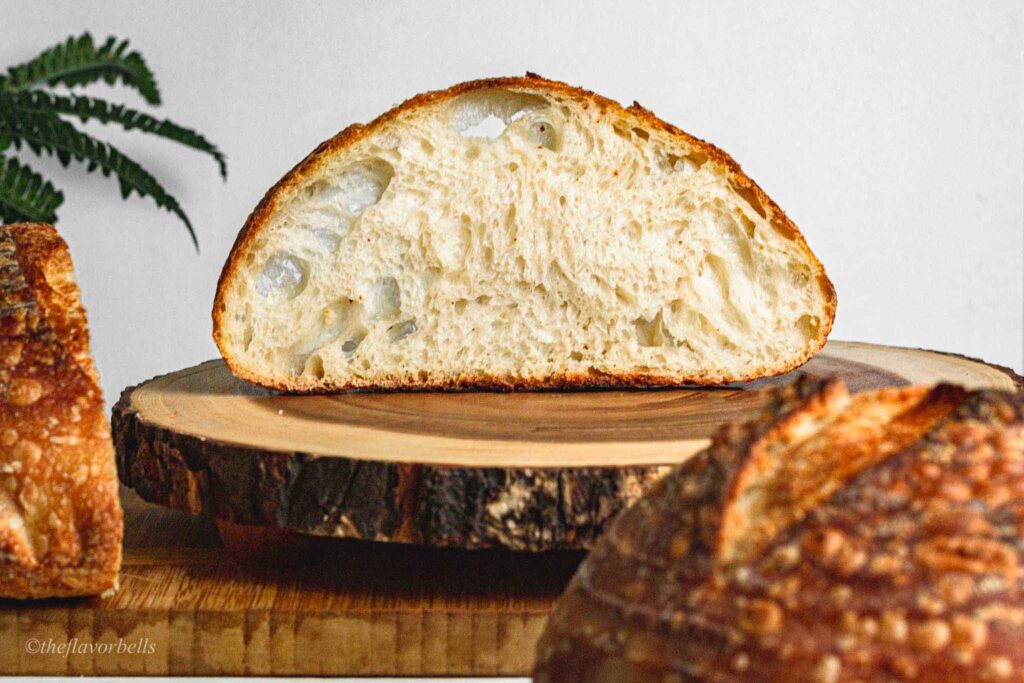
Mastering sourdough fermentation mechanics is the single greatest leap an amateur baker can make toward consistently producing airy, crackling artisan loaves with deeply complex flavor. Most beginners approach sourdough as if it were ordinary commercial baking, following rigid clock hours and hoping for magic. They measure their bulk rise with a stopwatch, cut their fermentation short on a cold Tuesday night, and end up with a pale, gummy brick that refuses to rise in the oven. But bread dough does not own a wristwatch. It is a living, pulsing micro-biome governed strictly by biochemistry, enzyme kinetics, and physical rheology.
When you stop treating sourdough like a mechanical recipe and begin treating it as an ecological system, the entire craft changes. You start feeling the exact elasticity of the gluten strands under your fingertips. You smell the delicate shift from milky sweetness to sharp vinegar before the dough collapses. You watch the domed surface of the fermentation tub swell with gas pockets, knowing precisely when to shape and when to hold back. Demystifying the mechanics behind wild fermentation is what transforms frustrating kitchen disasters into reliable artisan mastery.
The Living Wilderness Inside Flour and Water
To truly grasp sourdough fermentation mechanics, one must stop viewing dough as an inert mixture of starch and water. A sourdough starter is an intensely competitive natural ecosystem composed of wild yeasts and lactic acid bacteria living in symbiotic harmony. In a typical mature culture, bacteria outnumber yeasts by roughly one hundred to one. While commercial baker’s yeast relies solely on monocultures of fast-acting Saccharomyces cerevisiae, a wild sourdough starter harnesses rugged wild yeasts alongside specialized heterofermentative and homofermentative bacteria.
The genius of this wild partnership lies in metabolic non-interference. The dominant bacterial species found in traditional starters cannot metabolize maltose, the primary sugar released when grain enzymes chew through flour starch. Instead, these bacteria consume glucose and fructose. Wild yeasts operate in reverse, feasting voraciously on maltose without touching the carbon sources favored by their bacterial neighbors. As revealed by comprehensive microbial biodiversity studies of sourdough starters, this nutritional truce allows billions of micro-organisms to thrive in the same microscopic droplet without starving each other out.
As wild yeasts consume their share of simple carbohydrates, they release ethanol and carbon dioxide gas. That gas becomes trapped within the elastic network of gluten proteins, creating millions of tiny pneumatic cushions that will eventually form the open crumb of your baked loaf. Simultaneously, the lactic acid bacteria churn out two critical organic acids: lactic acid, which imparts a smooth, yogurt-like richness, and acetic acid, which delivers the sharp, tangy punch characteristic of classic sourdough. Without both organisms working in tandem, you get either a dense loaf with no loft or an insipid bread with no depth of character.
The Biochemical Tug of War Between Acid and Gluten Strength
Every minute your dough rests on the counter, two opposing biochemical forces fight for dominance: gas generation and structural breakdown. Gluten is formed by two plant proteins, glutenin and gliadin, which bond together when hydrated and agitated. Glutenin provides tensile strength and elasticity, allowing the dough to bounce back and hold its shape. Gliadin provides extensibility, allowing the dough to stretch and balloon outward as expanding pockets of carbon dioxide exert internal pressure.
However, the very acids produced by lactic acid bacteria alter the dough’s pH, dropping it from a near-neutral 6.0 down to a noticeably acidic 3.8 to 4.2. This acidity activates latent protease enzymes naturally present in the wheat berry. Protease enzymes act like molecular shears, snipping through gluten bonds and dismantling the structural webbing that holds the dough upright. In moderation, a slight drop in pH softens the gluten matrix just enough to give the dough remarkable extensibility, allowing for massive oven spring. But if fermentation proceeds unchecked, excessive acid production causes runaway proteolysis. The gluten framework completely dissolves, transforming a plump, bouncy dough into an unworkable puddle of sticky sludge.
This delicate biological balance forms the backbone of sourdough fermentation mechanics, shaping both the rise and the structural integrity of the crumb. If you bake too early, the gluten remains overly tight, the yeast has produced insufficient gas, and your bread emerges dense with erratic tunneling. If you bake too late, the yeast exhausts its fuel supply while the proteases chew the structural scaffolding to pieces, causing the loaf to collapse into a flat, gummy pancake the moment it meets the heat of the oven.
Four Proven Rules That Transform Wild Microbes Into Loaves of Perfection
Translating theoretical sourdough fermentation mechanics into everyday kitchen execution demands practical, repeatable habits. Just as studying tennis serve mechanics and 4 proven rules that unlock explosive court power reveals how physical efficiency trumps raw muscular force, bread baking rewards those who work in harmony with biological laws rather than brute mechanical effort. By controlling four essential variables, you can steer fermentation with absolute surgical precision.
Control Hydration to Dictate Microbial Speed and Gluten Mobility
Water does far more than moisten flour; it serves as the physical highway for enzymes and microbes. In a stiff dough with sixty percent hydration, microbial movement is restricted, enzyme activity slows down, and gluten bonds form tightly with minimal extensibility. Conversely, pushing hydration to seventy-five or eighty percent creates an aquatic paradise where enzymes glide effortlessly through the starch matrix, accelerating starch breakdown and quickening the pace of fermentation.
High hydration doughs require faster human reflexes. Because water accelerates enzymatic breakdown, a wet dough will reach its point of peak extensibility significantly faster than a dry one. Beginners often leap into high hydration recipes because internet bakers praise eighty percent hydration for achieving translucent, open crumb structures. Yet without the structural discipline to build gluten tension early, excess water simply accelerates proteolytic degradation, leaving you with dough that glues itself to your hands and your proofing baskets. Start at sixty-eight percent hydration, master the structural cues, and only increase water as your handling confidence catches up to the microbial rate of work.
Harness Ambient Temperature as Your Primary Gas Pedal
Bakers who honor sourdough fermentation mechanics recognize that ambient temperature acts as their primary throttle. Yeast cells thrive and multiply rapidly in warm environments between 26°C and 28°C (78°F to 82°F), maximizing carbon dioxide generation. Bacteria, however, remain active across a much broader thermal spectrum. When you drop the dough temperature down to 4°C (39°F) in a household refrigerator, yeast metabolic activity grinds almost to a complete halt, halting gas production.
Lactic acid bacteria, particularly heterofermentative strains, continue to slowly metabolize sugars even in the near-freezing chill of a cold retard. This thermal bifurcation gives you total control over flavor. If you want a mild, sweet, dessert-friendly sourdough with enormous vertical oven spring, run a warm, rapid bulk fermentation around 27°C and bake immediately once proofed. If you desire a deeply sour, complex loaf with lingering tang, complete a moderate bulk rise at room temperature and park the shaped banneton in the refrigerator for sixteen to twenty-four hours, giving the cold-hardy bacteria uninterrupted time to produce acetic acid while the yeast rests.
Read Physical Dough Cues Rather Than Trusting Rigid Wall Clocks
The single greatest mistake home bakers make is following recipe timelines down to the minute. A recipe that calls for a four-hour bulk fermentation was developed in a kitchen with a specific ambient temperature, using flour with a specific enzymatic profile, and an active starter with a specific microbial density. In your home kitchen, that identical four-hour window might represent catastrophic overfermentation on a humid summer afternoon or severe underfermentation on a drafty winter morning.
Stop watching the clock and start interrogating the dough itself. Look for rounded, domed edges along the sides of your transparent container, indicating positive internal gas pressure. Look for an aerated, silky underside when you tip the tub gently. Gently poke the surface: underfermented dough feels dense, heavy, and resists displacement, snapping back instantly. Overfermented dough feels slack, wet, and holds an indentation indefinitely without recovery. Perfectly fermented dough feels light, pillowy, and springs back slowly and partially, retaining a shallow, polite dimple that signals peak trapped potential energy.
Balance Lactic and Acetic Acid Through Inoculation Ratios
The proportion of mature starter you mix into your final dough—known as the inoculation percentage—directly dictates the trajectory of acid development. A high inoculation rate of twenty to twenty-five percent introduces an enormous initial population of active microbes and pre-existing acid into the mix. This kickstarts fermentation at blistering speed, shortening the bulk proof and keeping the crumb sweet and mild because the dough spends minimal total hours exposed to bacterial digestion.
Harmonizing acid production with sourdough fermentation mechanics ensures the dough remains extensible enough to expand dramatically in the oven. Dropping your inoculation down to ten or even five percent forces a tiny initial microbial population to build up slowly over many hours. This extended timeline creates profound starch breakdown, producing exceptional crust caramelization and a sharper, more distinct acidic bite. By matching your inoculation percentage to your daily schedule and desired flavor profile, you dictate the pace of the bake rather than letting the dough dictate your life.
Troubleshooting Structural Failures Before the Bake
Even seasoned bakers encounter loaves that misbehave, but diagnosing the culprit requires understanding how gas and structure interact. The most widespread error in modern sourdough baking is the deceptive phenomenon known as fool’s crumb. A baker pulls a loaf from the oven, cuts it open, and sees massive, cavernous holes surrounded by dense, gummy, unbaked ribbons of raw starch. Many assume this hyper-open structure represents success, but it is actually the textbook signature of severe underproofing.
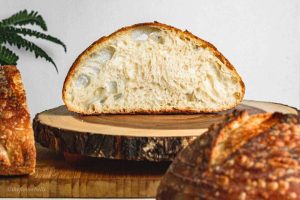
When dough goes into the hot oven underproofed, the gluten network is still tightly wound and lacking distributed micro-aeration. The sudden blast of heat vaporizes moisture, forcing massive steam explosions through the few existing weak points in the dense matrix, tearing open enormous localized caverns while the rest of the un-aerated dough remains fused and gummy. A truly mature, properly proofed crumb features an even, lace-like distribution of aerodynamic pockets extending all the way to the edges of the crust.
Conversely, if your loaf spreads horizontally like a flat flying saucer the second it tips out of the banneton, you are witnessing the physical aftermath of gluten collapse. Either the bulk fermentation dragged on so long that acid proteolysis dissolved the gluten bonds, or the ambient temperature caused the yeast to exhaust its food supply before the loaf ever hit the scorching baking surface. When the structural scaffold is gone, no amount of oven steam or cast iron heat can coax it upward.
Lifelong Mastery of the Living Loaf
Once you truly internalize sourdough fermentation mechanics, baking ceases to be an anxious dance with recipes and timers. You stop panicking when unexpected errands pull you away from the kitchen, because you understand how to drop your dough into a cool water bath or a refrigerator to suspend microbial action at will. You stop wondering why one bag of whole wheat flour ferments twice as fast as your standard white bread flour, knowing that the intact bran and germ supply a treasure trove of minerals and wild enzymes that fuel microbial reproduction.
The craft of artisan bread is not about exerting mechanical dominion over flour and water. It is about orchestrating an invisible ecological symphony, adjusting temperature, water, and time to shepherd billions of microscopic organisms toward their biochemical peak. When that blistering, mahogany loaf emerges singing from the oven, its crackling blisters and lofty aerated crumb are not the result of blind luck. They are the undeniable physical proof of biological mechanics mastered.