Emulsion sauce mechanics and 4 proven rules that prevent disastrous kitchen breaks
Discover the microscopic fluid physics that keep butter, oil, and liquid bound in silken harmony. Learn the essential mechanics and recovery techniques that permanently banish split sauces from your kitchen repertoire.
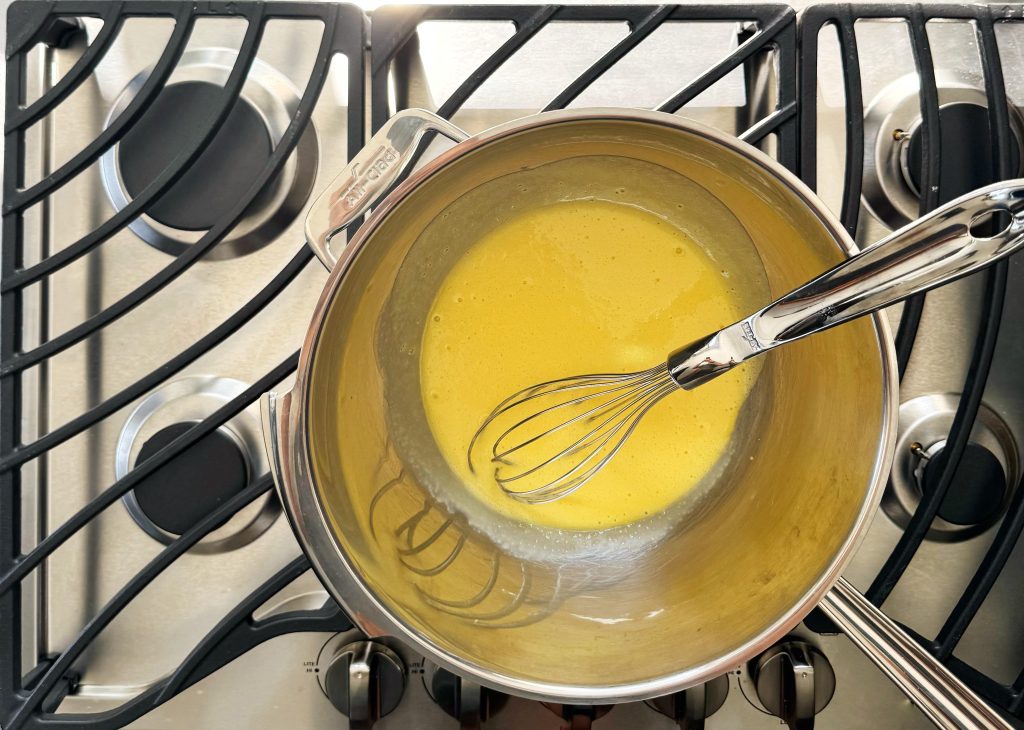
Mastering emulsion sauce mechanics is the ultimate rite of passage for any cook who refuses to settle for greasy pan drippings and grainy broken hollandaise. Watch an amateur cook struggle with a classic Béarnaise, and you will witness panic as the glossy golden ribbons disintegrate into a curdled puddle of oily yellow fat floating atop watery gray sediment. The disaster feels sudden, almost malicious, yet the underlying breakdown is purely mechanical. Culinary sauces are not static mixtures held together by wishful thinking; they are dynamic colloidal suspensions where billions of microscopic fat droplets are held in kinetic suspension across a continuous aqueous landscape.
When you transform liquid butter, fragrant wine reductions, and raw egg yolks into an opulent sauce, you are actively performing fluid engineering. The velvety mouthfeel that coats your tongue is the sensory signature of light bouncing off trillions of lipid globules suspended so densely that they trap water molecules between them. Achieving that texture requires far more than mechanical muscle or mindless wrist movement. It demands respect for thermodynamics, surface chemistry, and the microscopic friction that governs how liquids interact at the nanoscale.
The microscopic battle between fat droplets and liquid barriers
Understanding the fundamental physics behind emulsion sauce mechanics demystifies why lipid molecules and polar water behave like fierce adversaries across your pan. Water molecules are intensely polar, binding to one another through aggressive hydrogen bonds that pull the liquid inward into the tightest possible surface area. Cooking oils and clarified butterfat, composed largely of nonpolar triacylglycerols, have no electrical charge to offer these clinging water molecules. When dumped together, water squeezes the fat outward to minimize energetic friction, driving the hydrophobic fat droplets together until they fuse into a single slick layer.
To force these antagonistic substances into a unified sauce, you must overcome interfacial tension. This is the kinetic energy barrier that resists expanding the contact area between oil and water. Creating an oil-in-water suspension forces fat into millions of minute spheres, exponentially multiplying the surface area where lipids and water touch. According to historical thermodynamic research documented in the Exploratorium science of cooking archives, every microscopic square millimeter of new liquid interface requires physical work to build and continuous stabilizing energy to preserve. Without protective biochemical buffers standing sentinel at these borders, the system will relentlessly collapse back into two distinct, separated layers.
Why thermodynamic instability ruins classic kitchen pan sauces
Every emulsion represents an unstable truce between energy and entropy. Left to their own devices, suspended droplets drift through the liquid medium via Brownian motion, occasionally colliding. In a stable sauce, those collisions result in droplets harmlessly bouncing off one another. In an unstable sauce, colliding globules coalesce, merging into progressively larger spheres until the entire architectural network implodes.
When cooks disregard how heat governs emulsion sauce mechanics, the consequence is almost always catastrophic coalescence. Thermal energy acts as a double-edged sword across the stovetop. Gentle warmth lowers the viscosity of the continuous aqueous phase, allowing lipid spheres to deform, disperse, and flow with exquisite slipperiness. Excessive heat, however, accelerates molecular kinetic speed to violent extremes. Droplets slam into each other with enough momentum to rupture their protective chemical envelopes, while the proteins meant to shield those droplets coagulate into rigid, dense knots that squeeze out water like wrung sponges.
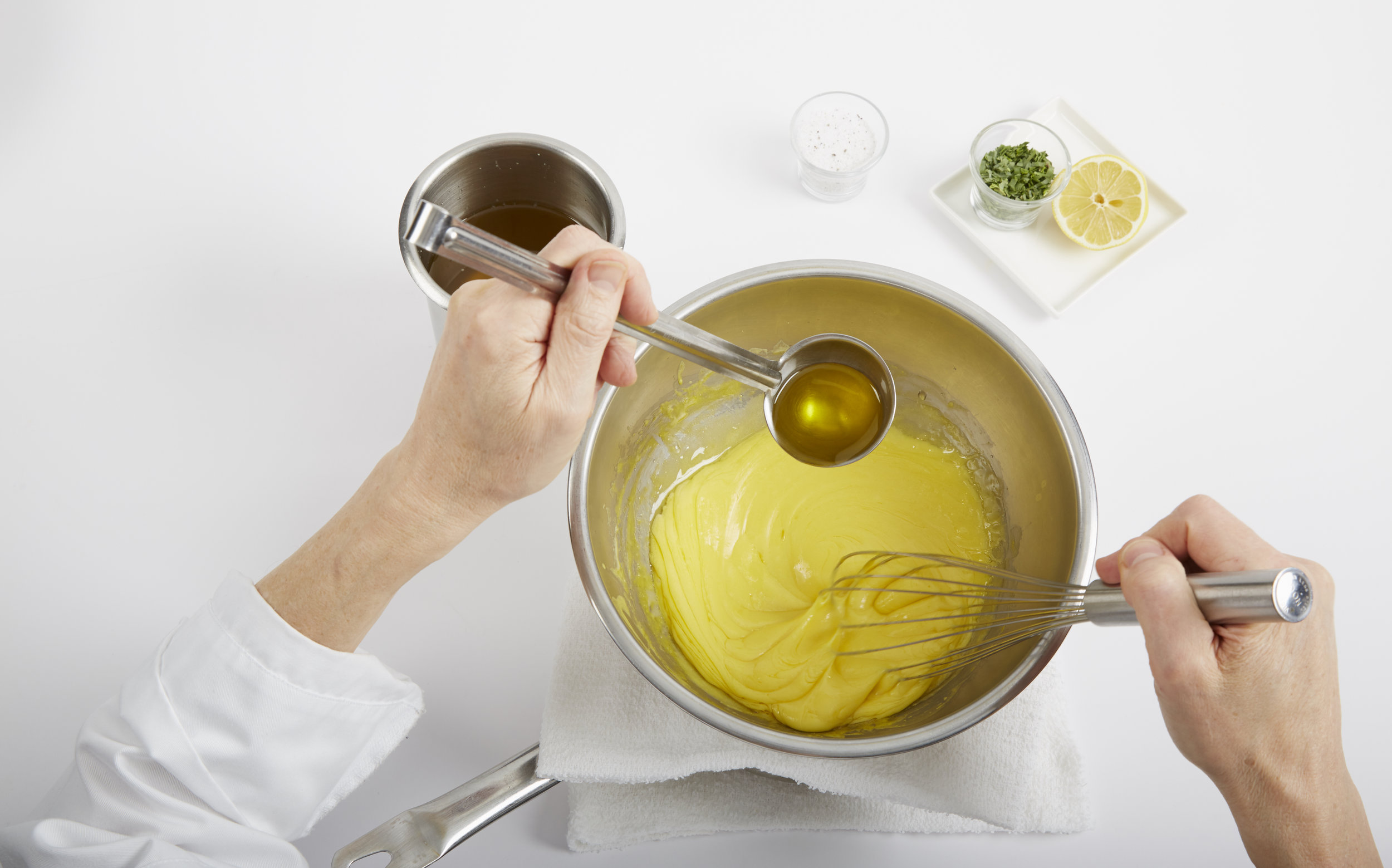
Four proven rules that maintain stable velvety culinary suspensions
These four rules distill emulsion sauce mechanics into dependable physical habits that eliminate guesswork from your cooking. Internalizing these mechanical principles allows you to manipulate liquid viscosity with effortless precision, turning intimidating restaurant masterworks into intuitive everyday executions.
Establish a generous continuous aqueous phase before adding fat
The single most catastrophic mistake in sauce preparation is dumping fat into an inadequate foundation of water, stock, wine, or citrus juice. In an oil-in-water emulsion, the aqueous phase serves as the matrix that must physically surround, isolate, and cushion every single droplet of fat. If you introduce fat too rapidly into an undersized water reservoir, the volumetric ratio flips against you. Instead of forming millions of isolated fat droplets drifting through water, the mixture crosses an inversion threshold, morphing into a greasy water-in-oil emulsion that feels slick, oily, and heavy on the tongue.
Always guarantee that your starting liquid volume provides ample physical room for incoming lipids. A single egg yolk contains roughly a tablespoon of water, which is biologically capable of suspending nearly a cup of oil, but only if that water is accessible from the opening second. Diluting yolks or reductions with a small splash of cool liquid before adding butter expands the physical volume of the matrix, creating an expansive buffer zone that easily absorbs incoming mechanical shock.
Modulate mechanical shear force to pulverize lipid spheres evenly
Physical agitation provides the kinetic hammer that shatters bulk fats into sub-microscopic droplets. Gentle stirring accomplishes nothing; lazy circular movements merely push large oil slicks around the perimeter of the bowl. True stabilization requires mechanical shear, the slicing force generated when adjacent layers of liquid move past each other at radically different velocities. In the realm of emulsion sauce mechanics, droplet diameter dictates stability because smaller globule radii dramatically lower the velocity of droplet aggregation.
By beating in rapid, figure-eight trajectories using a fine-wired balloon whisk, or by deploying the high-rpm vortex of an immersion blender, you subject the oil stream to violent localized shear. This tears the expanding lipid mass into spherical droplets between one and ten microns in diameter. These tiny spheres generate enormous surface area, raising the internal friction of the sauce and creating that luxurious, thick body that clings tenaciously to the back of a spoon.
Maintain the delicate thermodynamic window of protein denaturation
Egg yolks and butterfat rely on thermal cooperation to build structure without causing irreversible destruction. The ideal working window for warm emulsions sits strictly between 120°F and 145°F (49°C to 63°C). Within this narrow temperature corridor, butterfat remains completely molten and pliable, while the yolk proteins begin uncoiling their folded polypeptide chains. This gentle uncoiling exposes hidden hydrophobic and hydrophilic binding sites, allowing the proteins to migrate to the droplet perimeters and lock the sauce together.
Cross beyond 158°F (70°C), however, and those unfolded protein chains cross-link irrevocably into tight, rigid aggregates. The proteins bond to themselves rather than bridging the oil and water boundaries, precipitating out as grainy specks of cooked scrambled egg while liberated butter cascades into a greasy slick. Controlling heat through an indirect double boiler, or utilizing the residual insulation of heavy stainless steel, protects these fragile protein networks from thermal destruction.
Deploy molecular surfactants to coat exposed lipid boundaries
Pure mechanical whisking can temporarily blend oil and water, but the mixture will separate the moment agitation ceases. True permanent stabilization requires surfactants, amphiphilic molecules possessing split chemical personalities. One half of the surfactant molecule is hydrophilic and craves contact with water, while the opposing tail is intensely lipophilic and anchors itself inside the fat droplet. Surfactants assemble into microscopic monolayer shields around every single dispersed fat globule, establishing an electrostatic and steric barrier that makes colliding droplets physically repel one another.
Nature provides brilliant culinary surfactants across diverse ingredients. Egg yolks are packed with lecithin, an exceptional phospholipid that forms unbreakable protective boundaries around butterfat. Dairy creams carry native milk-fat globule membrane fragments rich in stabilizing proteins. Mustard seeds supply complex mucilage and sinigrin that anchor cold vinaigrettes, while crushed garlic cloves unleash amphiphilic organosulfur networks that drive genuine Mediterranean allioli. Knowing which surfactant to deploy transforms unstable mixtures into bulletproof culinary textures.
Rescuing split mixtures through strategic hydrodynamic reset
Even seasoned restaurant professionals occasionally miscalculate emulsion sauce mechanics during the frantic heat of a packed Saturday evening service. A pan gets too hot on the flat-top, butter is whisked in a fraction too fast, and the sauce breaks into a disheartening, fractured slurry. The instinct of the panicked cook is to whisk harder over high flame, a desperate reaction that only accelerates the separation by introducing more heat to an already compromised protein system.
High-stakes culinary maneuvers share an unmistakable kinship with tactical athletic pivots. Just as pressure mounts during postseason baseball adjustments—where unexpected moves like when Shane Drohan Sparks 4 Major Strategic Gambles for Brewers in NLCS Game 4 alter an entire defensive trajectory—recovering a shearing emulsion requires a calm, counter-intuitive intervention rather than frenzied over-whisking. To bring a broken sauce back to life, you must stage a disciplined hydrodynamic reset from scratch.
Remove the separated mixture entirely from direct heat. Place a clean, warm bowl on your work surface and introduce a fresh aqueous anchor: a single tablespoon of warm water, lemon juice, or a fresh raw egg yolk. Begin whisking that fresh liquid vigorously while trickling in the broken, separated sauce drop by drop. The new continuous phase seizes the incoming dispersed fat, enveloping it before it has the opportunity to aggregate. As the fresh emulsion forms its initial glossy nucleus, you can increase the pouring speed, seamlessly folding the entire failed batch back into an unblemished, velvety emulsion.
The quiet confidence of tactile kitchen fluid dynamics
Great sauciers do not rely on timers or kitchen thermometers; they listen to the subtle acoustic cues of their whisk and observe how liquid resists movement. As an emulsion builds, its viscosity increases dramatically because the densely packed fat spheres impede the free flow of the surrounding water. You can feel this transformation directly in your forearm. The whisk encounters tactile resistance, the hollow clatter against stainless steel softens into a muffled, rhythmic slap, and the liquid surface changes from translucent gloss to opaque, creamy satin.
A genuine intuition for emulsion sauce mechanics transforms culinary anxiety into absolute command over texture, sheen, and flavor delivery. You stop viewing sauces as temperamental, fragile recipes and begin handling them as predictable colloidal networks governed by transparent physical laws. Whether pulling together a silky pan sauce from deglazed roasting juices or whipping a classic Béarnaise atop tender beef, an appreciation for microscopic fluid physics ensures your creations will never separate on the plate again.