Baseball pitching mechanics and 4 proven rules that unleash devastating velocity
Elite pitching velocity is not generated by raw arm strength, but through a violent, coordinated kinetic whip starting at the cleats. Discover the anatomical principles and mechanical checkpoints that separate triple-digit fastballs from career-ending joint stress.

Understanding baseball pitching mechanics reveals a brutal paradox of human athletic performance: the fastest motion in all of sports generates velocity from the ground up. During a high-velocity throw, the human shoulder internally rotates at more than 7,000 degrees per second. That angular speed rivals the rotor blades of a military helicopter, yet the shoulder joint itself produces only a small fraction of the total work required to reach home plate. The arm is not a catapult. It is a biological whip that transfers kinetic energy forged against the rubber.
When velocity stalls or elbows blow out, ballplayers routinely blame forearm weakness, shoulder tightness, or insufficient effort. In reality, the breakdown almost always lives in the sequencing. A pitcher hurling ninety-five miles per hour does not necessarily own stronger shoulders than someone topping out at eighty; rather, they master the art of moving force through an unbroken chain of bone, fascial tension, and rotational torque without bleeding energy along the way.
The Physics of the Kinetic Whip from Spikes to Fingertips
When elite athletes refine baseball pitching mechanics, they are not building a stronger arm; they are assembling a human trebuchet. The entire action relies on proximal-to-distal sequencing. Kinetic energy originates at the contact point between the cleats and the dirt, climbs through the calves and quads, rotates through the pelvis, winds through the torso, rips through the shoulder and elbow, and finally snaps into the baseball across a window of mere milliseconds.
Every link in this anatomical chain must perform two distinct jobs in rapid succession: accelerate fully, then slam on the brakes. Peak pelvic rotation must stop abruptly so that its momentum transfers into the ribcage and thoracic spine. The torso accelerates forward, flexing and rotating over the lead hip, before it too must decelerate to sling the arm forward. If any single segment fails to decelerate, the energy that should have propelled the ball forward remains trapped in the body or dissipates into useless lateral drift.
The throwing arm acts primarily as a passive conduit during the early acceleration phase. Muscling the ball with the biceps, deltoid, or pectoral muscles short-circuits this kinetic whip. Instead, the shoulder muscles must stabilize the humerus inside the shallow glenoid cavity while the immense inertial lag stretches the anterior capsule like an industrial rubber band. The truest measurement of throwing power is not how hard a pitcher can shove forward, but how violently they can stabilize their base to release stored elastic potential.
The Hidden Danger of Arm Dominance and Energy Leakage
Flawed baseball pitching mechanics manifest almost instantly when an athlete rushes their upper half before the lower body sets anchor. The moment a thrower opens their chest toward home plate prematurely, the natural separation between the hips and shoulders evaporates. Deprived of the rotational torque built across the abdominal obliques, the nervous system panics and calls upon the shoulder and elbow to generate the missing velocity through isolated muscular force.
This mechanical dysfunction carries catastrophic physiological consequences. When the arm tries to make up for lost ground reaction force, the medial elbow absorbs extreme valgus torque. Extensive clinical studies from the American Sports Medicine Institute research on pitching biomechanics reveal that peak valgus stress at the elbow reaches levels exceeding the tensile strength of the ulnar collateral ligament (UCL) in cadaver testing. Only the simultaneous, dynamic firing of the flexor-pronator mass prevents immediate structural rupture on every single throw.
Energy leakage also poisons pitch movement and command. When a pitcher casts the ball away from their center of gravity or drops their elbow below the shoulder plane to manufacture late hand speed, release point variance skyrockets. A mechanical flaw of just two millimeters at release transforms a painted fastball on the black into a middle-in mistake crushed over the outfield wall. Velocity and command are not competing virtues; they are twin products of identical structural efficiency.
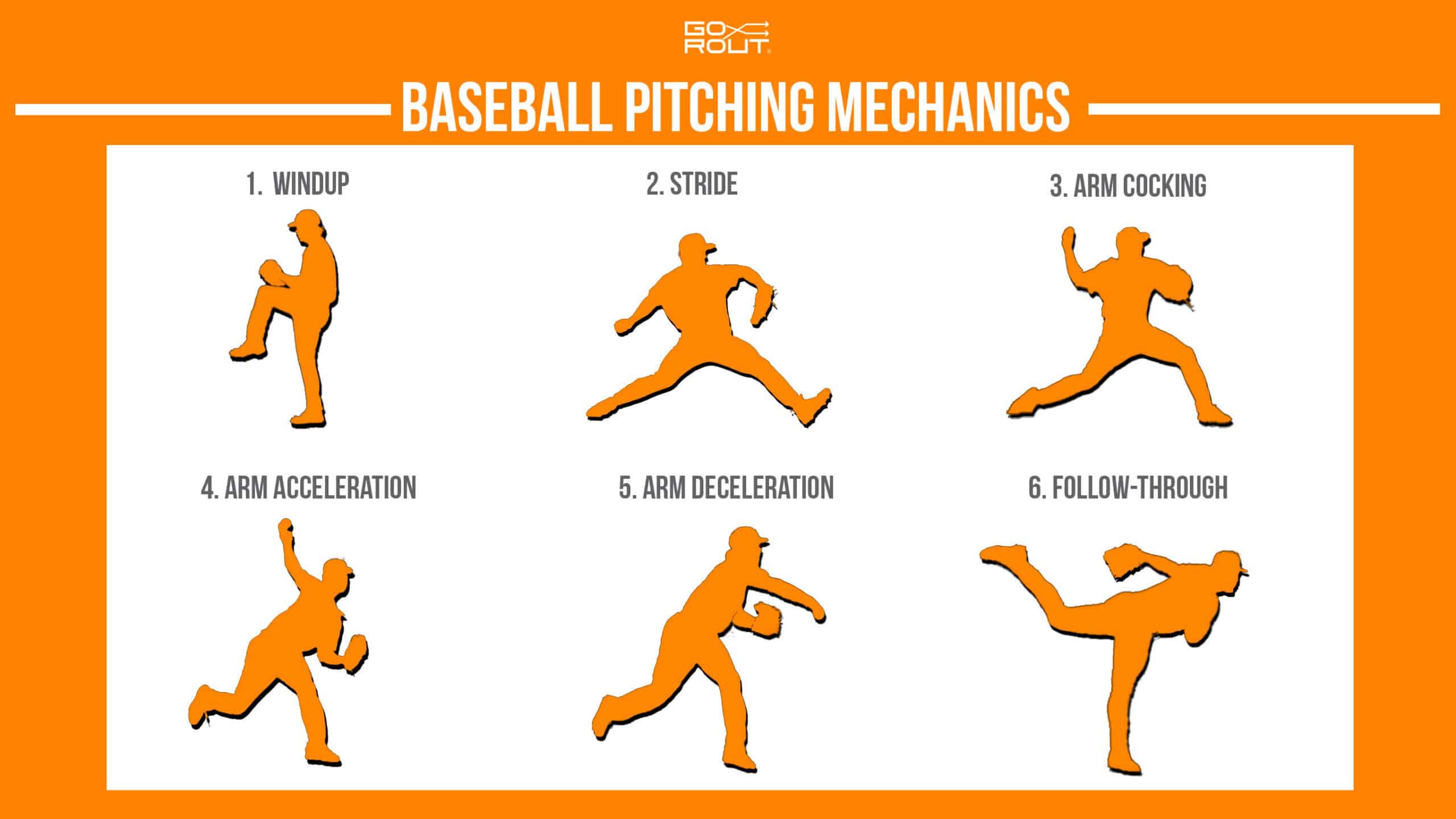
The Core Blueprint for Sustainable Velocity and Joint Preservation
Modern motion-capture laboratories evaluating baseball pitching mechanics emphasize that speed is an emergent property of sequential deceleration. The following four operational rules govern how force should be captured from the mound, preserved through the trunk, and expressed cleanly out of the fingertips.
Drive Ground Force Through an Uncompromising Stride and Plant
Every devastating pitch starts with aggressive horizontal drive that converts seamlessly into rotational energy. As the pitcher lifts their lead knee, the back hip must hinge and sit deeply into the gluteal complex, maintaining pelvic stability as gravity draws the body down the slope of the mound. The rear foot does not merely slide; it engages the rubber with active corkscrew pressure, anchoring the foot flat against the dirt to establish an immovable base.
Stride direction must remain laser-focused toward the target. Striding open bleeds torque through the front hip early, while cross-body landing traps the pelvis and forces the upper half to throw around a blocked torso. Just as Sprint acceleration mechanics and 4 proven rules that create explosive speed rely on directional ground reaction forces to project mass forward, a pitcher must direct linear drive down the midline before slamming down the front cleat.
Master Hip and Shoulder Separation to Coil the Torso Spring
The golden metric of raw throwing power is hip-to-shoulder separation. At the exact millisecond the lead foot lands flat in the dirt—known as front foot strike—the hips should have already rotated nearly open toward home plate, while the shoulder axis remains closed and perpendicular to the target. This differential ideally spans between forty and sixty degrees.
This massive rotational divergence stretches the anterior abdominal wall, the thoracolumbar fascia, and the internal and external obliques under tremendous tension. The body becomes a tightly wound torsional spring. When the pelvic girdle completes its rotation and abruptly stops, this fascial spring snaps the chest forward with explosive acceleration, multiplying rotational speed far beyond what voluntary muscle contraction could ever produce on its own.
Lock the Lead Leg into an Unyielding Dynamic Brace
Within high-performance baseball pitching mechanics, the dynamic brace serves as the physical fulcrum of ball release. Many amateur pitchers land on a soft, bent front knee that continues to collapse forward throughout the throw. This knee collapse acts as a shock absorber for the wrong forces, cushioning and extinguishing the momentum that should have launched into the ball.
Elite velocity demands an unyielding lead leg block. As the front foot strikes, the lead knee flexes slightly to absorb the landing shock, then aggressively extends or holds an isometric lock as the torso flexes forward. Think of a sprinter running at full speed who suddenly catches their foot on an immovable hurdle; their torso instantly flips over the obstruction. By firmly anchoring the front leg, the lower half stops dead in its tracks, catapulting the upper torso forward over the lead hip with blinding speed.
Achieve Clean Late Layback and Protective Forearm Pronation
Arm acceleration is governed by the phenomenon known as maximum external rotation, or late layback. As the trunk drives forward, the throwing forearm drops backward until it lies nearly parallel to the playing surface, reaching between 160 and 180 degrees of external rotation. This movement must happen passively through scapular retraction and upward tilt, never forced into hyperextension by artificial tension.
From deep layback, the internal rotators fire to whip the hand toward the release window. At ball release, the pitcher must instinctively pronate the forearm, turning the thumb inward and the palm outward. Dynamic pronation engages the pronator teres and flexor carpi ulnaris muscles, creating an active muscular shield across the medial elbow that absorbs residual deceleration stress and safeguards the UCL from catastrophic trauma.
Diagnosing Mechanical Breakdown Under Late Game Fatigue
When fatigue encroaches in late innings, baseball pitching mechanics degrade in a predictable, dangerous order. The initial casualty is rarely arm strength. Instead, the central nervous system loses its grip on neuromuscular timing. The back hip fails to hinge deeply, shortening the stride and robbing the kinetic sequence of ground-derived momentum.
As the lower half tires, the lead leg brace begins to yield. A pitcher who was snapping their front knee into a rigid post during the first inning begins to drift over a bent front leg by the sixth. To preserve velocity, the pitcher instinctively drops their arm slot or drags the arm behind the body to widen the whip, spiking torque on the shoulder capsule and medial elbow joint. Recognizing these subtle physical compensations before arm pain emerges is the defining difference between elite longevity and structural ruin.
Pitch tracking technology provides indisputable diagnostic data. A sudden dip in fastball spin efficiency or an unexpected vertical drop in release height almost always signals that the hips are lagging or the lead leg is collapsing at foot strike. When the kinematic sequence stutters, fighting through it with pure grit is an invitation to surgery. Mechanical precision is not a luxury to deploy when feeling fresh; it is the defensive armor that protects an athlete when stamina begins to wane.
The Lifelong Mastery of Precision Movement
Chasing throwing velocity through heavier lifting or reckless high-effort throwing regimes often leads directly to the operating table. Ball speed is not a trophy hammered out by blunt exertion. It is an intricate architectural achievement governed by torque, timing, and elastic recoil.
Ultimately, sustainable baseball pitching mechanics demand an uncompromising respect for physics over brute force. When you optimize the linear push from the rubber, nail the spatial separation between pelvis and torso, establish an unyielding lead leg block, and let the kinetic chain whip the arm through clean layback, triple-digit velocity stops feeling like an act of violent strain. It becomes an effortless expression of pure biomechanical harmony.