Sprinting biomechanics reveal 4 proven forces that create blistering speed
Elite sprinting is not about moving legs faster through the air, but striking the ground with terrifying force in under a tenth of a second. Explore the hidden physics behind maximum human velocity.
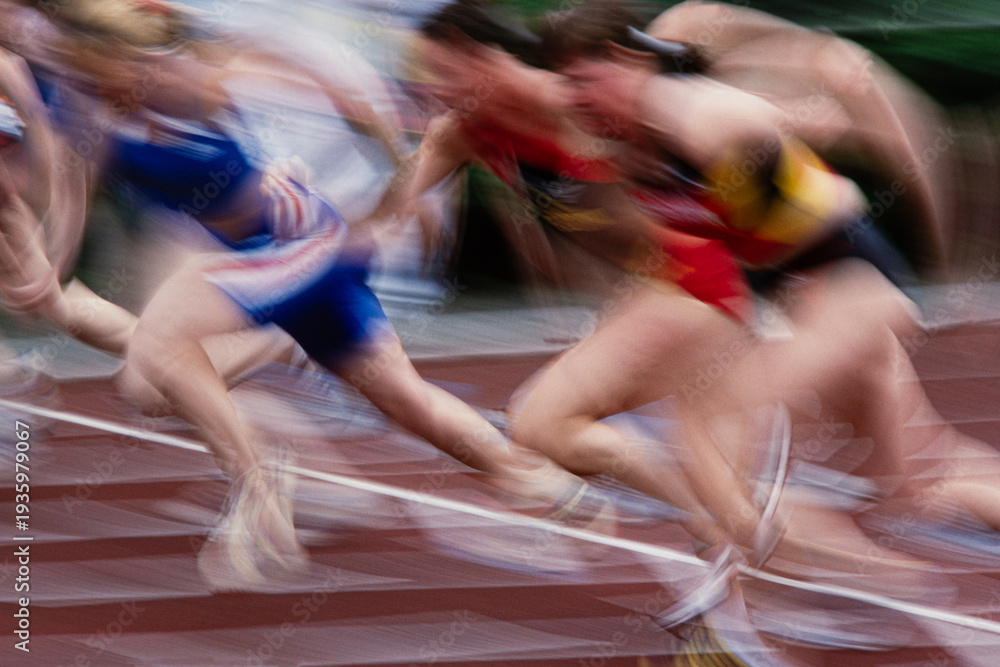
Studying elite sprinting biomechanics shatters almost every popular intuition about how human beings generate explosive acceleration and peak velocity on the track. Spectators watching an Olympic final naturally fixate on churning arms, flailing limbs, and facial strain. The untrained eye sees an athlete frantically pushing backward against the synthetic track, clawing their way through space. High-speed force plates and motion-capture telemetry tell an entirely different story. Sprinters do not win races because their legs cycle faster than their rivals. In fact, elite runners move their limbs through the air during the swing phase at roughly the same cadence as collegiate athletes and dedicated club runners. The true separation happens in a brutal, microscopic window of ground contact that defies ordinary physical perception.
When an elite sprinter operates at full stride, their foot remains on the ground for less than ninety milliseconds. To put that in perspective, the human eye takes roughly three to four times longer just to complete a single blink. In that razor-thin fraction of a second, the athlete must not only absorb the violent collision of their body weight hurtling forward at twenty-seven miles per hour, but also redirect that energy into the earth with monumental force. Speed is not a contest of turnover speed. Speed is an act of violent ground collision managed by impeccable anatomical geometry.
The Counterintuitive Reality of Ground Reaction Force
When researchers began systematically measuring sprinting biomechanics in laboratory settings, they expected to find that world-class sprinters took less time to reposition their legs in the air. Instead, a landmark locomotive study published in the Journal of Applied Physiology proved that airborne recovery time remains virtually identical across varying skill levels, hovering around one-third of a second. What truly separates a generational champion from an amateur is the magnitude of vertical ground reaction force applied per unit of body mass.
During maximum velocity, an elite runner punches the ground with peak forces exceeding four to five times their own body weight. A two-hundred-pound athlete delivers close to one thousand pounds of force into the surface, absorbs the shock, and launches back into the air, repeating this exchange forty to forty-five times across a hundred-meter stretch. Producing that volume of force requires far more than brute quadricep strength. It demands an intricate kinetic chain that acts like a stiff, hyper-tuned pogo stick rather than a soft hydraulic damper.
Just as delicate balance governs culinary chemistry—where emulsion sauce mechanics reveal 4 proven rules to conquer broken velvety sauces through microscopic stabilization—athletic speed demands an identical harmony between violent muscular output and elastic kinetic storage. Any collapse in the kinetic chain causes immediate dissipation of energy into ambient heat and tissue deformation, bleeding away velocity with every stride.
Four proven forces that dictate elite human velocity
Breaking down high-level sprinting biomechanics reveals that elite speed is not an accident of genetics, but rather the strict execution of mechanical laws. When an athlete hits maximum velocity, four interconnected biological mechanisms combine to dictate their acceleration ceiling and technical longevity.
Vertical ground reaction force delivered in microscopic contact windows
Amateurs instinctually believe that running faster requires pushing backward against the track. High-speed kinematic analysis demonstrates that forward propulsion at top speed is largely a byproduct of vertical impulse. Because the athlete is already moving forward with immense momentum, the primary challenge is keeping the center of mass elevated without braking. By delivering an explosive, downward spike of force within the first thirty to forty milliseconds of foot strike, the sprinter creates an equal and opposite vertical reaction that launches their body into the subsequent flight phase without shedding horizontal velocity.
Achilles tendon stiffness and elastic recoil energy
Muscles are relatively slow, energetically expensive engines. Tendons, by contrast, act as biological springs that store and release mechanical energy virtually for free. At top speed, the human calf muscles do not contract and relax through a wide range of motion. Instead, they contract quasi-isometrically, locking the ankle joint in place to create a rigid lever. When the metatarsal strikes the track, the Achilles tendon stretches under colossal strain, storing kinetic energy like a cocked bowstring, and instantly snaps back to propel the runner off the ground. Sprinters with greater tendon stiffness experience far less ankle deformation, allowing them to redirect ground forces instantly.
Aggressive thigh angular acceleration and front side mechanics
The speed of foot strike is heavily dictated by what happens in the air right before impact. Elite sprinters prioritize front-side mechanics, pulling the knee upward and forward in front of the pelvis before actively accelerating the foot downward toward the ground. This downward whipping motion is driven by ferocious hip extension. By striking the ground with a backward-moving foot that nearly matches the runner’s forward speed, the braking forces upon touchdown are virtually eliminated. The foot does not wait to be hit by the track; it attacks the track from above.
Pelvic integrity and lumbo-pelvic hip complex control
The pelvis serves as the mechanical chassis of the entire human locomotive engine. If an athlete suffers from anterior pelvic tilt—a condition where the front of the pelvis drops and the tailbone flares up—the hip extensors lose their optimal length-tension relationship. Hamstrings become overstretched and vulnerable to catastrophic tearing, while the gluteus maximus cannot achieve full recruitment. Elite sprinters maintain a neutral, robust pelvis locked by deep abdominal bracing and gluteal co-contraction, providing a stable foundation that prevents energy leaks between the upper torso and lower extremities.

The Costly Myth of Pawing and Pushing Backward
A pervasive misunderstanding within sprinting biomechanics is the notion of ‘pawing back’ at the ground or actively pushing off the toes as the foot leaves the surface. Many developing runners spend years performing drills designed to dig their feet backward into the synthetic turf, believing this backward kick drives them forward. In reality, once the foot passes behind the body’s center of mass, the ability to generate meaningful horizontal propulsion drops to near zero.
Trying to push off the back leg keeps the foot on the ground far too long, extending ground contact times beyond the optimal threshold. This mistake drags the kinetic chain into an excessive back-side cycle, where the trailing leg flails high behind the glutes. The athlete must then spend valuable airborne time swinging that distant limb all the way forward for the next step. Elite running looks effortless because the athlete cuts the stride off the moment force production peaks, immediately initiating the recovery phase to bring the swing leg back to the front.
Furthermore, overstriding—landing with the foot planted well ahead of the center of mass—acts as a literal emergency brake. Each time the heel or midfoot strikes out in front of the hip, ground reaction vectors point backward against the direction of travel, jarring the knees, destroying forward momentum, and placing unbearable eccentric loads onto the hamstring tendons.
Structural Drills That Rewire Neuromuscular Timing
Transforming abstract knowledge of sprinting biomechanics into neurological competence requires specific, deliberate movement patterns executed at high intensity. The central nervous system cannot process conscious biomechanical cues when moving at ten meters per second. Movements must be hardwired into spinal cord reflex loops and autonomous motor programs.
Wicket runs, popularized by master sprint coaches, utilize dozens of small plastic hurdles spaced at precisely measured, expanding intervals. These barriers force the runner to step over the obstacle and strike down beneath their center of mass, eliminating overstriding and automatically teaching front-side dominance without verbal overload. If the athlete attempts to reach forward or kick backward, their foot hits the hurdle, providing immediate physical feedback that no coach’s whistle can match.
Complementing wicket work, isometric ankle-holding drills and heavy sled pushes reprogram structural stiffness. Pushing a sled loaded with heavy resistance forces the body into an optimal forty-five-degree acceleration angle, forcing the hips, knees, and ankles to coordinate triple extension while developing the exact horizontal force vectors required during the initial drive phase out of the blocks.
Why Maximum Human Velocity Still Has Room to Grow
For decades, exercise physiologists debated whether human beings had approached their absolute biological ceiling for running speed. Mathematical models frequently pointed toward limits imposed by bone density, muscle fiber contraction speeds, and tendon tensile strength. Yet modern kinematic tracking continues to show small, incremental optimizations that unlock greater raw outputs.
The evolution of sprinting biomechanics will not stem from human beings miraculously moving their limbs through the air twice as fast. It will come from athletes learning to organize their ground collisions with greater structural stiffness, minimal braking angles, and optimized force vectors. Innovations in track surface elasticity and engineered carbon-fiber footplates also alter this calculation, acting in concert with the human foot to amplify biological energy return.
Mastering the fundamentals of sprinting biomechanics ultimately teaches us that speed is an art of conservation and violent precision. The fastest individuals on earth are not those who strain hardest to pull the horizon toward them, but those who transform their bodies into uncompromising springs, striking the ground with disciplined ferocity and gliding across space with mathematical grace.