Bond yield mechanics reveal 4 essential forces that dictate modern market valuations
Behind every stock rally, mortgage rate shift, and banking tremor lies the silent engine of the fixed income market. Discover the core physics of debt pricing and why bond yields dictate the trajectory of global capital.

Understanding bond yield mechanics provides the clearest window into how money actually moves across the global financial system. While equity markets capture public imagination with dramatic headlines and charismatic founders, the global debt universe operates on a scale that dwarfs public stock exchanges. Trillions of dollars in sovereign and corporate debt form the foundational bedrock upon which every mortgage rate, corporate borrowing facility, and discounted cash flow valuation is constructed.
At its core, a bond represents an unadorned promise. An institution borrows capital today, pledges regular interest payments along the way, and vows to return the original principal on a designated calendar date. Yet the behavior of that debt contract once it leaves the primary auction house and enters the secondary market confuses many observers. Prices fluctuate continuously, yields drift across shifting horizons, and entire banking balance sheets oscillate with every tick of a basis point.
Every asset class from tech equities to commercial real estate moves in direct response to sovereign debt yields. While stock market tickers dominate television chyrons, ignoring bond yield mechanics leaves market participants operating entirely in the dark. To navigate modern capital markets with clarity, one must step directly into the mathematical engine room where yields are forged.
The Counterintuitive Seesaw Between Bond Prices and Interest Rates
At the heart of bond yield mechanics lies a mathematical seesaw that trips up even seasoned professionals. When market interest rates climb, existing bond prices drop. Conversely, when prevailing interest rates decline, the market price of existing bonds surges. This inverse relationship is not an arbitrary market quirk; it is an iron law of comparative yield arbitrage.
Imagine purchasing a newly issued ten-year government bond with a face value of one thousand dollars offering a fixed annual coupon rate of three percent. That instrument reliably pays thirty dollars each year. If broad economic conditions shift and newly issued ten-year bonds begin offering a four percent coupon, no rational investor on the open market will pay one thousand dollars for your three percent bond. Why settle for thirty dollars a year when fresh sovereign paper delivers forty?
To attract a buyer, the secondary market price of your three percent bond must drop until its effective return matches the prevailing four percent market environment. A buyer purchasing your bond at a discount pays less than face value upfront, collects the annual coupon payments, and pockets the full face value at maturity. That capital gain across the holding period bridges the gap, equalizing the instrument’s yield to maturity with prevailing market opportunities.
The severity of this price movement depends heavily on an engineering metric known as duration. Duration measures a bond’s sensitivity to interest rate fluctuations by weighting the timing of all remaining cash flows. A bond maturing in twelve months will barely register a fifty basis point rate hike because principal return is imminent. In sharp contrast, a thirty-year bond with distant cash flows will experience violent price swings when rates shift. Convexity adds a layer of non-linear curvature to this relationship, showing that as yields drop, prices rise at an accelerating rate, whereas rising yields cause prices to fall at a decelerating rate.
Why Fixed Income Dictates the Gravity of Every Asset Class
Sovereign bond yields establish the universal benchmark for risk-free returns. When an investor evaluates an apartment building, a speculative private equity fund, or an emerging semiconductor firm, every expected future dollar must be judged against what capital could earn with zero credit risk backed by a sovereign treasury. Legendary allocators frequently compare the benchmark yield to financial gravity. When gravity is weak because yields hover near zero, speculative asset valuations can float upward to dizzying heights. When bond yields rise, gravity strengthens, pulling distant earnings projections rapidly back toward earth.
Corporate finance relies heavily on the discounted cash flow model. Under this formula, the intrinsic value of any business equals the sum of its future cash flows discounted back to the present day using a hurdle rate. That hurdle rate incorporates the risk-free bond yield plus a bespoke risk premium. When government bond yields rise by two hundred basis points, the denominator in that valuation formula expands across every single projected year. Companies whose profitability lies far in the future suffer immense immediate valuation contractions.
Beyond theoretical valuation models, bond yields govern real-world operational cash flows. Corporate borrowing costs track corporate bond spreads priced directly atop sovereign yield curves. Commercial real estate depends entirely on debt refinancing rates to service mortgages. When yields climb, capital expenditures slow, debt servicing eats into free cash flow, and consumers confront higher payments on personal loans and home mortgages.
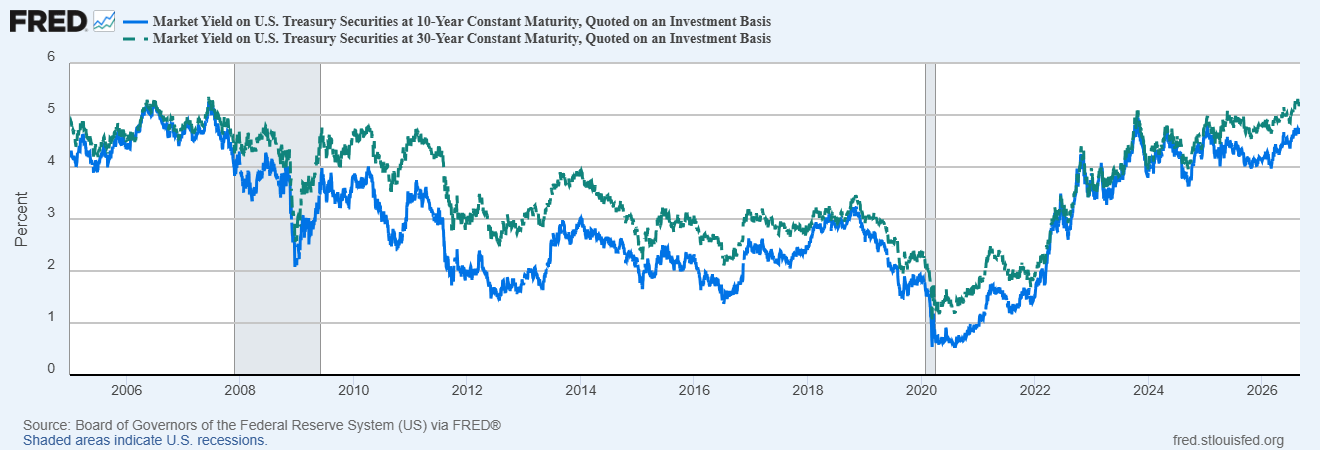
Four Core Forces That Drive the Yield Curve Across Economic Cycles
When evaluating bond yield mechanics, fixed-income traders break down long-term yields into specific component vectors rather than treating borrowing costs as a monolithic entity. The shape and slope of the yield curve reflect constant negotiations among distinct macroeconomic forces.
Expected Inflation and the Erosion of Purchasing Power
Fixed-rate debt delivers fixed nominal cash streams. If a lender locks up capital for ten years at an annual interest rate of four percent, but inflation averages five percent over that decade, the lender suffers a guaranteed loss in real purchasing power. Consequently, expected inflation forms the primary baseline hurdle for bond yields. Market expectations for inflation are tracked directly through the breakeven rate, which represents the spread between nominal government bonds and inflation-protected securities. When forward inflation projections tick upward, investors immediately demand higher nominal yields to insulate their principal from currency debasement.
Central Bank Policy Rates and Short End Liquidity Pressures
Monetary authorities wield direct control over the short end of the yield curve through overnight lending rates, reserve requirements, and liquidity management operations. When a central bank raises its benchmark policy rate to cool an overheating economy, yields on short-dated instruments such as three-month bills and two-year notes march upward almost in lockstep. The short end of the curve is essentially a mechanical reflection of where central banks have pinned overnight borrowing costs today alongside market consensus on where those policy rates will sit across the coming quarters.
Term Premium Demands for Locking Up Capital Over Time
Committing capital for thirty years carries vastly more vulnerability than parking cash in a ninety-day treasury bill. Unforeseen geopolitical shocks, shifting government deficits, liquidity crunches, and erratic monetary regimes can all unfold over multiple decades. The term premium represents the surplus yield lenders demand purely as compensation for bearing the duration risk of long-term debt. During periods of aggressive central bank asset purchases, term premiums can compress into negative territory. When governments issue massive debt volumes to finance fiscal deficits, term premiums widen sharply. This dynamic reveals how bond yield mechanics react when long-duration risks suddenly reprice, punishing passive holders who mistook government paper for risk-free stability.
Credit Risk and the Widening of Default Spreads
While sovereign governments that print their own currency face negligible nominal default risk, corporate and municipal issuers face genuine operational solvency challenges. The yield on a corporate bond consists of the benchmark sovereign yield plus an additional credit spread. In calm economic climates, abundant liquidity narrows credit spreads as investors hunt for incremental return. When economic stress emerges, default anxiety surges, pushing credit spreads wider. High-yield debt instruments trade with dramatic price volatility because their yield swings reflect fundamental corporate survivability alongside general interest rate movements.
Reading the Curve When Unexpected Swerves Stun Investors
Under ordinary economic conditions, the yield curve slopes upward from left to right. Lenders demand higher yields for committing money over ten or thirty years than they do for three months. Yet the market occasionally delivers jarring deviations from this baseline. Much like unpredictable aerodynamic shifts create sharp breaks in sports flight paths, as explored when Curveball Pitch Mechanics Reveal 4 Proven Forces Behind Devastating Late Movement, bond yield mechanics can twist the curve into an inversion that rattles equity markets.
An inverted yield curve occurs when short-term yields climb higher than long-term yields. This phenomenon transpires when central banks aggressively tighten policy to extinguish price pressures while fixed-income allocators simultaneously rush to purchase long-dated bonds. Long-term buyers accept lower yields because they anticipate an inevitable economic slowdown followed by emergency rate cuts. Rigorous empirical insights from the Bank for International Settlements research on sovereign debt term structures demonstrate how structural capital flows and international liquidity imbalances routinely shape these curve inversions.
Market observers also dissect the precise mechanics of curve steepening and flattening. A bear flattener happens when short-term yields surge faster than long-term yields, typically during aggressive monetary tightening campaigns. A bull steepener occurs when short-term yields collapse dramatically as a central bank slashes borrowing costs to counter a deepening recession. Each micro-adjustment along the curve reveals real-time institutional sentiment long before lagging economic indicators report contraction or recovery.
Strategic Navigations for Portfolios in Shifting Rate Regimes
Navigating debt markets requires moving beyond simple directional bets on interest rates. Sophisticated portfolio managers engineer structural allocations designed to harvest yield while mitigating duration hazards. One time-tested approach involves laddering maturities. By buying bonds that mature at sequential intervals across five or ten years, an allocator ensures a steady stream of capital returning at par value, ready for redeployment into whatever yield environment exists at maturity.
Another classic deployment strategy is the barbell framework. In this structure, capital concentrates heavily in very short-dated bills on one end and long-duration debt on the other, skipping intermediate maturities entirely. The short end preserves capital and supplies liquidity, while the long end locks in attractive yields and serves as a volatility hedge during flight-to-safety episodes.
Real returns dictate actual wealth preservation. An investor locking in a six percent nominal yield during an era of seven percent inflation is mathematically falling behind. Dissecting nominal rates into real yields, evaluating spread durations, and monitoring term premiums gives allocators an enduring analytical framework. Mastering bond yield mechanics transforms fixed income from an intimidating tangle of percentages into an intuitive map of economic reality.