Bicycle drafting mechanics reveal 4 proven secrets to shatter exhausting aerodynamic drag
Cycling through ambient atmosphere requires cleaving through a viscous ocean of air that steals up to ninety percent of forward momentum. Discover how the physical laws of drafting turn turbulent slipstreams into massive energy savings.
Understanding bicycle drafting mechanics transforms cycling from a brutal battle against invisible friction into an elegant masterclass of applied fluid dynamics. To the human eye, riding down an open highway looks like traveling through an empty void. In physical reality, an athlete is wading through a dense, viscous ocean of nitrogen and oxygen molecules that refuse to get out of the way. Once a bicycle exceeds eighteen miles per hour, mechanical friction from wheel bearings and tire rubber becomes negligible compared to the sheer energetic toll of parting the atmosphere. At racing speeds, overcoming aerodynamic drag accounts for roughly eighty to ninety percent of a cyclist’s entire power output.
Drafting is neither a shortcut nor an unfair trick of the trade. It is the calculated manipulation of atmospheric pressure gradients. By tucking closely behind a leading body, a trailing rider exploits an artificial low-pressure wake, dramatically lowering the forward thrust required to sustain velocity. When executed with surgical precision, this kinetic shielding yields immediate energy reductions that redefine what an endurance athlete can accomplish over distance.
The Invisible Ocean of Road Aerodynamics
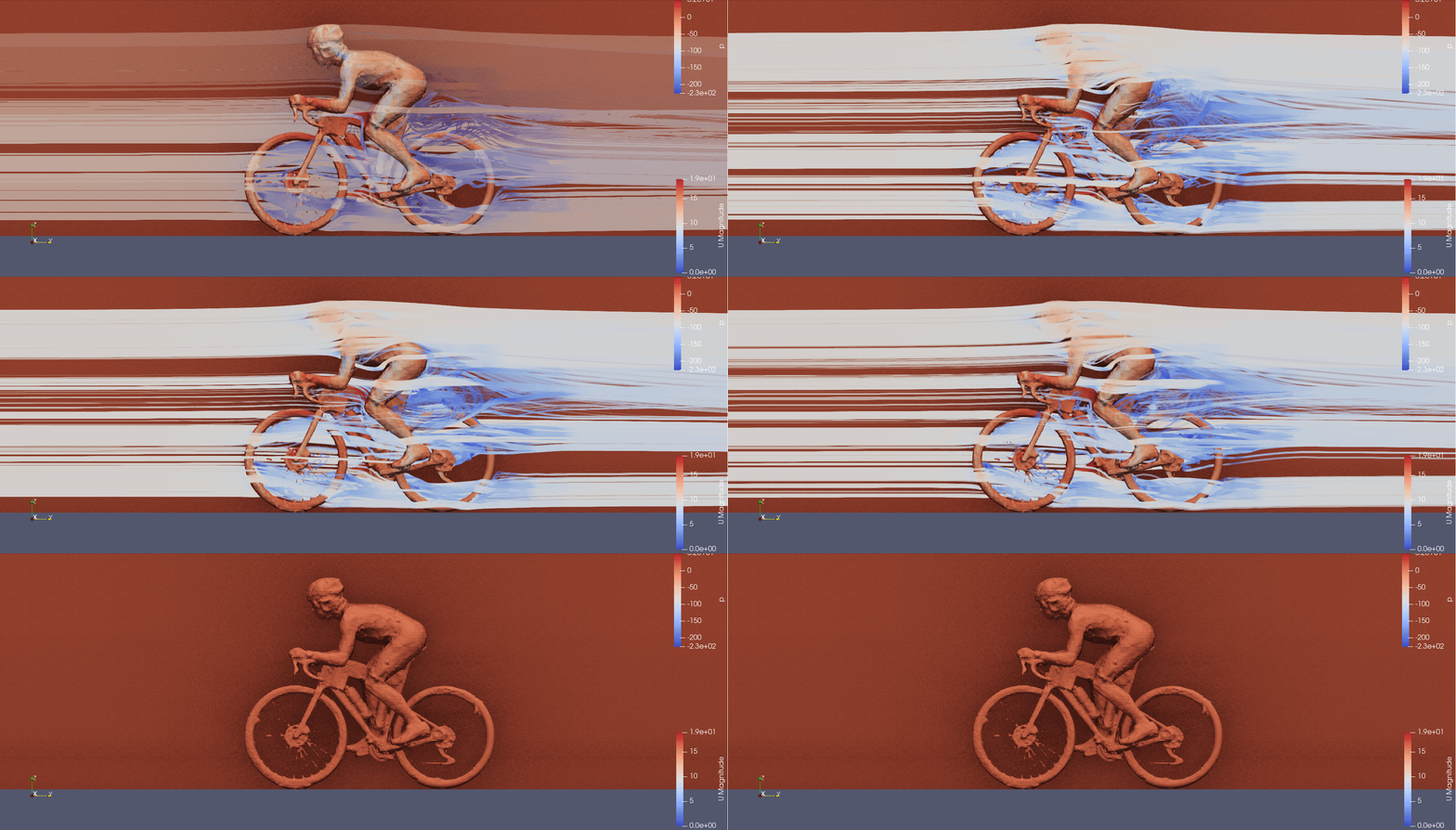
Air acts as a fluid, conforming to classical hydrodynamic laws established centuries ago. As a cyclist cuts forward, their helmet, shoulders, and handlebars collide directly with still air, establishing an intense high-pressure stagnation zone on the front of the body. Molecules must accelerate around the torso, arms, and legs. Because the human form is aerodynamically bluff rather than streamlined like an airplane wing, the airflow cannot remain cleanly attached along the rider’s back. It separates violently, tumbling off into chaotic vortices and leaving behind a broad, low-pressure cavity in the rider’s wake.
This pressure differential produces what fluid dynamicists call pressure drag or form drag. The high pressure pushing against the chest combined with the low-pressure suction pulling on the lower back acts as an atmospheric anchor. Moving twice as fast does not double this resistance; it quadruples aerodynamic drag and requires an eightfold increase in mechanical wattage. This non-linear mathematical reality explains why solo breakaways often crumble in competitive cycling, and why bicycle drafting mechanics represent the single greatest determinant of kinetic efficiency on flat and rolling terrain.
Fluid Dynamics Behind the Upstream Push and Downstream Pull
Most athletes imagine drafting as a purely one-sided arrangement where the lead rider does all the heavy lifting while the trailing rider rests inside a protected vacuum. Delving into bicycle drafting mechanics reveals a dual aerodynamic phenomenon that surprises even seasoned road racers. The presence of a trailing cyclist fundamentally alters the fluid structure for the person in front.
When a second rider follows inches behind the front wheel, their body occupies the turbulent low-pressure void created by the leader. Instead of atmospheric air separating sharply off the leader’s hips and creating a dragging suction vortex, the incoming mass of the follower’s front wheel and torso cushions that wake. This upstream interaction effectively fills in the vacuum, equalizing pressure behind the front rider’s back. Rigorous wind tunnel assessments and peer-reviewed aerodynamic research in the Journal of Wind Engineering and Industrial Aerodynamics demonstrate that the lead cyclist actually experiences a two to three percent reduction in drag simply by having someone tucked tightly on their rear wheel.
The follower, meanwhile, enjoys dramatic relief. Entering that partially evacuated pocket of air means their frontal area collides with air that has already been accelerated in the direction of travel. Just as visual artists manipulate invisible layers of light and contrast when they study how film color grading mechanics reveal 4 proven secrets to master cinematic mood, cyclists manipulate invisible pressure gradients to orchestrate effortless group velocity.
Four Proven Principles That Dictate Slipstream Efficiency
A rigorous breakdown of bicycle drafting mechanics highlights four specific physical interactions that govern how air behaves between moving bodies. Mastering these concepts separates nervous riders who waste energy from tacticians who slice through headwinds with ruthless economy.
Wheel Separation Distance and Turbulent Boundary Compression
The magnitude of aerodynamic protection scales inversely with distance. When the trailing tire sits ten to fifteen centimeters behind the leading rear wheel, the trailing rider experiences an astonishing thirty-five to forty percent reduction in aerodynamic drag. This corresponds to an immediate drop of over one hundred watts at racing speeds.
Opening that gap degrades the protective boundary layer with shocking speed. Allowing the separation to expand to one meter cuts the drag reduction to less than twenty-five percent. At two meters, the protective low-pressure pocket collapses almost entirely as swirling cross-currents re-enter the corridor. Preserving maximum kinetic efficiency requires the physical confidence and micro-handling skill to maintain microscopic gaps without panicking or overcorrecting.
Angular Crosswinds and True Echelon Geometry
Wind rarely collides with a peloton dead ahead. Natural environments feature crosswinds that create an apparent wind angle, known in aerodynamics as the yaw angle. When wind blows diagonally from the front-left, the low-pressure wake does not trail directly behind the lead rider’s back wheel. Instead, it gets sheared off sharply to the rear-right.
Riders who sit directly behind a wheel during a crosswind receive zero aerodynamic benefit while remaining vulnerable to sudden gusts. To locate the protected sweet spot, trailing athletes must offset their front wheels laterally, aligning behind the leeward shoulder of the rider ahead. This creates an echelon, a staggered diagonal formation sweeping across the asphalt. Because a two-lane road has a finite physical width, only a handful of riders can fit inside the protective envelope before the formation runs out of tarmac, brutally stranding everyone else in the punishing crosswind gutter.
Peloton Compression and the Collective Pressure Cocoon
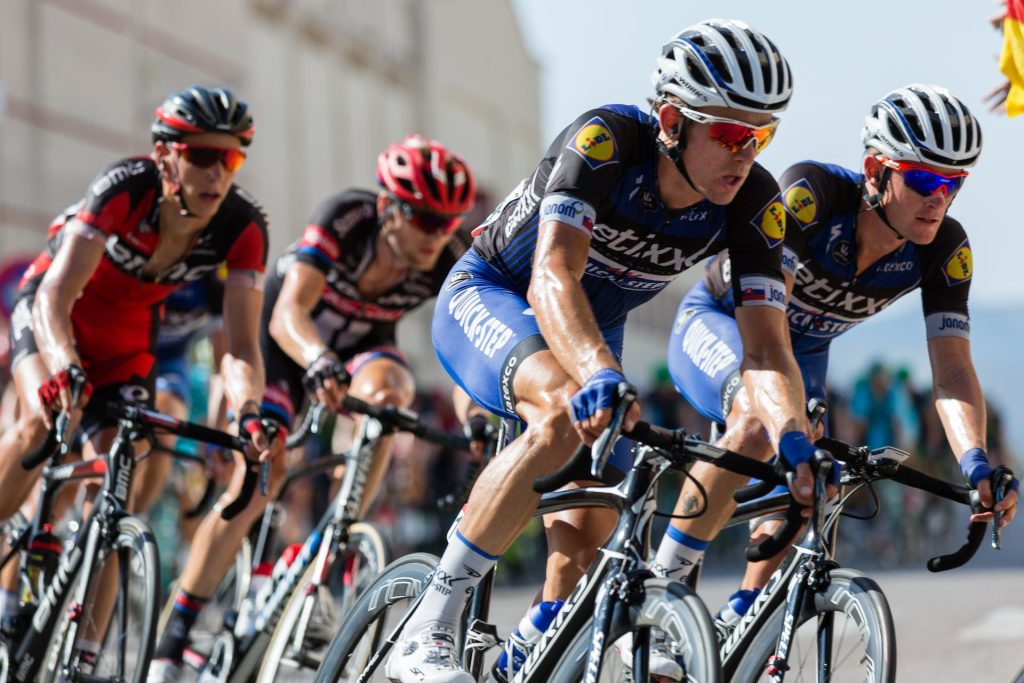
Inside a dense pack, bicycle drafting mechanics evolve from a simple two-rider wake phenomenon into a macro-fluid dynamic envelope. When dozens of bodies cluster together in tight formation, they cease to function as individual aerodynamic obstacles. Instead, the pack behaves as a unified, blunt-nosed mega-structure traveling through the air.
The front ranks act as a sacrificial plow, taking the brunt of stagnation pressure and driving the airflow up, over, and around the collective mass. Riders seated deep in the belly of the group, roughly four to six rows back, are completely sheltered from ambient atmospheric resistance. In this central cocoon, aerodynamic drag plummets by an astonishing sixty to seventy percent. A rider buried inside this mobile sanctuary can maintain a blistering thirty miles per hour while barely turning the pedals above a recovery heart rate.
Rider Silhouette Asymmetry and Vorticity Matching
Air cares deeply about silhouette geometry. A small climber tucked behind a massive time trial specialist enjoys a near-total blackout of headwind. The broad shoulders and muscular torso of the larger athlete punch an expansive atmospheric tunnel that entirely engulfs the smaller rider’s frontal area.
Conversely, when a tall rider drafts behind a diminutive teammate, the shelter diminishes. The top of the tall rider’s helmet, upper chest, and wide shoulders spill outside the borders of the narrow low-pressure wake, colliding with raw incoming airflow. To extract performance from an asymmetric draft, the taller cyclist must modify their cockpit posture, rolling their shoulders inward, dropping their chin toward the stem, and flattening their spine to keep their silhouette inside the smaller wake.
Tactical Pacelines and Kinetic Momentum Preservation
Executing effective bicycle drafting mechanics on the road requires acute spatial discipline and an instinctive feel for atmospheric shear. In training and racing, groups organize into coordinated formations called pacelines to share the physiological burden of breaking the wind. In a single paceline, the lead rider pulls at an even tempo before pulling off to drift smoothly down the windward side and rejoin at the back.
In a continuous circular paceline, often called a Belgian chaingang, the formation never remains static. One line drifts slowly backward while the other moves incrementally forward. Riders swap lead duties for mere seconds, continuously recycling effort. The primary danger in any rotating paceline is the accordion effect. When an inexperienced rider surges at the front or taps their brakes in fear, that deceleration travels through the line like a shockwave. Riders several wheels back are forced to slam on their brakes, instantly obliterating their kinetic momentum before being forced to sprint at maximal wattage to close the resulting gap. True mastery requires feathering the pedals, adjusting cadence rather than grabbing brakes, and letting atmospheric resistance cushion micro-surges.
Physiological Conservation and the Economics of Human Wattage
The human body possesses a finite reservoir of anaerobic battery power and a limited supply of glycogen stored within muscle tissue and the liver. Burning four hundred watts into an unyielding headwind depletes glycogen stores rapidly, flooding muscle fibers with acidic metabolic byproducts and bringing an athlete closer to exhaustion. Lowering that requirement to two hundred and forty watts inside the draft keeps energy production predominantly aerobic, relying on fat oxidation and preserving vital anaerobic reserves for decisive attacks.
Riders who misunderstand slipstream dynamics frequently boast about their high average wattage numbers, failing to realize that high wattage often reflects poor positioning rather than athletic superiority. The smartest cyclist in the peloton is almost never the one generating the most total kinetic energy. It is the cyclist who wastes the fewest joules against the air. Ultimately, mastering bicycle drafting mechanics bridges the gap between raw biological horsepower and competitive victory, turning an invisible wall of wind into a personal launchpad.