Foley sound mechanics and 4 proven rules that prevent disastrously fake audio
Cinematic immersion shatters the instant an audience hears synthetic, detached sound effects. Discover how Foley artists manipulate physical acoustics, kinetic weight, and micro-textures to engineer absolute reality.

Mastering Foley sound mechanics separates immersive cinematic storytelling from amateur productions where every movement feels detached, hollow, or synthetic. When an actor steps onto a rain-slicked cobblestone street, reaches into a leather satchel, or sets an antique bone china teacup onto a saucer, the microphone suspended over the soundstage rarely captures those delicate interactions. In contemporary film production, dialogue microphones deliberately ignore environmental contact noises to keep spoken words pristine and free of phase interference. Stripping away that sonic friction leaves behind an unnerving sensory void. Without physical audio cues, moving images feel weightless, like digital ghosts drifting across a two-dimensional screen.
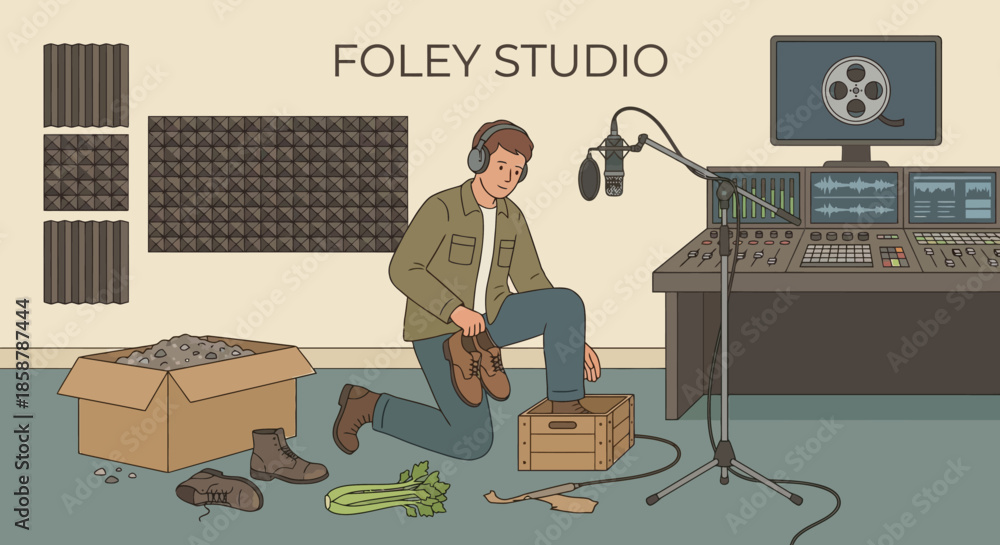
Rebuilding that lost physical universe falls upon Foley artists. Working in custom-designed studios equipped with dirt pits, water troughs, marble slabs, and racks of eccentric household debris, these performers recreate every rustle, scuff, and kinetic impact in direct synchronization with projected footage. It is a peculiar discipline requiring equal measures of physical choreography, material physics, and psychological deception. Foley is rarely about recording the real object shown on screen; instead, it manipulates human perception so that an audience never questions the authenticity of what they see.
The unseen psychoacoustics of physical movement on screen
Sound operates on the human nervous system far faster than visual processing. When visual information conflicts with auditory input, the brain experiences immediate cognitive dissonance, often breaking narrative immersion without the viewer consciously understanding why. In sensory science, the ventriloquism effect describes our tendency to visually bind sounds to the apparent physical action on screen, provided the acoustic properties align with expectation. If an actor wearing heavy work boots makes a high-pitched, hollow tapping sound against a concrete floor, the illusion collapses instantly.
The deeper architecture of Foley sound mechanics relies on human psychoacoustics to establish physical presence, spatial depth, and emotional subtext. The brain does not simply register volume; it measures transient response, harmonic resonance, and spectral decay to estimate mass and tactile density. When footsteps lack the slight heel-to-toe roll of human anatomy, our auditory cortex interprets the noise as synthetic. Audio engineers must construct a tangible bridge between visual stimulus and visceral sensation, tricking the ear into feeling the grit of desert sand, the friction of coarse denim, or the cold bite of polished steel before conscious scrutiny can intervene.
Why digital sound libraries fail to capture organic performance dynamics
Modern audio editing software provides millions of pre-recorded sound effects at the touch of a button. Sound editors can easily find high-resolution recordings of creaking floorboards, door handles, and cloth rustles. Yet, relying entirely on static digital sound libraries inevitably produces stiff, lifeless audio tracks that fatigue the listener. The reason lies in the inherent variability of physical kinematics.
No human walking across a room takes two identical strides. Every single step varies in velocity, foot strike angle, body weight shift, and shoe sole torsion. Dragging and dropping identical waveform files into a digital audio workstation creates the notorious machine gun effect, where repeated sound transients strike the listener’s ear with robotic regularity. Even when editors randomize pitch and gain, the underlying kinetic gesture remains static. True sonic realism demands physical intentionality: an artist who leans forward into a stride when a character is angry, or drags their heels when a character is exhausted. That kinetic storytelling cannot be synthesized through algorithmic modulation.
Essential Foley sound mechanics and 4 proven rules for believable audio
Understanding practical Foley sound mechanics requires treating the Foley stage as an expressive musical instrument rather than a sound-effect warehouse. Crafting invisible sound requires balancing material chemistry, performance kinetics, acoustic environment, and micro-dynamics. Foley artists rely on four foundational principles to guarantee that physical sounds weld seamlessly to the visual edit.
Match weight and acoustic impedance rather than visual mimicry
The single most common rookie mistake in audio production is using the identical object seen on screen to recreate its sound. Visual objects rarely sound like their cinematic archetypes. Actual bone fractures sound wet, dull, and remarkably anti-climactic; to communicate catastrophic bone trauma on film, Foley artists routinely snap stalks of cold celery wrapped in wet leather. Real sword draws from metal scabbards produce dull scraping sounds; cinema demands the ringing overtone of hardened steel dragged slowly across a vintage brass wrench.
Acoustic impedance—the resistance a medium presents to acoustic waves—determines how sound energy transmits into the air. Matching the perceived weight and physical density of an on-screen object requires choosing materials that emphasize the proper frequency resonance. Costumes dictate sound; the heavy rustle of sequined silk taffeta or structured velvet—a textile mastery often studied in discussions of legendary Hollywood wardrobe designers, much like how the Bob Mackie death records reveal 3 critical truths behind his tragic passing and career—carries acoustic signatures that stock nylon audio packs simply cannot mimic. When sound supervisors neglect the principles of Foley sound mechanics during post-production, they wind up with lightweight sounds that undercut the dramatic gravitas of the scene.
Track micro variations in rhythm and kinetic velocity
Physical objects in motion undergo continuous acceleration and deceleration. When a character sits into a worn leather armchair, the sound does not happen all at once. There is an initial transient as the hips compress the cushion, followed by the friction of clothing sliding against leather grain, the mechanical creak of internal steel coil springs taking on load, and a lingering hiss as air evacuates through the cushion seams.
A believable Foley pass requires tracking those micro-variations across the entire kinetic event. Foley artists practice mimicking an actor’s breathing and physical center of gravity to synchronize the micro-rhythms of movement. A frightened character will walk with short, tentative heel strikes and rapid toe adjustments, highlighting why nuanced Foley sound mechanics demand direct human performance rather than automated sequencing. Replicating that physical rhythm ensures that audio transients land with convincing kinetic veracity.
Capture room proximity and off axis acoustic decay
Sound does not exist in a vacuum; it exists inside an enclosure. Inexperienced recordists frequently place a shotgun microphone six inches away from every prop in a dry vocal booth, producing ultra-crisp, hyper-detailed recordings. While this creates clean audio, it utterly destroys spatial depth. When a character appears thirty feet away from the camera in a cathedral hallway, a hyper-close Foley track will sound like the actor is walking directly inside the viewer’s skull.
Perspective matching requires positioning microphones to mirror the camera’s optical focal length. For wide shots, Foley artists step back into the studio, allowing natural boundary reflections and air absorption to soften high frequencies. Utilizing off-axis microphone placement mimics the natural dispersion pattern of acoustic energy. By aligning physical microphone distance with camera perspective, artists maintain spatial coherence, validated extensively by Audio Engineering Society research into cinematic psychoacoustics, ensuring that the auditory world feels three-dimensional and spatially grounded.
Layer incidental micro textures beneath dominant impact transients
Real-world sounds are rarely solitary events; they are symphonies of subtle incidental noises. Consider picking up a set of house keys from a wooden kitchen table. The dominant transient is the brass jingle of keys colliding. But beneath that loud metallic strike lies a complex bed of secondary micro-textures: the friction of fingertips sliding across lacquered wood, the slight skin adhesion release as the fingers grasp the brass, the sliding drag of the key ring across timber grain, and the secondary settling rattle of keys resting in the palm.
Omitting those quiet, secondary micro-textures leaves the audio feeling synthetic and hollow. Layering low-amplitude incidental details establishes sensory depth. These subtle textures whisper to the subconscious, giving the listener the visceral impression of material tactility without pulling conscious attention away from narrative dialogue.
Calibrating frequency balance and mix hierarchy across the final stem
Recording exceptional Foley assets is only half the battle; integrating these dynamic layers into a cohesive mix demonstrates how Foley sound mechanics bridge the gap between production dialogue and musical score. Foley tracks occupy a precarious zone in the frequency spectrum, frequently clashing with spoken dialogue around 1 kHz to 4 kHz and with orchestral bass instruments below 150 Hz.
Re-recording mixers employ precise subtractive equalization to carve breathing room around dialogue tracks. High-pass filters roll off useless low-frequency studio rumble, while gentle parametric dips make space for vocal consonants. Static automation is useless here; mixers dynamically ride Foley faders, letting incidental cloth movement blossom during dramatic pauses and ducking down footsteps during intense dialogue exchanges. Convolution reverbs loaded with impulse responses matching the film’s filming locations are applied across the Foley stems, bathing the tactile studio recordings in the acoustic architecture of the scene.
The enduring artistic legacy of custom tactile audio performance
In an era dominated by generative artificial intelligence and synthetic media engines, the tactile craft of Foley remains resolutely physical. Computer algorithms can simulate statistical frequency distributions, but they cannot feel dramatic tension, interpret narrative hesitation, or manipulate an old leather jacket to communicate a character’s unspoken grief. Foley artists are actors who perform with their hands and feet, translating emotional arcs into visceral acoustic gestures.
Every footstep recorded on a Foley stage carries intent, history, and human vulnerability. That physical dedication ensures that cinematic soundscapes remain rooted in reality. Understanding tactile sound design proves that Foley sound mechanics will always remain an indispensable human art form in modern entertainment, grounding imaginary visual spectacles in the unforgettable, tangible physics of our physical universe.