Tennis serve biomechanics and 4 proven laws that generate effortless power
Unlock effortless power on your delivery by understanding the kinetic whip from ground to stringbed. Discover the mechanical principles that protect your rotator cuff while generating genuine racquet speed.
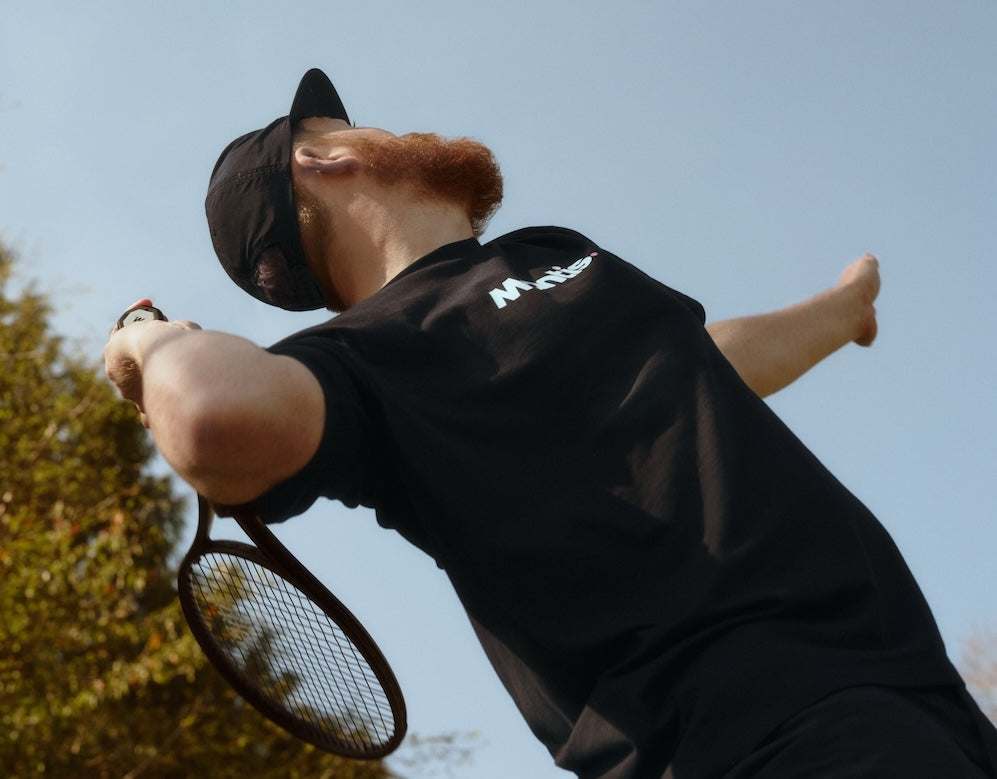
Mastering tennis serve biomechanics transforms what looks like a violent arm swing into a rhythmic, elastic whip. When an amateur watches a professional blast an untouchable delivery down the center stripe at over one hundred and twenty miles per hour, the untrained eye sees furious shoulder strength and rapid arm speed. Yet players who attempt to reproduce that velocity through brute physical exertion invariably encounter two painful outcomes: anemic ball speed and a shredded rotator cuff. The real engine of an elite serve does not live in the arm. It begins beneath the soles of your shoes.
The serve represents the single most mechanically intricate stroke in tennis because it is the only shot entirely within the player’s control. There is no incoming pace to redirect, no strange spin to calculate off an uneven bounce, and no opponent dictating positioning. You start from absolute stillness, toss an object into the air, and coordinate eight distinct body segments into a fractional-second kinetic wave. When those segments fire out of sync, energy dissipates like water through cracked pipes. When they align, the ball explodes off the stringbed with a clean, crackling pop that feels nearly weightless in your hand.
The physics of segmental sequencing from turf to stringbed
To understand how elite servers produce terrifying pace without tearing their shoulder joints apart, one must examine the law of conservation of momentum. A tennis serve is not a single muscular heave. It is a kinetic whip. In physics, a whip cracks because energy generated at the thick handle travels toward the thin tip, accelerating exponentially as the mass of each successive segment decreases.
When researchers evaluate tennis serve biomechanics in sports science laboratories, they observe this exact principle across what biomechanists call proximal-to-distal sequencing. Ground forces initiate the movement, driving upward through the ankle joints, knees, and hips. The pelvis turns first, abruptly decelerating to transfer its rotational momentum into the trunk. The upper torso twists forward and upward, transferring that energy into the shoulder complex, which funnels it down the humerus, through the elbow, into the forearm, through the wrist, and finally into the racquet head.
Each segment acts as a conduit that both absorbs force from the preceding link and multiplies it before braking. If you bypass the lower body and attempt to generate power solely from the chest and shoulder, you forfeit more than half of your potential force production. Even worse, you force a fragile ball-and-socket joint designed for precision to shoulder the mechanical burden intended for your quadriceps, glutes, and abdominal wall.
The catastrophic fallacy of arm generated power
Generations of recreational tennis players have fallen victim to the misconception that arm speed creates ball speed. This error often begins with the visual illusion created by broadcast television cameras. Because the racquet moves at blistering velocities during the final thirty milliseconds before impact, our brains intuitively attribute the entire feat to the hitting arm.
In reality, muscular contraction in the arm provides less than fifteen percent of the serve’s terminal velocity. The arm is not the engine; it is the whip cord. When a player actively tenses their biceps, triceps, and forearm flexors in an attempt to hit harder, they paradoxically slow the racquet down. Muscular tension produces stiffness, and stiffness destroys elastic recoil. An arm locked in rigid contraction cannot drop into the deep back scratch position, nor can it whip upward through internal rotation.
Over-relying on arm muscles also places catastrophic stress on the supraspinatus tendon, the labrum, and the medial elbow. Impingement syndromes and chronic tendonitis are almost never caused by hitting too many serves; they are caused by hitting serves where the arm is forced to compensate for a stalled kinetic chain. This biomechanical breakdown explains why modern tennis serve biomechanics treat the upper extremity primarily as an energy conductor rather than an energy creator, preserving joint longevity while maximizing mechanical efficiency.
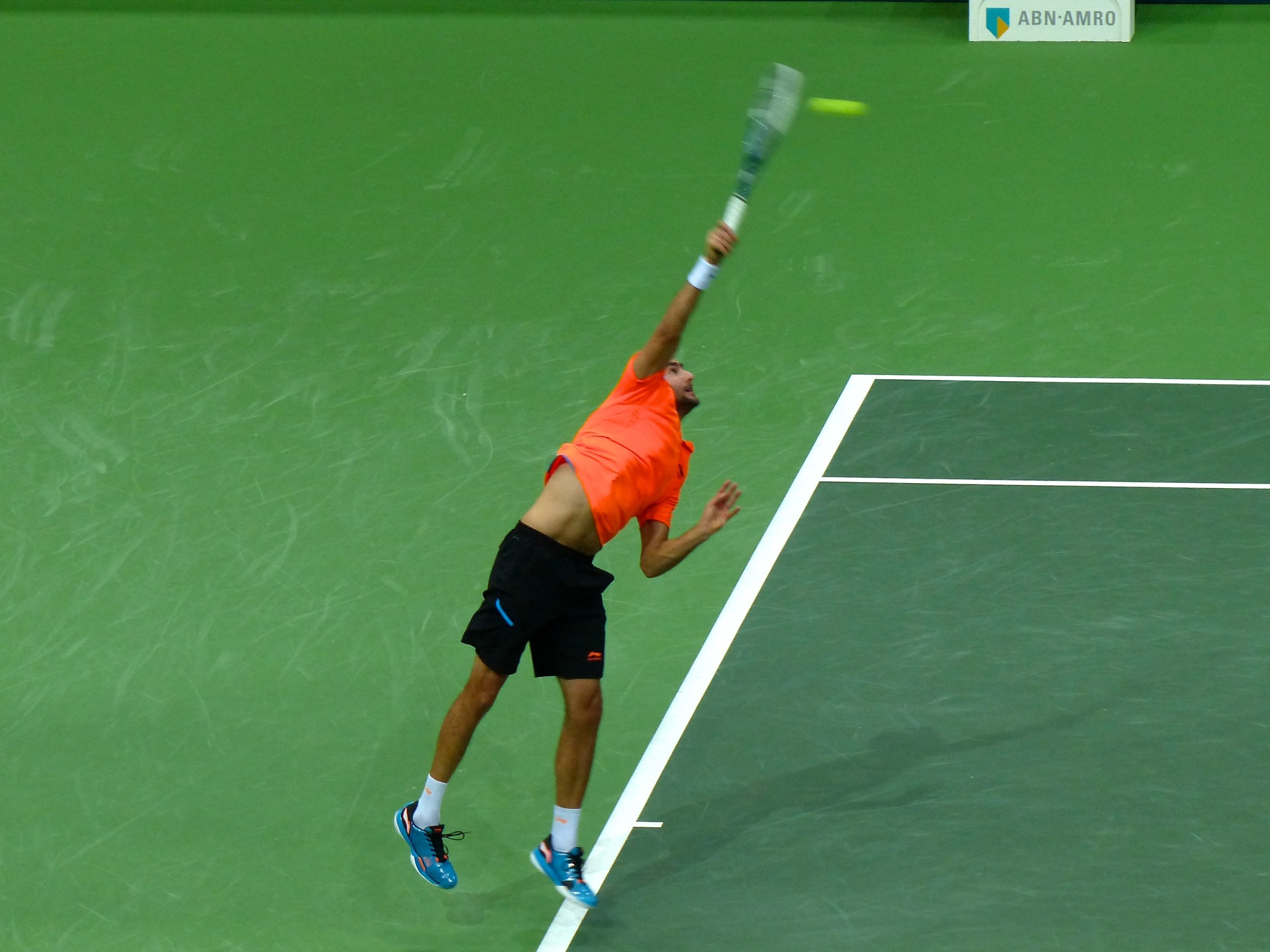
4 proven pillars of an unbreakable kinetic chain
A clinical breakdown of elite tennis serve biomechanics reveals four non-negotiable kinetic gateways that separate an unstable arm push from a devastating, fluid delivery.
Ground reaction force and the deep knee bend
Everything begins with the court surface beneath your feet. Elite servers do not simply bend their knees; they actively load their body weight into the court to harvest ground reaction force. As Isaac Newton established, every action produces an equal and opposite reaction. When you drive down into the asphalt or clay, the earth pushes back with identical force.
The timing of this knee drive determines whether that energy enters the kinetic chain or dissipates into thin air. Many club players make the mistake of jumping before the racquet begins its upward journey, floating in mid-air with their legs dangling while their arm tries to catch up. A mechanically sound knee drive initiates just as the racquet drops behind the back. As the legs extend upward, they drive the hitting shoulder toward the sky, converting pure vertical ground force into angular momentum. Whether you utilize a platform stance with stationary feet or a pinpoint stance where the back foot slides forward, the goal remains identical: compress the lower body like a heavy industrial spring and release that energy directly into the pelvis.
Hip shoulder separation and the elastic core stretch
Once the ground reaction force propels your body upward, the torso must harness that vertical energy and convert it into high-speed rotational torque. This transformation hinges on a biomechanical phenomenon known as the stretch-shortening cycle, achieved through hip-shoulder separation.
During the trophy phase of the delivery, the player’s hips should begin turning forward toward the net while the upper torso and shoulders remain coiled sideways or even slightly turned away from the target. This deliberate rotational lag stretches the large oblique muscles and abdominal wall like a heavy elastic band. When those stretched core muscles snap back into alignment, they unleash rotational velocity that no isolated arm stroke could ever match. Maintaining this coil requires exceptional core stability and disciplined timing. Even at the highest levels of the ATP Tour, subtle hitches in trunk rotation can amplify double faults under pressure, an operational reality explored when examining how Alexander Zverev Faces 4 Major Battles on His Path to World Number One while working to stabilize his second delivery. When the rotational coil unwinds cleanly, it flings the hitting shoulder up and forward along a precise angular vector.
The cartwheel vector and internal shoulder rotation
A frequent technical flaw among improving players is rotating the upper body purely on a horizontal plane, spinning like a carousel. A world-class serve, by contrast, operates far more like an aggressive cartwheel. The hitting shoulder must travel over the non-hitting shoulder, creating a vertical tilt that launches the server up into the court.
As the racquet drops behind the back, the elbow remains bent at approximately ninety degrees while the shoulder goes into extreme external rotation. The racquet points downward, sometimes perpendicular to the court surface, creating a long lever arm. From this deep pocket, the shoulder reverses direction into violent internal rotation. Inside the intricate framework of tennis serve biomechanics, internal shoulder rotation accounts for roughly forty percent of final racquet head velocity. It is the anatomical equivalent of a trebuchet releasing its counterweight, hurling the racquet upward along an accelerating arc toward the strike zone.
Forearm pronation and dynamic balance at contact
The final link in the kinetic chain occurs milliseconds before and after impact. Many amateurs mistake the snapping motion at the top of the serve for wrist flexion, actively bending their wrist downward like a basketball player shooting a jump shot. In reality, attempting to snap the wrist forward on a tennis serve leads straight to wrist strain and erratic trajectory control.
The true snapping mechanism is forearm pronation. Approaching the ball with an eastern or continental grip, the racquet ascends edge-first, as if cutting through the air like an axe blade. At the very last microsecond, the radius bone rotates around the ulna, turning the stringbed outward to meet the ball square on. Following impact, the racquet face continues turning outward to the right for a right-handed server, with the thumb pointing down. This rapid rotary motion provides explosive speed without compromising joint integrity. Throughout this violent release, the player’s non-dominant arm tucks into the ribcage to act as a rotational brake, stabilizing the torso so the hitting arm can whip through a perfectly fixed axis of balance.
Diagnosing energy leaks on the practice court
Identifying broken links in your tennis serve biomechanics does not require a multi-camera motion capture lab. Most kinetic failures announce themselves through unmistakable physical symptoms and ball flight patterns.
The most common leak is a premature hip leak, where a player opens their hips toward the net before their legs have completed their upward drive. When this occurs, the abdominal stretch collapses, and the hitting shoulder must drag the racquet forward through sheer muscular effort. You can spot this flaw instantly if your serves consistently clip the top of the tape with a flat, hollow sound, or if your hitting shoulder feels sore after just three sets of play.
Another ubiquitous breakdown occurs at the tossing arm. Dropping the non-dominant arm too early pulls the hitting shoulder down prematurely, killing the cartwheel effect and flattening your angle of attack. According to biomechanical research published in the British Journal of Sports Medicine, keeping the non-dominant shoulder elevated during the early leg drive creates the requisite shoulder tilt necessary for optimal racquet head acceleration. If your toss drifts erratically or you pull your eyes away from the contact point before impact, your kinetic chain breaks at its most sensitive junction.
Building a repeatable delivery under tournament pressure
Transferring these mechanical principles into match play requires stripping away conscious technical thoughts during the point itself. You cannot think about knee flexion, hip angles, and forearm pronation while staring down a break point in the third set. Motor learning studies prove that trying to micro-manage internal body mechanics under stress leads to paralysis by analysis.
Instead, mechanical mastery must be baked into deep muscle memory through deliberate, slow-motion repetitions on practice courts away from competition. Use exaggerated pause drills at the trophy position to feel the deep elastic coil in your abdominal wall. Practice serving with an old racquet into a fence, focusing exclusively on loose arm whips and clean pronation rather than where the ball lands. Establish an unshakeable pre-serve routine that sets your breathing, anchors your foot placement, and clears your cognitive bandwidth.
Ultimately, mastering tennis serve biomechanics is less about chasing raw miles per hour and more about trusting an unbroken energy sequence. When your lower body provides the foundation, your core manages the rotational torque, and your hitting arm remains a relaxed, elastic whip, speed becomes the natural byproduct of efficiency. The ball leaps off the strings not because you strained to hit it hard, but because you gave the kinetic chain permission to do its work.