
Tennis Serve Biomechanics and 4 Proven Fixes That Unlock Devastating Power
Raw muscle will never produce an elite serve. Discover how sequential kinetic chaining and precise joint alignments unlock explosive speed with effortless control.
Mastering modern tennis serve biomechanics separates erratic baseline hitters from dominant players who dictate matches from their very first strike. Most recreational athletes believe that a thunderous serve comes from a muscular arm or a desperate snap of the wrist. They step up to the baseline, muscle the ball with their deltoids, and wonder why their fastest delivery barely tests their opponent while leaving their shoulder throbbing with inflammation. The truth is simple and brutal. Muscular force alone creates slow, fragile serves. True velocity comes from fluid mechanical timing.
Elite servers treat their bodies not as single levers, but as an elastic whip. Energy starts in the court surface, travels upward through the legs, multiplies across the torso, and releases through the racket strings with effortless ferocity. When every link in this biological machine fires in absolute harmony, ball speed surges, spin rates climb, and the physical stress on your rotator cuff drops dramatically. Understanding this chain transforms how you view the single most crucial stroke in tennis.
The Kinetic Chain from Ground Reaction Force to Racket Head Speed
Every dynamic serve starts against the court surface. When your shoes grip the hard court or clay, you push downward into the earth to generate ground reaction force. The ground pushes back with equal magnitude. If your lower body remains rigid or disconnected, that precious energy dissipates into thin air before it ever crosses your waistline.
At the heart of tennis serve biomechanics lies a principle known as sequential summation of momentum. Think of an Olympic javelin thrower or a champion high jumper. They never launch their projectile using arm strength alone. Energy flows upward through large, fatigue-resistant muscle groups before transferring into smaller, faster joints. The quadriceps, hamstrings, and glutes generate the primary wave of force. As your legs extend, that raw energy surges into your hips, causing them to rotate toward the net.
From the hips, the rotational force twists through the core and thoracolumbar fascia, stretching the abdominal wall like an industrial rubber band. By the time this kinetic wave reaches the thoracic spine and shoulder girdle, it has multiplied in velocity. The smaller muscles of the upper arm and forearm do not generate the speed. Their sole job is to guide and release that amplified ground energy directly through the sweet spot of the racket face. A breakdown at any step along this path forces the downstream joints to overcompensate, killing power and inviting catastrophic tissue breakdown.
Four Proven Structural Adjustments That Transform Serve Velocity and Control
When coaches dismantle broken serves, flaws in tennis serve biomechanics almost always stem from timing breakdowns rather than muscular weakness. The following four mechanical corrections align your skeleton with the natural laws of physics, replacing erratic arm swings with fluid, repeatable power.
Deep Knee Flexion and Explosive Vertical Drive
Many amateur players drop their knees into a casual, decorative bend that does nothing to harness ground reaction forces. A functional knee drive demands deliberate, athletic loading. As your toss ascends, both knees must flex between fifty and seventy degrees, shifting weight cleanly over the balls of the feet while maintaining an active arch in the spine.
Whether you prefer a pinpoint stance with feet together or a platform stance with feet separated, the objective remains identical. You are coiling the largest muscles in your body against the ground. The subsequent vertical explosion must drive upward and slightly forward into the court, converting stationary potential energy into upward momentum. This vertical leap does not merely elevate your contact point. It initiates the violent hip rotation that accelerates your entire upper torso into the hitting zone.
Hip Shoulder Separation and Thoracic Extension
Raw leg drive accomplishes nothing if your upper body turns at the exact same moment as your lower body. True rotational horsepower depends on separation angle. As the hips begin to uncoil toward the target, the shoulders must remain angled sideways to the net for a split second longer. This creates a powerful diagonal stretch across the rectus abdominis and internal obliques.
Simultaneously, the upper back must arch into thoracic extension rather than collapsing into a dangerous lumbar bend. Arching through the mid-back opens up the rib cage and creates a stable foundation for the shoulder blade to glide smoothly. When the torso finally whips forward to catch up with the hips, the resulting elastic recoil generates massive rotational torque without requiring conscious muscular strain from the chest or neck.
The Elastic Transition from Trophy Pose to Racket Drop
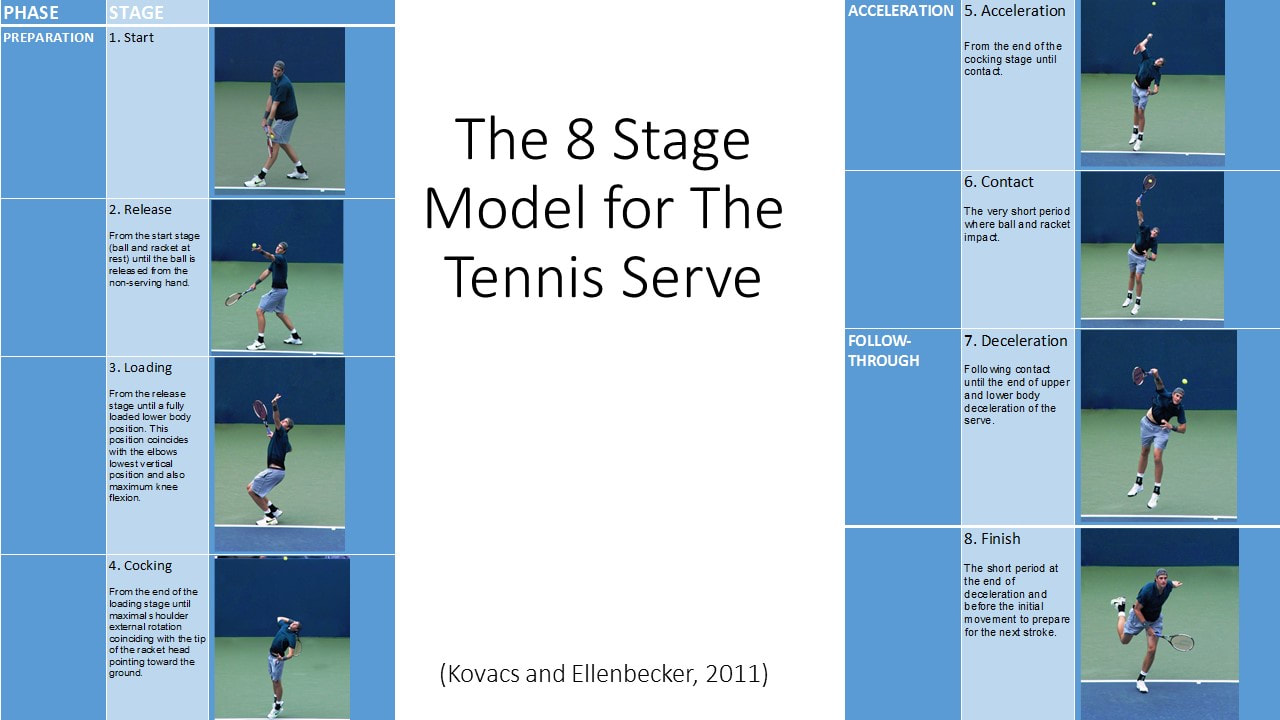
The iconic trophy pose is not a static pause. It is a dynamic loading checkpoint. Your non-dominant arm points skyward toward the falling ball, establishing balance and tracking depth, while your hitting elbow aligns roughly level with your shoulders. At this exact junction in tennis serve biomechanics, the body functions like an archer’s bow drawn to full tension.
As the legs launch upward and the chest rotates open, the racket head must drop cleanly down the server’s back. This movement must never be forced by conscious tricep contraction. Instead, the inertia of the racket head, combined with external rotation of the humerus, allows the racket to tumble freely into the slot. The deeper and looser this racket drop, the longer the runway your racket has to accelerate before reaching the impact window.
Forearm Pronation and Violent Internal Shoulder Rotation
The greatest technical misconception on public tennis courts is the idea of snapping the wrist downward. The human wrist is a delicate, multi-bone joint designed for stabilization, not for absorbing hundred-mile-per-hour impact forces in extreme flexion. Forcing a downward wrist snap leads directly to wrist tendonitis and chronic net errors.
A critical checkpoint in tennis serve biomechanics involves uncoupling active wrist flexion from true anatomical pronation. Elite players approach the ball on edge, as if they are preparing to chop the tennis ball with the frame of the racket. In the microsecond before contact, the forearm pronates violently, rotating the radius bone over the ulna to square the strings at impact and then turning the palm outward toward the fence. This rotational speed dwarfs anything a wrist snap could ever hope to produce, adding blistering pace and heavy topspin while keeping the delicate wrist joint in a protected, neutral alignment.
The Costly Energy Leaks That Wreck Rotator Cuffs and Rob Precision
Ignoring sound tennis serve biomechanics does more than compromise ball speed and placement. It places catastrophic stress on vulnerable soft tissues. When the kinetic sequence misfires, the shoulder complex inevitably takes the brunt of the punishment. A classic diagnostic breakdown appears in the comprehensive clinical analysis of the tennis serve kinetic chain, which demonstrates how modest drops in leg drive force disproportionate muscular loading onto the delicate rotator cuff tendons.
The most widespread culprit is the dreaded waiter’s tray error. Here, the server opens the racket face flat toward the sky early in the backswing, entirely bypassing the edge-on approach. This mechanical flaw eliminates the dynamic stretch-shortening cycle, kills racket drop depth, and forces the supraspinatus tendon into impingement against the acromion bone. Over thousands of repetitions, this abrasive friction wears away tendon fibers, leading to chronic impingement syndrome and debilitating labral tears.
Another silent saboteur is an erratic toss. A toss thrown too far behind the head forces the spine into severe hyperextension, placing extreme shear loads on the lumbar vertebrae while stripping the kinetic chain of forward momentum. Conversely, tossing the ball too low rushes the entire sequence, forcing the server to strike before the kinetic wave has traveled from the legs into the torso. When observing top-tier professional competition, such as when Arthur Gea Delivers 3 Major Shocks in Shanghai Masters Breakthrough, you see firsthand how unshakeable rhythmic coordination and mechanical discipline protect players under immense psychological pressure.
Practical Drills to Ingrain Fluid Neuromuscular Sequencing
Reading about mechanical theory is simple. Rewiring deeply ingrained movement patterns on the court requires targeted drills that isolate specific segments of the kinetic chain before integrating them into live play.
Begin with the football throwing progression. Stand sideways along the baseline and throw an American football or a weighted plyometric ball over the net with a high release point. Because a football wobbles unless thrown with clean forearm pronation and hip-shoulder separation, your body instinctively organizes itself into proper biomechanical positions without the distraction of strings or grips. Notice how your legs automatically load and your chest expands upward.
Next, transition to the paused trophy drill. Take your normal stance and begin your toss, but freeze at the bottom of your knee bend in the classic trophy alignment. Hold that coiled position for two full seconds. Feel your glutes engaged, your weight anchored into the court, and your toss arm extended straight up. From this dead stop, explode upward and hit the serve without any hitch. This drill strips away chaotic momentum and trains your nervous system to fire the kinetic chain from a position of absolute stability.
The Path to Effortless Power on Match Point
Ultimately, refining your tennis serve biomechanics demands patient unwinding of bad habits. It requires trading the illusion of muscular strain for the sensation of relaxed, whip-like acceleration. When your mechanics are pure, an explosive serve feels shockingly easy in your hands, leaving you balanced, energized, and ready to attack the next ball.
Step onto the practice court with a focused mind. Film your motion from behind and from the side, analyzing your knee bend, your separation angles, and the path of your racket face through contact. As the pieces fall into place, your serve will stop being a gamble and become the ultimate tactical weapon.